

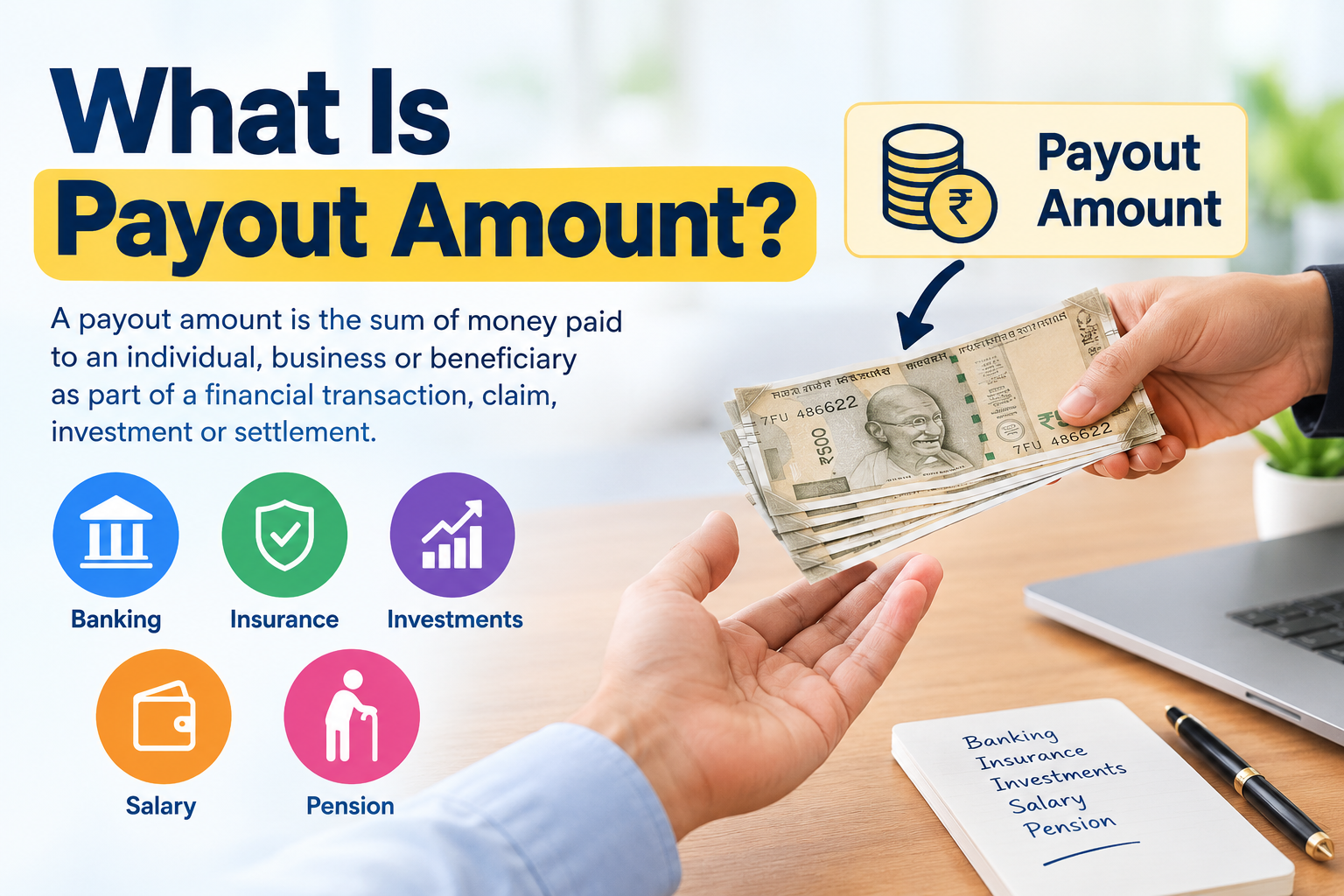
What Is Payout Amount? Meaning, Types, Calculation and Examples
Introduction
Have you ever checked a bank statement, insurance policy, loan settlement, or investment account and come across the term “payout amount”?
The payout amount is an important financial term used in banking, insurance, investments, employment, and online payment services. It refers to the amount of money paid or transferred to a person, business, or beneficiary.
Understanding the payout amount can help you manage your finances, track payments, and understand how much money you are actually entitled to receive.
In this guide, we explain the payout amount meaning, its types, calculation methods, and practical examples in simple language.
What Is Payout Amount?
A payout amount is the total sum of money paid to an individual or business as part of a financial transaction, claim, investment, or settlement.
In simple words, it is the money you receive after a payment becomes due.
For example, if an insurance company approves a claim of ₹5 lakh, the approved amount payable to the policyholder or beneficiary is the insurance payout, subject to applicable deductions and policy conditions.
The exact meaning of a payout depends on the financial transaction involved.
Payout Amount Meaning in Simple Words
| Term | Meaning |
|---|---|
| Payout | Money paid to someone |
| Payout amount | The specific amount of money paid |
| Total payout | The total payment before applicable deductions |
| Net payout | The amount received after deductions |
| Payout date | The date on which the payment is made |
What Is an Example of a Payout Amount?
Suppose you sell products online and earn ₹20,000 during a payment cycle.
The payment platform deducts ₹500 as applicable transaction charges.
Your payout calculation would be:
| Description | Amount |
|---|---|
| Total earnings | ₹20,000 |
| Transaction charges | ₹500 |
| Net payout amount | ₹19,500 |
In this example, ₹19,500 is the amount transferred to your bank account.
This is a simplified example. Actual deductions and payout schedules depend on the payment platform and its terms.
Types of Payout Amounts
Payout amounts are used in several financial situations. Here are some common types.
1. Insurance Payout Amount
An insurance payout is the amount an insurance company pays after approving a claim under the policy terms.
For example:
- Life insurance death benefit
- Health insurance claim reimbursement
- Motor insurance claim settlement
- Maturity benefits from eligible life insurance policies
The final amount depends on the policy coverage, claim approval, exclusions, and applicable deductions.
2. Investment Payout Amount
An investment payout refers to money received from an investment.
Examples include:
- Dividend payments from shares
- Interest payments from eligible investments
- Proceeds from selling investments
- Maturity proceeds from certain financial products
The amount depends on the investment type, applicable terms, and performance where relevant.
3. Salary Payout Amount
A salary payout is the amount an employee receives from an employer for a particular pay period.
It may differ from gross salary because of deductions such as provident fund contributions, income tax, or other applicable payroll deductions.
4. Loan Payout Amount
In lending, a loan payout may refer to the amount disbursed by a lender to a borrower.
For example, if a bank approves a loan of ₹10 lakh but deducts applicable processing charges before disbursement, the amount credited may be lower than the sanctioned loan amount.
Always check the loan agreement and disbursement statement to understand the actual amount.
5. Pension Payout Amount
A pension payout is the amount a person receives under an eligible pension or retirement arrangement.
Depending on the scheme, payments may be monthly, annually, or in another permitted form.
The amount depends on the scheme rules, accumulated benefits, and selected payout option.
How to Calculate Payout Amount
The payout amount is generally calculated by subtracting applicable deductions from the gross amount payable.
Basic Formula:
Net Payout Amount = Gross Payout Amount − Applicable Deductions
Payout Amount Calculation Example
Suppose an individual is eligible for a payout of ₹1,00,000.
Applicable deductions total ₹5,000.
Net payout = ₹1,00,000 − ₹5,000
Final payout amount = ₹95,000
This is a simplified calculation. Some payouts may include additional benefits, adjustments, taxes, or other conditions.
Difference Between Payout Amount and Claim Amount
Payout amount and claim amount are related, especially in insurance, but they are not always identical.
| Feature | Payout Amount | Claim Amount |
|---|---|---|
| Meaning | Money paid to a recipient | Amount requested or payable under a claim |
| Common usage | Banking, insurance, salary, investments | Primarily insurance and compensation claims |
| Calculation | Depends on the transaction | Depends on claim details and applicable terms |
| Final payment | May be the net amount received | May be approved in full or in part |
A claim amount may be different from the final payout if the claim is partially approved or applicable deductions are made.
What Factors Affect the Payout Amount?
Several factors can influence the amount a person actually receives.
- Payment terms: The agreement or policy determines the amount payable.
- Applicable deductions: Charges, fees, taxes, or other deductions may reduce the final payment.
- Eligibility: The recipient must meet the applicable conditions.
- Claim approval: Insurance or compensation payouts may depend on claim assessment.
- Payment schedule: Some payouts are made in instalments rather than as a lump sum.
- Outstanding dues: Certain payments may be adjusted against pending amounts, depending on the agreement.
Key Takeaways
- Payout amount means the money paid to a person, business, or beneficiary.
- It is commonly used in banking, insurance, salary, pensions, and investments.
- Gross payout and net payout may be different.
- Applicable charges, deductions, and payment terms can affect the final amount.
- Always check the relevant statement, agreement, or policy document to understand your payout.
Frequently Asked Questions (FAQs)
1. What is payout amount?
A payout amount is the sum of money paid or transferred to an individual, business, or beneficiary.
2. What does payout mean in banking?
In banking, payout generally refers to money transferred or disbursed to a recipient.
3. What is the meaning of payout amount in insurance?
It is the amount an insurer pays under an eligible and approved insurance claim or policy benefit.
4. Is payout amount the same as the credited amount?
Not always. The payout amount before deductions may differ from the amount finally credited to your bank account.
5. What is net payout amount?
Net payout is the amount remaining after applicable deductions are subtracted from the gross payout.
6. What is gross payout amount?
Gross payout is the total amount payable before applicable deductions.
7. How do I calculate payout amount?
A basic calculation is gross payout minus applicable deductions. Actual calculations depend on the payment terms.
8. What is payout amount in salary?
It generally refers to the salary payment an employee receives for a particular pay period.
9. What is payout amount in investments?
It refers to money received from investments, such as dividends, interest, or eligible maturity proceeds.
10. Why is my payout amount lower than expected?
Possible reasons include transaction charges, applicable taxes, outstanding dues, adjustments, or partial approval.
11. What is a payout date?
A payout date is the scheduled or actual date on which the payment is made.
12. Does payout mean profit?
No. A payout is a payment. It may include earnings, a refund, a benefit, or repayment of money, and is not necessarily profit.
13. What is a one-time payout?
A one-time payout is a payment made in a single transaction rather than through recurring instalments.
14. Can payout amounts be paid in instalments?
Yes. Depending on the applicable agreement or scheme, payouts may be made periodically instead of as a lump sum.
15. Where can I check my payout amount?
You can usually check it through the relevant bank statement, insurance claim status, investment account, salary slip, or payment platform.
Conclusion
The payout amount is a common financial term that describes the money paid to an individual or business. Whether it relates to insurance, salary, banking, pensions, or investments, understanding the payout amount helps you track payments and avoid confusion.
Published on : 22st September
Published by : MONISHA
www.vizzve.com || www.vizzveservices.com
Follow us on social media: Facebook || Linkedin || Instagram
🛡 Powered by Vizzve Financial
RBI-Registered Loan Partner | 10 Lakh+ Customers | ₹600 Cr+ Disbursed