

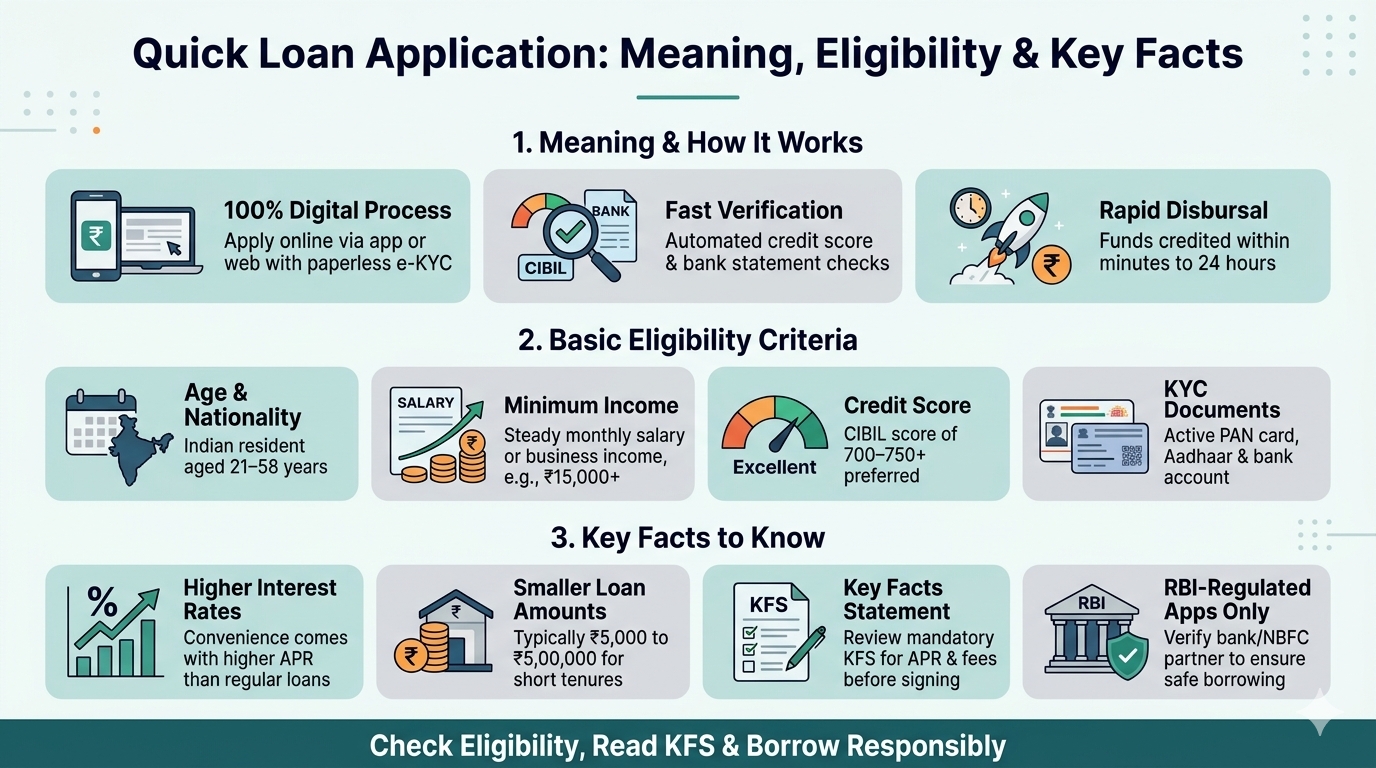
Introduction
Financial needs can arise unexpectedly. A medical bill, urgent home repair, education expense or temporary cash-flow shortage may require funds sooner than planned. In such situations, people often search for a quick loan application that allows them to submit a loan request without visiting a branch.
A quick loan application is generally a streamlined way to apply for credit. Depending on the lender, applicants may complete the process through a website or mobile application, provide personal and income details, upload documents and receive an update after verification.
However, applying quickly does not mean that every applicant will qualify. Banks and Non-Banking Financial Companies (NBFCs) assess income, repayment capacity, credit history and other risk factors before making a lending decision.
This guide explains the meaning of a quick loan application, common eligibility requirements, documents, application steps, costs and important safety checks for borrowers in India.
AI Answer Box: What Is a Quick Loan Application?
A quick loan application is a simplified process through which a person requests a loan from a bank, NBFC or digital lending platform. It may allow the applicant to enter details, submit documents and complete identity verification online.
Key facts:
-
Applicants generally need to meet the lender's age, income and repayment criteria.
-
Common documents include PAN, identity and address proof, bank statements and income records, depending on the lender.
-
Approval depends on the lender's credit assessment.
-
Interest rates, fees, loan amounts and repayment periods vary by lender.
-
A quick application does not guarantee instant approval or disbursal.
-
Borrowers should check the actual lender, Key Facts Statement (KFS), Annual Percentage Rate (APR) and repayment terms before accepting an offer.
1. What Is a Quick Loan Application?
A quick loan application is a loan-request process designed to reduce unnecessary paperwork and make it easier for applicants to submit their details. It may be available through a lender's website, mobile app or a digital platform working with a regulated lender.
Traditional loan applications may involve branch visits and physical paperwork. Digital applications can allow several steps to be completed remotely.
How does a quick loan application work?
A typical process includes:
-
Selecting a loan product.
-
Entering personal and contact information.
-
Providing employment or business details.
-
Submitting income and bank information.
-
Completing identity verification.
-
Allowing the lender to assess creditworthiness.
-
Reviewing the loan offer and disclosures.
-
Accepting the agreement, if suitable.
-
Receiving disbursal after the lender completes its process.
The exact process differs between banks, NBFCs and lending products.
Is a quick loan application the same as an instant loan?
No. The terms are often used together in online searches, but they describe different things.
A quick loan application refers to the application process. An instant loan generally describes a product marketed around faster processing or disbursal.
A digital application may be submitted quickly, but the lender may still need time to verify information, assess risk and complete formalities.
2. Why Do People Use Quick Loan Applications?
People may choose a digital loan application because it can make the process more convenient.
Common reasons include:
-
Convenience: An application may be completed from a phone or computer.
-
Reduced paperwork: Some lenders accept digitally submitted records.
-
Application tracking: Digital systems may provide status updates.
-
Time flexibility: Applicants may be able to submit details outside branch working hours.
-
Clearer comparison: Online disclosures can help borrowers compare offers.
-
Remote access: Applicants may not need to visit a physical branch for every step.
Convenience should not be the only deciding factor. A loan with a simple application can still be expensive or unsuitable.
3. Who Is Eligible for a Quick Loan in India?
Quick loan eligibility depends on the bank or NBFC offering the product. There is no single eligibility rule that applies to every lender.
Lenders commonly consider the following factors.
3.1 Age requirements
Applicants must meet the lender's minimum and maximum age requirements. The applicable limits can vary depending on the loan type and repayment tenure.
3.2 Income and repayment capacity
The lender evaluates whether the applicant has sufficient income to repay the proposed instalments.
Income may come from:
-
Salary
-
Business earnings
-
Professional services
-
Freelance assignments
-
Other acceptable and verifiable sources
A higher income does not automatically guarantee approval. Existing EMIs and regular expenses also matter.
3.3 Employment or business stability
Lenders may review how consistently an applicant earns.
For salaried applicants, this may involve employment history and salary credits. For self-employed applicants, lenders may examine business continuity, bank transactions, tax records or other financial information.
3.4 Credit history
Credit reports and repayment records may help lenders understand how an applicant has handled previous borrowing.
A history of timely repayments may support an application. Missed payments, high outstanding balances or frequent credit enquiries may affect the lender's assessment.
A particular credit score does not guarantee approval because each lender uses its own credit policy.
3.5 Bank account activity
Bank statements may help lenders understand income patterns, regular expenses, existing loan repayments and cash flow.
Applicants should provide genuine and accurate records.
Quick loan eligibility summary
| Eligibility factor | What lenders may check |
|---|---|
| Age | Whether the applicant meets the lender's age limits |
| Income | Regularity and amount of earnings |
| Employment | Job continuity or business stability |
| Credit history | Previous repayments and outstanding debt |
| Bank records | Income credits, balances and existing EMIs |
| Existing obligations | Whether another EMI is affordable |
| Identity | Valid identity and address information |
4. Can Salaried and Self-Employed People Apply?
Yes. Both salaried and self-employed applicants may be eligible, subject to the lender's policy and verification.
Quick loan application for salaried employees
Salaried applicants may be asked for:
-
Recent salary slips
-
Bank statements showing salary credits
-
PAN
-
Address proof
-
Employment information
-
Other documents requested by the lender
The lender may review monthly income, employment stability, existing EMIs and credit history.
Quick loan application for self-employed applicants
Self-employed individuals may include shop owners, consultants, freelancers, small business owners and independent professionals.
Depending on the lender, they may need:
-
Bank statements
-
Income tax returns
-
Business registration or proof of business activity
-
GST records, where applicable
-
PAN and address proof
-
Other acceptable income records
A salaried applicant and a self-employed applicant may be assessed differently because their income patterns can differ.
What if income changes every month?
People with variable income should examine their average earnings and lower-income months before choosing an EMI. A repayment amount that is affordable in a strong month may become difficult during a slow business period.
5. What Documents Are Required for a Quick Loan Application?
The documents depend on the lender, product and applicant profile. Some applications use digital verification, while others require uploaded files.
| Document | Why it may be required |
|---|---|
| PAN | Identity and financial verification |
| Aadhaar or other accepted identity proof | Identity verification, where applicable |
| Address proof | Confirming residential details |
| Salary slips | Assessing salaried income |
| Bank statements | Reviewing income and cash flow |
| ITR | Assessing declared income, where applicable |
| Business proof | Supporting self-employed applications |
| Photograph | Identification, if required |
Important document safety tips
-
Submit documents only through the lender's official and verified channel.
-
Never share OTPs, passwords, PINs or card security codes.
-
Do not send identity documents to unknown individuals over messaging apps.
-
Check why an app requests access to personal information.
-
Avoid edited, false or misleading income records.
Not every lender will ask for every document listed above.
6. How to Apply for a Quick Loan Online: Step-by-Step Guide
A digital loan application can be straightforward when applicants prepare their information in advance.
Step 1: Identify the actual lender
Find out whether the loan is offered by a bank or NBFC. A digital platform may provide technology or application support, but it may not be the entity that actually lends the money.
Step 2: Check basic eligibility
Review the lender's published requirements for age, income, employment, credit history and location.
Do not assume that a pre-qualified message means final approval.
Step 3: Choose a suitable loan amount
Calculate the amount you genuinely need. Avoid borrowing extra simply because a higher limit is displayed.
Step 4: Enter accurate details
Provide correct information about:
-
Name and contact details
-
Employment or business
-
Income
-
Existing financial obligations
-
Bank account details
Incorrect details can delay verification or lead to rejection.
Step 5: Complete verification
The lender may use document checks, bank verification, identity verification or other permitted processes.
Step 6: Review the loan offer
Before accepting, examine:
-
Loan amount
-
Net amount to be disbursed
-
Interest rate
-
APR
-
Processing fee
-
Repayment tenure
-
EMI amount
-
Late payment charges
-
Foreclosure or prepayment conditions
Step 7: Read the loan agreement
Do not accept an agreement without understanding its terms. Save the loan documents and payment schedule for future reference.
Step 8: Accept only if repayment is manageable
Proceed only when the total cost and repayment schedule fit your budget.
7. What Is the Difference Between a Quick Loan Application and a Traditional Loan Application?
Both methods involve a lender assessing an applicant's creditworthiness. The main difference is how the application and verification process is handled.
| Comparison point | Quick or digital application | Traditional application |
|---|---|---|
| Application channel | Website or mobile app | Often branch-based |
| Document submission | May be digital | May involve physical or digital documents |
| Application tracking | Often available online | Depends on lender |
| Verification | May use digital tools | May involve branch or digital checks |
| Physical visits | May not be required | May be required |
| Approval | Subject to lender assessment | Subject to lender assessment |
| Disbursal | Depends on completed checks | Depends on completed checks |
A digital process is not automatically cheaper or safer. Compare the lender and loan terms rather than choosing only by application speed.
8. What Costs Should You Check Before Applying?
A quick loan may involve several charges. Looking only at the advertised interest rate can give an incomplete picture of the borrowing cost.
8.1 Interest rate
The interest rate determines the interest charged on the loan. Check whether the rate is fixed or variable and understand how it applies to the outstanding balance.
8.2 Annual Percentage Rate (APR)
APR represents the annualised cost of credit and includes applicable charges as prescribed by the relevant regulatory framework.
It is generally more useful for comparing the overall cost of loan offers than looking at the interest rate alone.
8.3 Processing fee
Some lenders charge a processing fee. Check whether applicable taxes are added and whether the fee is deducted before disbursal.
8.4 Late payment charges
Missing an EMI may result in additional charges and can affect your credit record. Review the agreement for the applicable terms.
8.5 Prepayment and foreclosure conditions
Check whether you can repay early and whether any applicable charges or conditions apply.
Example: Understanding the cost of a quick loan
Suppose an applicant considers a loan of ₹30,000 for 12 months at an illustrative annual interest rate of 18% on a reducing-balance basis.
| Particular | Illustrative value |
|---|---|
| Loan principal | ₹30,000 |
| Annual interest rate | 18% |
| Tenure | 12 months |
| Approximate monthly EMI | ₹2,750 |
| Approximate total EMI repayment | ₹33,000 |
| Approximate interest | ₹3,000 |
These figures are rounded estimates and exclude processing fees, taxes and other charges. The actual EMI and APR may differ depending on the lender's calculation method and loan terms.
9. Important RBI Rules and Borrower Rights in Digital Lending
Digital lending in India is subject to regulatory requirements. The Reserve Bank of India (RBI) issued the Reserve Bank of India (Digital Lending) Directions, 2025 on May 8, 2025. These directions apply to specified regulated entities, including banks and NBFCs, and set out requirements for digital lending activities.
Important borrower-facing points include:
-
Creditworthiness assessment: Lenders must obtain relevant economic-profile information, including age, occupation and income details, before extending credit.
-
Key Facts Statement: Borrowers should receive a KFS containing important loan information, including the APR and applicable charges.
-
Loan documentation: Relevant digitally signed loan documents should be provided through the registered and verified communication channels as required.
-
Fund flow: Digital loan disbursal and repayment must follow applicable RBI fund-flow requirements. In general, disbursal is made to the borrower's bank account, subject to specified exceptions.
-
Cooling-off period: The applicable digital lending framework provides an initial cooling-off option of at least one day, subject to its conditions. A disclosed reasonable one-time processing fee may be retained where permitted.
-
Grievance redressal: Regulated entities and relevant lending service providers must provide appropriate complaint-handling arrangements.
These protections do not mean every app advertising loans is authorised or trustworthy. Verify the actual lender and its relationship with the digital platform.
10. How to Identify a Safe Quick Loan Application
A convenient application should also protect the applicant's financial and personal information.
Safety checklist
Before submitting your details, check the following:
-
The actual bank or NBFC is clearly identified.
-
The lender's official website confirms the app or platform relationship.
-
Interest rate, APR, fees and repayment terms are disclosed.
-
A Key Facts Statement is provided before loan acceptance, as applicable.
-
The privacy policy explains how personal data is collected and used.
-
The app does not demand unnecessary permissions.
-
No one asks you to share an OTP, PIN or password.
-
The repayment account belongs to the legitimate lender or follows the permitted payment arrangement.
-
Customer support and grievance details are available.
-
The loan agreement can be reviewed and saved.
Warning signs of a potentially unsafe loan app
Be cautious if an app or agent:
-
Promises guaranteed approval without checks.
-
Demands an advance payment to release a loan.
-
Refuses to identify the actual lender.
-
Pressures you to accept without reading the agreement.
-
Requests access to contacts, photos or other unrelated phone data.
-
Sends threatening messages or uses intimidation.
-
Asks for OTPs, UPI PINs or banking passwords.
The RBI advises borrowers to verify whether a digital lending app is associated with a regulated bank or NBFC. Checking the lender's own website is an important step. The RBI's digital lending app directory can also be used as an additional verification aid, but it should not be treated as an endorsement or guarantee.
11. Pros and Cons of a Quick Loan Application
| Advantages | Limitations |
|---|---|
| Convenient online submission | Approval is not guaranteed |
| May reduce physical paperwork | Digital verification can still take time |
| Application status may be trackable | Eligibility varies by lender |
| Can be accessed remotely | Personal data must be handled carefully |
| Documents may be submitted digitally | Fees and interest can make borrowing expensive |
| Allows comparison of online offers | Some platforms may use misleading marketing |
When can a quick loan application be useful?
It may be useful when:
-
You have a genuine short-term funding need.
-
You can demonstrate a stable repayment source.
-
You have compared the total cost of available offers.
-
The lender is properly identified and verified.
-
The EMI fits comfortably within your budget.
When should you reconsider?
Think carefully if:
-
You need another loan to repay an existing EMI.
-
Your income is uncertain.
-
You do not understand the charges.
-
The lender is pressuring you to accept immediately.
-
You cannot afford the repayment after essential expenses.
12. Common Reasons a Quick Loan Application May Be Rejected
A rejection does not always mean that an applicant has poor financial habits. Lenders use different credit policies and risk models.
Common reasons include:
-
Insufficient income: The lender may consider the income inadequate for the requested loan.
-
High existing EMIs: Current repayments may leave limited room for another loan.
-
Credit repayment issues: Previous missed or delayed payments may affect assessment.
-
Incomplete documents: Missing or unclear records can delay or prevent verification.
-
Incorrect application details: Differences between submitted information and verified records may create problems.
-
Unstable income: Irregular earnings may make repayment capacity harder to assess.
-
Lender-specific criteria: The applicant may not meet a particular lender's internal policy.
What can applicants do after rejection?
-
Check whether the lender has provided a reason.
-
Review the credit report for errors.
-
Correct inaccurate personal or financial details.
-
Reduce existing debt where possible.
-
Prepare complete and genuine income records.
-
Avoid submitting multiple applications without understanding the reason for rejection.
13. Practical Tips to Improve Your Loan Application
There is no guaranteed way to secure approval, but applicants can make their applications clearer and easier to verify.
Before applying
-
Check your credit report and identify any errors.
-
Review your current EMIs and monthly expenses.
-
Decide how much money you actually need.
-
Keep required documents ready.
-
Compare more than one suitable lender.
While applying
-
Enter accurate information.
-
Use your own verified contact details.
-
Submit genuine documents.
-
Read consent requests before granting access.
-
Avoid applying through unknown links.
After receiving an offer
-
Compare APR and total repayment.
-
Check the net amount you will receive.
-
Read the KFS and loan agreement.
-
Confirm the EMI due date.
-
Save the lender's contact and grievance details.
14. Real-World Example: A Freelancer Considering a Quick Loan
Consider a freelance graphic designer who needs ₹25,000 to replace a work laptop. Monthly income changes depending on client projects.
Instead of accepting the first loan offer, the freelancer:
-
Reviews average income over recent months.
-
Checks existing EMIs and essential monthly expenses.
-
Compares loan offers using APR and total repayment.
-
Checks whether the platform identifies its actual bank or NBFC partner.
-
Reviews the KFS and repayment schedule.
-
Chooses an EMI that remains manageable even during a lower-income month.
This example illustrates an important point: a quick application should make the process convenient, not encourage rushed borrowing.
15. Expert Commentary: What Should Borrowers Prioritise?
A responsible approach to quick borrowing begins with affordability and transparency. The application process may be short, but the repayment commitment can continue for months or years.
Borrowers should focus on three questions:
-
Who is lending the money? Identify the regulated bank or NBFC responsible for the loan.
-
What is the complete cost? Review the APR, KFS, processing fee and repayment schedule.
-
Can the EMI be paid comfortably? Consider existing obligations, essential expenses and possible income changes.
A well-prepared application can reduce avoidable errors, but it cannot replace the lender's assessment or guarantee approval.
16. Quick Loan Application: Key Facts at a Glance
| Question | Short answer |
|---|---|
| What is a quick loan application? | A simplified process for requesting a loan |
| Can I apply online? | Yes, where the lender offers a digital channel |
| Who can apply? | Eligible salaried and self-employed applicants |
| Is approval guaranteed? | No |
| Are documents required? | Usually, depending on the lender |
| Is a credit check possible? | Yes, as part of the lender's assessment |
| Is an online loan always instant? | No |
| Should I compare APR? | Yes |
| Should I check the actual lender? | Always |
| Can I apply through a mobile app? | Yes, if it is a legitimate lending channel |
Frequently Asked Questions (FAQs)
1. What is a quick loan application?
A quick loan application is a simplified process for requesting a loan through a bank, NBFC or digital lending platform. It may allow applicants to submit details and documents online.
2. How does a quick loan application work?
The applicant selects a loan product, enters personal and income information, submits documents and completes verification. The lender then assesses eligibility and communicates its decision.
3. Who is eligible for a quick loan in India?
Eligibility depends on the lender. Common factors include age, income, employment or business stability, credit history, bank activity and existing financial obligations.
4. Can salaried employees apply for a quick loan?
Yes. Salaried employees may apply if they meet the lender's requirements. They may be asked for salary slips, bank statements, PAN and address information.
5. Can self-employed people apply for a quick loan?
Yes. Self-employed applicants may qualify by providing acceptable income and business records, such as bank statements, income tax returns or business proof, depending on the lender.
6. What documents are required for a quick loan application?
Common documents include PAN, accepted identity and address proof, bank statements and income records. The exact list varies by lender and applicant profile.
7. Does a quick loan application guarantee instant approval?
No. A quick application only describes the application process. The lender must still verify information and assess repayment capacity before approving a loan.
8. Can I apply for a quick loan using my mobile phone?
Yes. Some banks and NBFCs provide mobile-friendly application channels or work with digital lending service providers. Use only verified channels connected to the actual lender.
9. Does credit history affect quick loan eligibility?
It can. Lenders may review repayment history, outstanding balances and other credit information as part of their assessment. Their approval criteria differ.
10. What is the difference between a quick loan and an instant loan?
A quick loan application refers to a simplified application process. An instant loan generally refers to a product promoted for faster processing or disbursal. Neither term guarantees approval.
11. What charges should I check before accepting a quick loan?
Review the interest rate, APR, processing fee, applicable taxes, late payment charges and prepayment conditions. Also check the net amount disbursed and total repayment.
12. How can I check whether a quick loan app is genuine?
Identify the actual bank or NBFC and check its official website for the app or platform relationship. Review the privacy policy, loan disclosures and grievance details. Do not rely only on advertisements or app-store listings.
13. Can a quick loan application be rejected?
Yes. Applications may be rejected due to insufficient income, high existing EMIs, credit history, incomplete documents, inconsistent details or lender-specific eligibility rules.
14. Is a quick loan suitable for self-employed borrowers?
It may be suitable if the borrower has verifiable income and can manage the EMI. Self-employed applicants should account for income fluctuations and keep business and bank records ready.
15. What should I do before accepting a quick loan offer?
Verify the lender, review the KFS and loan agreement, compare APR and total repayment, check all fees and confirm that the EMI fits your budget.
Conclusion
A quick loan application can make borrowing more convenient by allowing people to submit information and documents through digital channels. It can be useful for salaried employees, self-employed individuals and other eligible applicants who need a structured way to request credit.
However, speed should never replace careful evaluation. Eligibility, approval and disbursal depend on the lender's verification and credit policy. Before accepting an offer, check the actual lender, APR, processing charges, repayment period and total cost.
A responsible borrower compares available options, protects personal information and chooses an EMI that can be paid without disturbing essential expenses.
Explore your loan options with Vizzve Financial at www.vizzve.com, and review all applicable eligibility and loan terms before proceeding.
Published on : 27th November
Published by : Doulath bee
www.vizzve.com || www.vizzveservices.com
Follow us on social media: Facebook || Linkedin || Instagram
🛡 Powered by Vizzve Financial
RBI-Registered Loan Partner | 10 Lakh+ Customers | ₹600 Cr+ Disbursed