

When checking your CIBIL report or loan repayment status, you may come across the term Special Mention Account (SMA).
This classification is used by banks to flag early warning signs of stress in a borrower’s loan account — even before the account becomes an NPA (Non-Performing Asset).
Understanding SMA is crucial because it reflects your repayment discipline and can significantly influence your future loan eligibility.
Here’s everything you need to know.
What Is a Special Mention Account (SMA)?
A Special Mention Account (SMA) is a category used by banks to identify accounts that show early signs of delay or default in loan repayment.
It helps lenders monitor risk before the loan becomes a major problem.
SMA classification is directly linked to the number of days your EMI is overdue.
Types of SMA in CIBIL Report
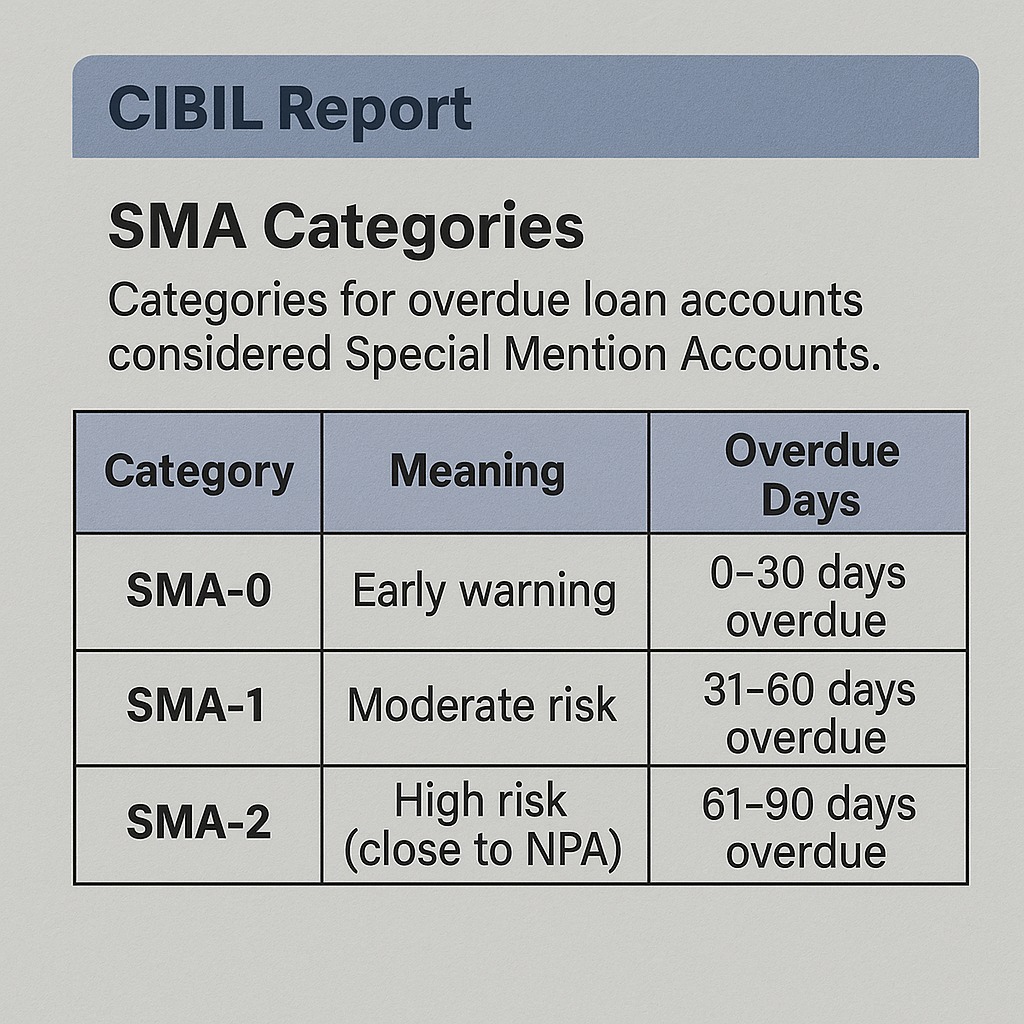
SMA accounts are classified into three categories based on overdue days:
1. SMA-0 — Early Warning (0–30 days overdue)
Your EMI is overdue but less than 30 days.
Indicates:
Slight irregularity
Possible oversight or delay
Not yet serious but gets recorded
Impact:
A warning signal to banks
May affect approval for new loans if frequent
2. SMA-1 — Increasing Risk (31–60 days overdue)
Your EMI is overdue between 31 to 60 days.
Indicates:
Borrower is struggling with payments
Higher risk of future default
Impact:
Lenders may restrict new credit
Interest or penalty charges apply
Big red flag for future borrowing
3. SMA-2 — High Risk (61–90 days overdue)
Your EMI is overdue between 61 to 90 days.
Indicates:
Severe repayment stress
Account may soon slip into NPA
Impact:
Very high impact on credit score
Banks may initiate recovery action
New loan applications likely to get rejected
When does an account become an NPA?
If your EMI remains overdue for 90+ days, the account is officially classified as a Non-Performing Asset (NPA).
This is the most serious category and has major consequences for your credit profile.
How SMA Appears in Your CIBIL Report
CIBIL reflects the SMA category under your loan account history.
Banks update it monthly based on repayment behaviour.
If your account is marked as SMA-0, SMA-1, or SMA-2, lenders reviewing your report will see clear signs of financial stress.
Impact of SMA on Your Credit Score
SMA classification affects:
✔ Your credit score
Delays beyond 30 days cause the score to drop.
✔ Your loan eligibility
Banks avoid lending to SMA-1/SMA-2 borrowers.
✔ Interest rates
You may be charged higher rates in future.
✔ Loan top-ups
Banks restrict additional credit if your account is under SMA.
Even SMA-0 repeated multiple times indicates chronic late payments.
How to Avoid Getting SMA Classification
Pay EMIs before the due date
Enable auto-debit for loans
Maintain enough balance on EMI date
Avoid taking multiple loans when income is unstable
Communicate with your bank if facing temporary financial issues
How to Remove SMA Status from Your Account
Clear all overdue EMIs immediately
Ensure no dues remain pending for 90 days
Request lender to update CIBIL after repayment
Maintain 6–12 months of clean repayment history
Once timely payments resume, the SMA tag reduces its impact over time.
FAQs
1. What does SMA mean in CIBIL?
It means your loan account has overdue EMIs and is showing early signs of financial stress.
2. Is SMA a negative mark?
Yes, it indicates delayed payments, but not as severe as NPA.
3. Does SMA affect loan approval?
Yes. Lenders may reject or delay approval for new loans.
4. How long does SMA stay in the CIBIL report?
Until the overdue EMIs are cleared and lenders update the status.
5. What happens if SMA-2 is not resolved?
Your account will become an NPA after 90+ days overdue
Published on : 19th November
Published by : SMITA
www.vizzve.com || www.vizzveservices.com
Follow us on social media: Facebook || Linkedin || Instagram
🛡 Powered by Vizzve Financial
RBI-Registered Loan Partner | 10 Lakh+ Customers | ₹600 Cr+ Disbursed
Source Credit: By: Jaivinder Bhandari Review By: Ankur Koul