

Introduction
Have you ever noticed that the salary credited to your bank account is lower than the salary mentioned in your offer letter? One common reason is TDS (Tax Deducted at Source).
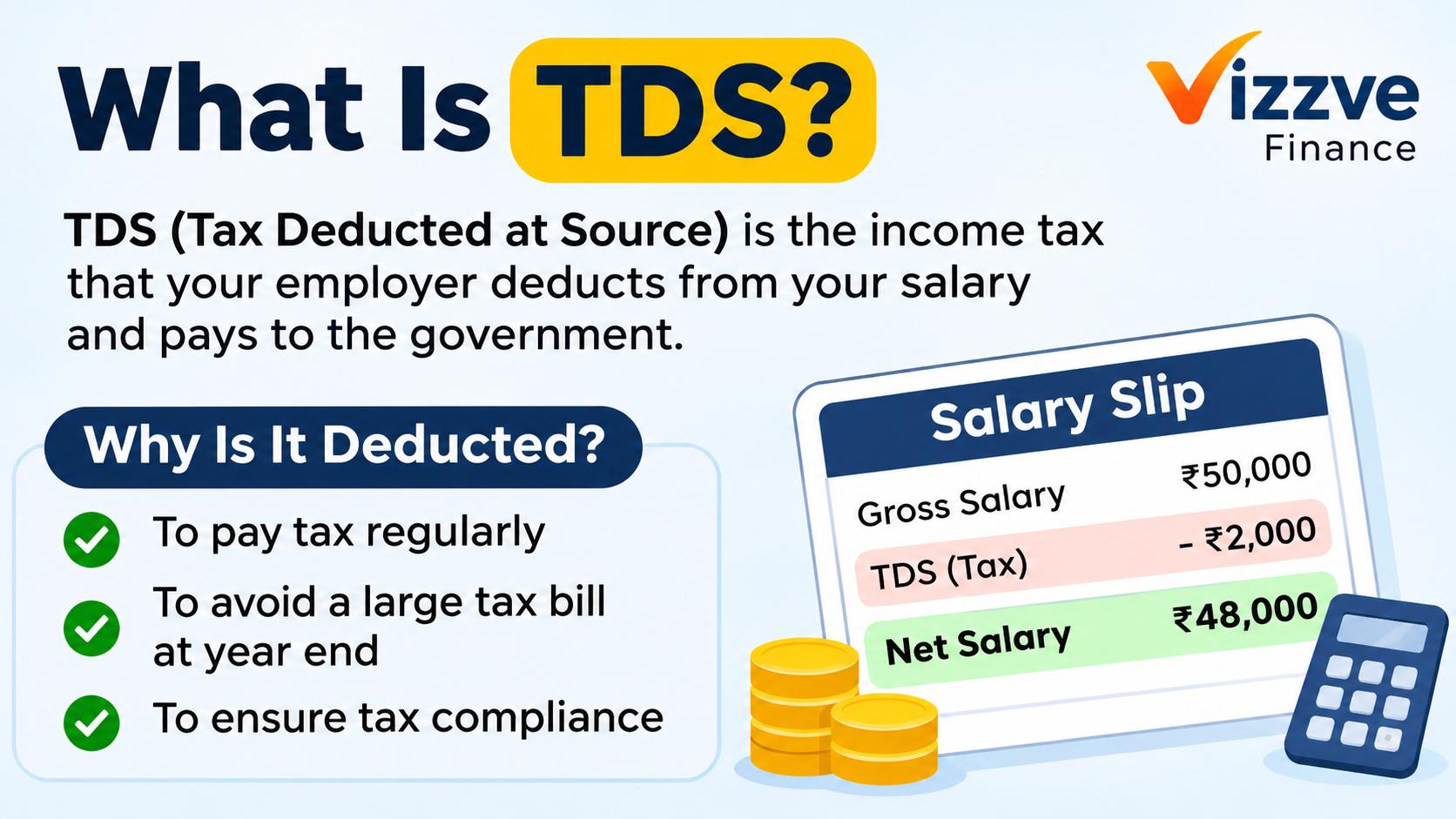
TDS is a system where your employer deducts a certain amount of income tax from your salary and deposits it with the government. It helps employees pay their income tax regularly instead of paying the entire amount at the end of the financial year.
In this blog, let us understand what TDS is, why it is deducted from salary, how it is calculated, and how employees can save tax.
1. What Is TDS?
TDS stands for Tax Deducted at Source. It is a method of collecting income tax where the person making a payment deducts tax before paying the remaining amount to the receiver.
For salaried employees, employers deduct TDS from monthly salaries under Section 192 of the Income-tax Act, 1961, based on the estimated taxable income for the financial year.
The deducted amount is deposited with the Income Tax Department against the employee's PAN.
Example:
If your monthly salary is ₹50,000 and your employer deducts ₹2,000 as TDS, you will receive ₹48,000 as your salary, before considering other deductions.
2. Why Is TDS Deducted From Salary?
TDS is deducted from salary for several important reasons:
-
Regular tax payment: It helps employees pay income tax throughout the year.
-
Avoids last-minute payments: Employees do not have to pay their entire tax liability at once.
-
Government revenue collection: It helps the government collect taxes regularly.
-
Reduces tax evasion: It creates a transparent tax payment system.
-
Easy tax management: Employers calculate and deduct estimated tax on behalf of employees.
3. How Is TDS Calculated on Salary?
Salary TDS is calculated based on the employee's estimated annual taxable income, applicable tax regime, eligible deductions and exemptions, and the tax rates for the financial year.
The employer generally follows these steps:
-
Calculate the employee's estimated annual salary.
-
Consider applicable exemptions and deductions.
-
Calculate the estimated annual income tax.
-
Adjust for tax already deducted or paid.
-
Deduct the remaining estimated tax from salary during the year.
For Tax Year 2026–27, salary TDS is governed by Section 392(1) of the Income-tax Act, 2025, which replaced the earlier Section 192 for salary payments made from 1 April 2026.
4. Example of TDS Calculation
Suppose an employee has the following monthly salary:
|
Particulars |
Amount |
|---|---|
|
Monthly salary |
₹50,000 |
|
Annual salary |
₹6,00,000 |
|
Estimated annual income tax |
₹0 |
|
Monthly TDS |
₹0 |
This is an illustrative example. The actual tax depends on the applicable tax regime, taxable income, deductions and exemptions.
If an employee has a taxable income that results in an annual tax liability of ₹24,000, the employer may deduct approximately ₹2,000 per month over 12 months.
5. What Is the Difference Between Gross Salary and Net Salary?
Many employees get confused between gross salary and net salary.
|
Gross Salary |
Net Salary |
|---|---|
|
Total salary before deductions |
Salary received in your bank account |
|
Includes salary components and allowances |
Amount after applicable deductions |
|
Higher amount |
Usually lower amount |
|
Mentioned in salary structure |
Also called take-home salary |
Example:
If your gross monthly salary is ₹30,000 and total monthly deductions are ₹2,500, your take-home salary will be ₹27,500.
6. How Can Employees Reduce TDS on Salary?
Employees can manage their tax liability by understanding the available tax benefits and selecting a suitable tax regime.
Here are some useful steps:
-
Choose the appropriate tax regime.
-
Submit eligible investment and deduction details to your employer.
-
Provide valid rent receipts if claiming eligible HRA exemption.
-
Declare eligible home loan interest and other permitted deductions.
-
Submit the required investment proofs within the employer's deadline.
-
Check your salary slip regularly.
Remember that deductions and exemptions differ between the old and new tax regimes. Always check the applicable rules before making tax-saving investments.
7. What Is Form 16?
Form 16 is a TDS certificate provided by an employer to an employee. It contains important information about salary income, tax deductions and the TDS deposited with the government.
Employees can use Form 16 while filing their Income Tax Return (ITR).
Form 16 generally contains:
-
Total salary paid during the financial year.
-
Taxable salary details.
-
Applicable deductions and exemptions.
-
Total TDS deducted.
-
Tax deposited with the government.
8. How to Check TDS Deducted From Your Salary?
You can check your TDS details online by following these steps:
-
Visit the official Income Tax e-Filing website.
-
Log in using your PAN credentials.
-
Open the e-File section.
-
Select Income Tax Returns and View Form 26AS.
-
Check your salary TDS details.
-
You can also review your Annual Information Statement (AIS).
Always compare the TDS details with your salary slips and Form 16.
9. What Happens If Extra TDS Is Deducted?
Sometimes, an employer may deduct more TDS than the actual income tax payable by an employee.
There is no need to panic.
If excess TDS has been deducted, you can claim a refund by filing your Income Tax Return (ITR), provided the return reflects the correct tax calculation and you are eligible for a refund.
The Income Tax Department will process your return and issue the eligible refund after verification.
10. Important Things Every Salaried Employee Should Know
-
TDS is an advance collection of income tax.
-
TDS is not an additional tax.
-
Your employer deducts TDS based on estimated annual tax liability.
-
TDS may be zero if no income tax is payable.
-
Always provide your correct PAN details.
-
Check Form 16 and Form 26AS/AIS regularly.
-
You can claim an eligible refund if excess tax is deducted.
Key Takeaways
-
TDS means Tax Deducted at Source.
-
Employers deduct TDS from taxable salary when applicable.
-
TDS helps employees pay income tax throughout the year.
-
Salary TDS is calculated using estimated annual taxable income.
-
Form 16 provides details of salary and TDS.
-
Employees can claim eligible refunds for excess TDS.
Frequently Asked Questions (FAQs)
1. What is TDS in salary?
TDS is the tax deducted by an employer from an employee's salary and deposited with the government.
2. Why is TDS deducted every month?
It helps employees pay their estimated income tax in smaller amounts throughout the year.
3. Is TDS compulsory for every employee?
No. TDS generally applies when the employee's estimated salary income creates an income-tax liability.
4. Can I get my TDS money back?
Yes. If excess TDS has been deducted, you can claim an eligible refund by filing your ITR.
5. What is Form 16?
Form 16 is a certificate issued by an employer showing salary income and TDS details.
6. What happens if my employer deducts incorrect TDS?
You should contact your employer's payroll or HR department and request a correction.
7. Does TDS reduce my monthly salary?
Yes. TDS reduces your take-home salary when tax is deducted.
8. How can I check my TDS online?
You can check your TDS details through Form 26AS and AIS on the official Income Tax e-Filing portal.
9. Is TDS and income tax the same?
No. Income tax is the actual tax liability, while TDS is a method of collecting that tax in advance.
10. What is the new section for salary TDS in 2026?
Section 392(1) of the Income-tax Act, 2025 governs salary TDS for payments from 1 April 2026.
Conclusion
TDS is an important part of salary management and income tax payment. It helps employees pay taxes regularly and avoid a large tax payment at the end of the year. Understanding TDS, checking Form 16 and reviewing your salary slip can help you manage your finances better.
Stay informed with Vizzve Finance for more simple guides on income tax, salary management, savings and personal finance.
Published on : 20th November
Published by : monisha
www.vizzve.com || www.vizzveservices.com
Follow us on social media: Facebook || Linkedin || Instagram
🛡 Powered by Vizzve Financial
RBI-Registered Loan Partner | 10 Lakh+ Customers | ₹600 Cr+ Disbursed