

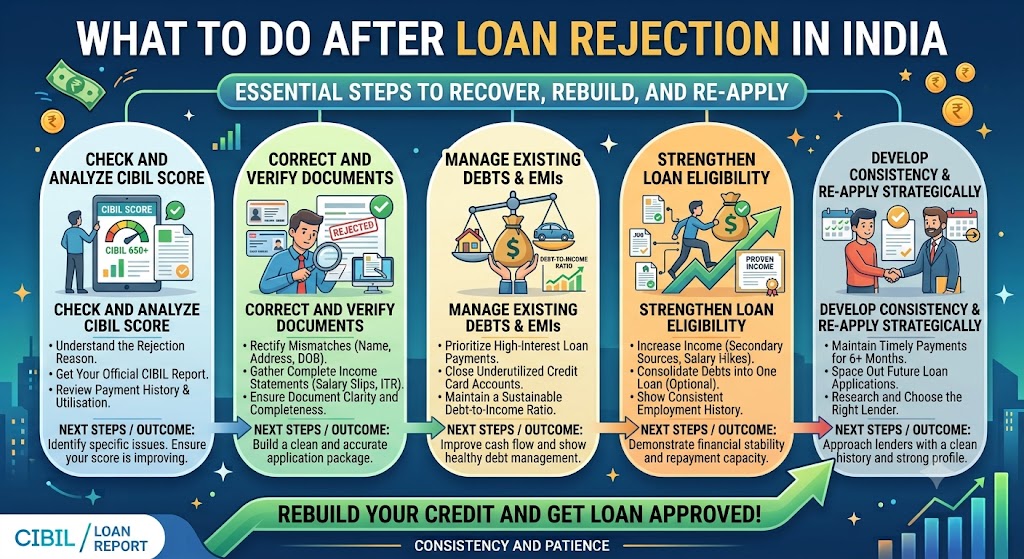
Getting a personal loan rejection can be frustrating, especially when you need money for an emergency, medical expenses, education, or other important financial needs. However, a rejected loan application does not mean you will never qualify for credit. It simply means the lender's requirements were not met at the time of assessment.
Banks and Non-Banking Financial Companies (NBFCs) consider several factors before approving a loan, including your CIBIL score, monthly income, existing EMIs, employment stability, and document verification.
In this guide by Vizzve, we explain what to do after loan rejection, how to identify the reasons behind it, and how to improve your chances of approval when you apply again.
Why Was Your Loan Rejected?
Before taking any action, try to understand why your application was rejected. Common reasons include:
-
Low CIBIL score: A history of missed payments or high credit utilisation may affect your credit profile.
-
Insufficient income: Your income may not meet the lender's minimum requirements.
-
High existing EMIs: Existing loan repayments may reduce your ability to manage another EMI.
-
Incomplete documents: Incorrect PAN details, inconsistent bank statements, or missing salary slips may affect verification.
-
Unstable income: Irregular earnings or limited employment history may make repayment capacity harder to assess.
-
Eligibility mismatch: You may not meet the lender's age, employment, location, or other requirements.
Understanding the specific reason helps you choose the right next step instead of submitting multiple applications without making improvements.
7 Things to Do After Loan Rejection
1. Ask the Lender for the Reason
Start by reviewing the rejection notification or contacting the lender through its official customer-support channel. Ask whether the issue relates to your credit profile, income, documents, or eligibility criteria.
Knowing the reason can help you avoid repeating the same mistake.
2. Check Your CIBIL Score and Credit Report
Your credit report contains information about your credit accounts, repayment history, outstanding balances, and credit enquiries.
Check for:
-
Incorrect overdue payments.
-
Loans that have already been repaid but still appear outstanding.
-
Accounts you do not recognise.
-
Incorrect personal information.
-
Unexpected credit enquiries.
If you find an error, raise a dispute with TransUnion CIBIL and the relevant lender. A correction may help ensure your credit profile reflects accurate information, although a score increase is not guaranteed.
3. Improve Your Credit Score
A healthy credit profile can support future loan applications. To improve it, pay EMIs and credit card bills on time, reduce credit card balances, and avoid unnecessary borrowing.
Try to keep credit utilisation below 30% where practical. Remember that credit-score improvement takes time, and no genuine service can guarantee an instant increase.
4. Review Your Income and Existing EMIs
Lenders assess whether you can comfortably repay a new loan after accounting for your existing financial commitments.
Calculate your monthly income, household expenses, current EMIs, and other debt payments. If your debt obligations are too high, consider reducing outstanding balances before applying again.
Choose a loan amount that fits your repayment capacity instead of borrowing the maximum amount offered.
5. Correct Documentation Issues
Sometimes a loan application is rejected because the submitted documents do not match the information provided in the application.
Before reapplying, check that:
-
Your name and personal details are consistent.
-
Your bank statements are clear and up to date.
-
Your salary slips or income-tax returns are accurate.
-
Your KYC documents are valid.
-
Your employment and income details are correctly reported.
Always submit genuine documents through the lender's official website or authorised application.
6. Avoid Applying to Multiple Lenders Immediately
Submitting several loan applications within a short period can generate multiple lender-initiated credit enquiries. These enquiries may affect your credit profile and may also signal frequent credit-seeking behaviour to lenders.
Instead, compare eligibility requirements, interest rates, processing fees, and repayment terms before choosing a suitable lender.
There is no universal waiting period after rejection. The right time to apply again depends on the reason for rejection and the lender's policies.
7. Choose a Suitable Loan Amount and Lender
If your requested loan amount exceeds your eligibility, a smaller amount may be more manageable. Review the lender's minimum income, employment, age, and credit requirements before submitting another application.
Check that the lender is a regulated bank or an RBI-registered NBFC, as applicable. Read the Key Facts Statement (KFS), annual percentage rate (APR), fees, and repayment schedule before accepting an offer.
Avoid loan apps that promise guaranteed approval, demand suspicious advance payments, or ask for your OTP, PIN, or banking password.
How Long Should You Wait Before Reapplying?
There is no fixed waiting period that applies to every rejected loan application.
| Reason for rejection | Recommended next step |
|---|---|
| Missing documents | Correct the documents and check the lender's reapplication policy |
| Low CIBIL score | Improve repayment habits and review your credit report |
| High existing EMIs | Reduce debt where possible and reassess affordability |
| Insufficient income | Check the eligibility requirements and consider a suitable loan amount |
| Incorrect credit-report information | Raise a dispute and wait for verification and reporting updates |
Reapplying immediately without addressing the underlying problem may lead to another rejection. Focus on correcting the issue first.
Real-World Example
Suppose a salaried applicant earns ₹35,000 per month and already pays ₹15,000 in EMIs. The applicant requests an additional personal loan, but the lender rejects the application after assessing the existing debt burden.
Instead of applying to several other lenders, the applicant reviews the monthly budget, works on reducing outstanding debt, checks the credit report, and reassesses how much additional repayment is affordable.
This approach may help the applicant prepare a stronger application in the future, although approval will still depend on the lender's criteria.
How Vizzve Can Help Borrowers Make Better Decisions
Vizzve readers can use a loan rejection as an opportunity to review their financial profile and understand responsible borrowing practices.
Before applying again:
-
Understand the factors that influence loan eligibility.
-
Compare loan costs rather than focusing only on quick approval.
-
Review repayment obligations carefully.
-
Protect personal and financial information.
-
Borrow only when repayment is affordable.
Responsible borrowing is more important than obtaining immediate approval.
Conclusion
A loan rejection can be disappointing, but it gives you an opportunity to identify weaknesses in your financial profile. By checking your credit report, managing existing EMIs, correcting documentation issues, and choosing a suitable loan amount, you can prepare more effectively for a future application
Published on : 14th October 2026
Published by : yogendra
www.vizzve.com || www.vizzveservices.com
Follow us on social media: Facebook || Linkedin || Instagram
🛡 Powered by Vizzve Financial
RBI-Registered Loan Partner | 10 Lakh+ Customers | ₹600 Cr+ Disbursed