

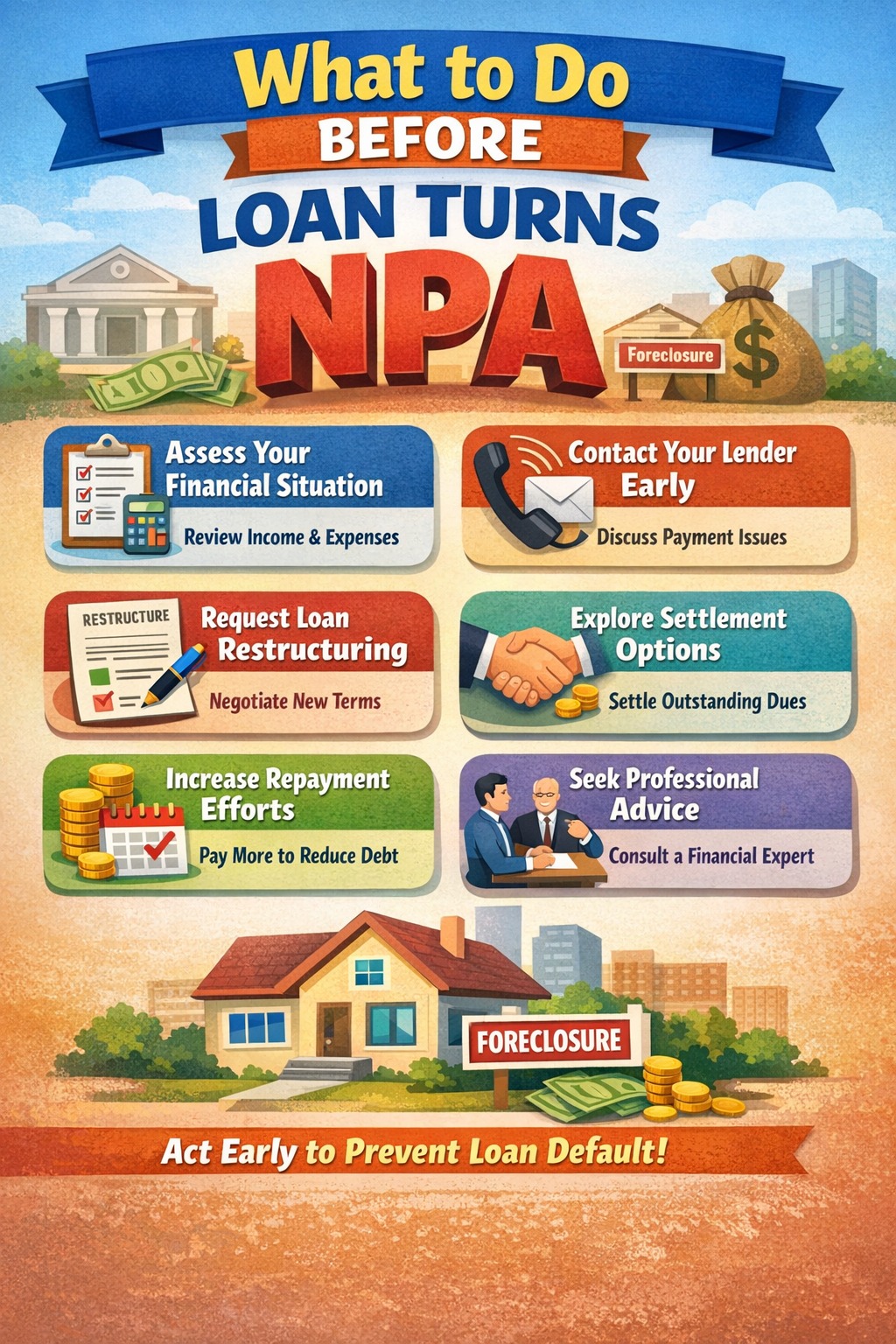
A loan becomes NPA after 90 days of missed EMIs. Before this happens, borrowers should communicate with the lender, restructure EMIs, seek moratorium or tenure extension, and protect their credit report. Early action can prevent long-term financial damage.
AI Answer Box
What to do before loan becomes NPA:
Act within first missed EMI
Inform lender immediately
Request restructuring or relief
Avoid ignoring calls/notices
Protect credit score early
🔹 Introduction
Missing one EMI is stressful. Missing two feels alarming. But once a loan crosses 90 days overdue, it officially becomes an NPA (Non-Performing Asset)—a stage where consequences escalate sharply.
Many borrowers don’t realize that the window before NPA is your most powerful opportunity. Acting early can save your credit score, reduce penalties, and even protect you from legal action.
This guide explains exactly what to do before your loan turns NPA—step by step.
🔹 What Is an NPA? (Simple Explanation)
A loan is classified as NPA when:
EMI remains unpaid for 90 consecutive days
Interest or principal is overdue beyond 90 days
This applies to:
Home loans
Personal loans
Business loans
Credit cards
As per the Reserve Bank of India, NPA classification is mandatory for banks and NBFCs.
🔹 NPA Timeline: When Trouble Starts
| Days Overdue | Loan Status | Risk Level |
|---|---|---|
| 1–30 days | Overdue | Low |
| 31–60 days | SMA-1 | Medium |
| 61–90 days | SMA-2 | High |
| 90+ days | NPA | Severe |
📌 Action before 60 days is critical.
🔹 Early Warning Signs Your Loan Is at Risk
Salary/business income disruption
Using credit cards to pay EMIs
Ignoring bank messages
Multiple EMIs consuming income
Frequent late fees and penalties
Recognizing stress early prevents collapse.
🔹 Step-by-Step: What to Do Before Loan Turns NPA
✅ Step 1: Don’t Ignore the First Missed EMI
One missed EMI hurts—but silence hurts more.
Pay partial amount if possible
Inform lender proactively
Avoid repeated delays
✅ Step 2: Contact Your Lender Immediately
Banks prefer resolution over default.
Ask about:
Temporary EMI reduction
Payment rescheduling
Grace period or short moratorium
📌 Communication builds trust.
✅ Step 3: Request Loan Restructuring (If Needed)
Restructuring may include:
Tenure extension
EMI reduction
Temporary interest-only payments
This is far better than defaulting.
✅ Step 4: Prioritise EMI Over Other Expenses
Before NPA:
Pause discretionary spending
Avoid new loans
Use emergency savings wisely
Saving your credit profile should be priority #1.
✅ Step 5: Avoid Settlements Before NPA
Settlement before NPA:
Permanently damages credit report
Signals financial distress
Settlements should be last-resort, not first action.
✅ Step 6: Keep Proof of All Payments & Communication
Maintain:
Payment receipts
Emails/messages with bank
Call logs
These help if disputes arise later.
🔹 What Happens If You Ignore the Problem?
If loan becomes NPA:
Credit score drops sharply
Recovery calls intensify
Legal notices may follow
Settlement/write-off risk rises
Prevention is always cheaper than recovery.
🔹 Can EMI Relief or Moratorium Help?
Sometimes, yes—especially during:
Job loss
Medical emergencies
Temporary business slowdown
Banks assess intent + ability to repay.
🔹 Borrower Rights Before Loan Becomes NPA
You have the right to:
Know outstanding dues
Request restructuring
Receive fair communication
Avoid harassment
Regulated lenders must follow RBI conduct rules.
🔹 Real-World Borrower Insight
From loan stress cases, borrowers who approach banks within 30–45 days of stress often avoid NPA entirely, while those who wait till 80–90 days face long-term damage—even if income recovers later.
➡️ Timing matters more than amount.
🔹 Pros & Cons of Early Action
✅ Pros
Credit score protection
Lower penalties
Better negotiation power
❌ Cons
Temporary lifestyle adjustment
Longer loan tenure
🔹 Key Takeaways
NPA starts after 90 days overdue
Early action can prevent NPA
Communication with lender is critical
Restructuring is better than default
Credit behaviour defines future access
🔹 Frequently Asked Questions (FAQs)
1. When does a loan become NPA?
After 90 days of non-payment.
2. Can one missed EMI make loan NPA?
No, but repeated misses can.
3. Does NPA affect credit score?
Yes, severely.
4. Can I stop loan from becoming NPA?
Yes, with early action.
5. Is restructuring bad for credit score?
Less harmful than NPA.
6. Should I ignore recovery calls?
No, communicate.
7. Can banks take legal action before NPA?
Usually after NPA.
8. Is settlement better than restructuring?
No.
9. Can I take another loan to pay EMI?
Risky—avoid.
10. Does RBI protect borrowers?
Yes, via fair practice norms.
11. How fast does credit score fall after NPA?
Immediately.
12. Is NPA permanent?
No, but recovery takes years.
🔹 Conclusion + CTA
A loan turning NPA is not a sudden event—it’s a process. Borrowers who act early, communicate honestly, and choose restructuring over silence can avoid years of financial damage.
Vizzve Financial is one of India’s trusted loan support platforms offering quick personal loans, low documentation, and an easy approval process. Apply at www.vizzve.com.
Published on : 8th January
Published by : SMITA
www.vizzve.com || www.vizzveservices.com
Follow us on social media: Facebook || Linkedin || Instagram
🛡 Powered by Vizzve Financial
RBI-Registered Loan Partner | 10 Lakh+ Customers | ₹600 Cr+ Disbursed