

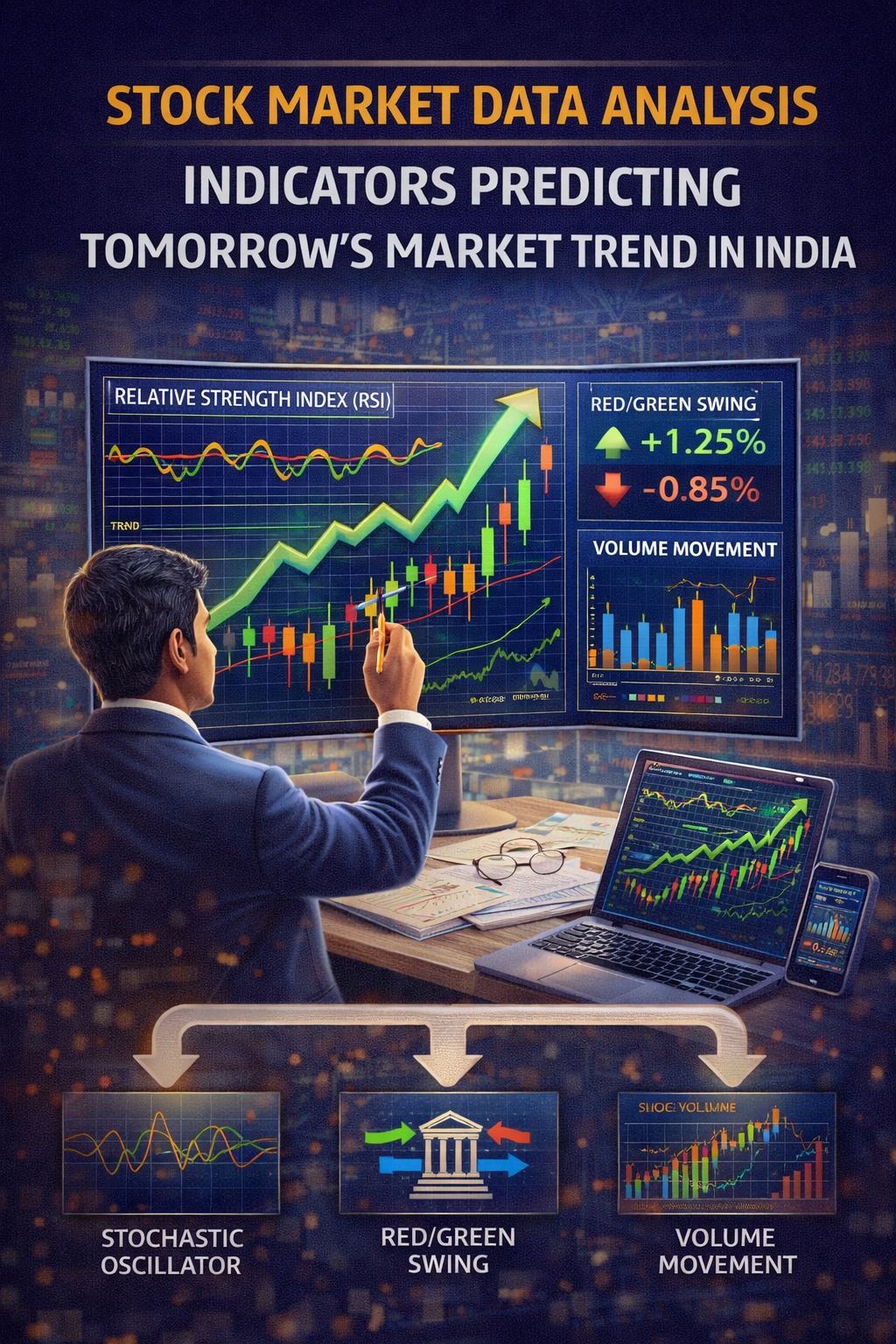
In today’s fast-moving financial world, data is everything. Investors and traders constantly analyze market signals to predict what might happen next. But can today’s data really forecast tomorrow’s market?
The answer lies in understanding how key indicators, trends, and global cues interact to shape short-term and long-term market movements.
AI ANSWER BOX
Can today’s data predict tomorrow’s market?
Yes, to an extent. Indicators like volume, trends, global cues, and sentiment help forecast likely market direction.
Key signals to watch:
- Market trend (bullish/bearish)
- Volume and momentum
- Global market cues
- Economic indicators
SUMMARY BOX
| Indicator | What It Signals |
|---|---|
| Market Trend | Direction |
| Volume | Strength of move |
| Global Cues | External influence |
| Sentiment | Investor behavior |
Key Indicators That Predict Tomorrow’s Market
🔹 1. Trend Analysis
The most basic yet powerful indicator.
- Uptrend → Likely continuation of bullish sentiment
- Downtrend → Possible further decline
👉 “Trend is your friend” remains a core market principle.
2. Volume & Momentum
- High volume = strong conviction
- Low volume = weak trend
Momentum indicators show whether a rally is sustainable or not.
3. Global Market Cues
Markets are interconnected.
- US and Asian market performance
- Crude oil prices
- Currency movements
👉 Global signals often set the tone for Indian markets.
4. Institutional Activity (FII & DII)
- FII buying → Bullish signal
- FII selling → Bearish pressure
Domestic Institutional Investors (DIIs) can stabilize markets.
5. Economic Data & News
Key triggers include:
- Inflation data
- GDP growth
- RBI policy updates
These directly influence market expectations.
Data Interpretation Table
| Data Type | Bullish Signal | Bearish Signal |
|---|---|---|
| Volume | Increasing | Decreasing |
| FII Flow | Buying | Selling |
| Global Markets | Positive | Negative |
| Oil Prices | Falling | Rising |
Expert Commentary
Market experts emphasize:
“No single indicator predicts the market. It’s the combination of data points that gives a clearer picture.”
From real trading experience:
- Short-term predictions rely heavily on sentiment
- Long-term trends depend on fundamentals
- Over-reliance on one indicator can be risky
Pros & Cons of Market Prediction
✅ Pros
- Helps in better decision-making
- Identifies entry and exit points
- Reduces emotional trading
❌ Cons
- No guarantee of accuracy
- Sudden news can change direction
- Over-analysis can confuse investors
Step-by-Step: How to Use Today’s Data
Smart Approach:
- Check market trend
- Analyze volume
- Track global markets
- Monitor FII/DII activity
- Watch key news/events
- Combine all signals before decision
Example Scenario
| Today’s Data | Tomorrow’s Expectation |
|---|---|
| Strong rally + high volume | Continued bullish trend |
| Market fall + weak global cues | Further downside |
| Mixed signals | Sideways movement |
Key Takeaways
- Today’s data provides directional clues, not certainty
- Combining multiple indicators improves accuracy
- Global cues play a major role
- Risk management is essential
❓ Frequently Asked Questions (FAQs)
1. Can we predict the stock market?
Partially, using data and indicators.
2. What is the best indicator?
No single indicator; combination works best.
3. What are global cues?
International market trends affecting local markets.
4. What is market sentiment?
Investor mood (bullish or bearish).
5. Do FIIs control markets?
They significantly influence trends.
6. What is volume in trading?
Number of shares traded.
7. Is prediction accurate?
Not always.
8. What is technical analysis?
Study of price charts and indicators.
9. What is fundamental analysis?
Evaluation of economic and company data.
10. Can beginners predict markets?
With learning and practice.
11. What is volatility?
Price fluctuation.
12. Should I rely on predictions?
Use them with caution.
13. What affects tomorrow’s market most?
Global cues and news.
14. What is bullish trend?
Rising market.
15. What is bearish trend?
Falling market.
Conclusion
While today’s data offers valuable insights, it does not guarantee tomorrow’s outcomes. Successful investors use data as a guide—not a certainty—and combine it with disciplined strategies.
👉 The smarter approach is to stay informed, diversify, and focus on long-term growth.
Need funds to invest smartly?
👉 Apply now at www.vizzve.com
Published on : 24th March
Published by : SMITA
www.vizzve.com || www.vizzveservices.com
Follow us on social media: Facebook || Linkedin || Instagram
🛡 Powered by Vizzve Financial
RBI-Registered Loan Partner | 10 Lakh+ Customers | ₹600 Cr+ Disbursed