

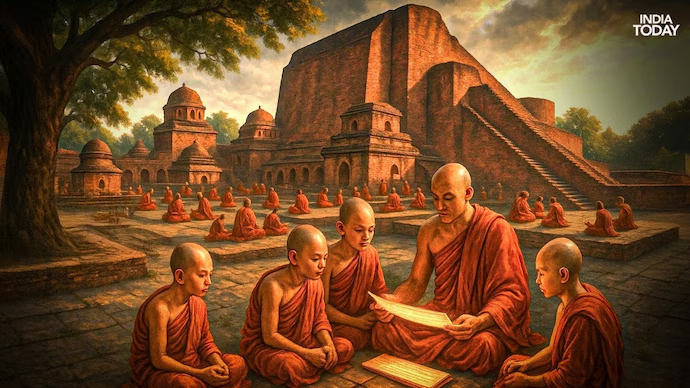
What Was Taught at Nalanda? The 64 Subjects of India’s Ancient University
Nalanda University, located in present-day Bihar, India, is one of the world’s oldest and most celebrated centers of higher learning. Established during the Gupta Empire around the 5th century CE, Nalanda attracted scholars from across Asia — including China, Korea, Japan, Tibet, and Central Asia.
Students at Nalanda were not only trained in Buddhist philosophy but also in an expansive range of 64 disciplines, encompassing science, mathematics, medicine, linguistics, and the arts. These subjects shaped the intellectual, cultural, and spiritual foundation of Asia for centuries.
The 64 Subjects Taught at Nalanda University
Nalanda’s curriculum was vast and interdisciplinary. It reflected a blend of Buddhist wisdom and practical sciences. The subjects included:
Logic and Philosophy (Nyaya, Hetuvidya)
Grammar (Vyakarana)
Rhetoric and Debate
Literature (Sahitya)
Buddhist Scriptures (Tripitaka)
Vedas and Upanishads
Medicine (Ayurveda)
Surgery and Anatomy
Astronomy (Jyotisha)
Mathematics (Ganita)
Physics (Padartha Vidya)
Chemistry and Alchemy (Rasayana)
Political Science (Rajaneeti)
Economics (Arthashastra)
Law and Ethics (Dharma Shastra)
Geography
Architecture (Vastu Shastra)
Agriculture
Zoology
Botany
Logic of Debate (Tarka Shastra)
Psychology and Consciousness Studies
Yoga and Meditation
Poetry and Poetics (Kavya)
Performing Arts (Dance, Drama, Music)
Sculpture and Iconography
Sanskrit and Prakrit Studies
Comparative Religion
Tantric Studies
Linguistics
Theology
Sociology
Ethics (Niti Shastra)
Astronomy and Cosmology
Metallurgy
Astrology
Manuscript Preservation
Translation Techniques
Art and Calligraphy
Sound and Phonetics (Shiksha)
Hermeneutics (Mimamsa)
Logic of Causation
Moral Philosophy
Indian Logic (Anvikshiki)
History and Chronology
Cultural Studies
Diplomacy
War and Defense Studies
Comparative Law
Environmental Studies
Commerce and Trade
Public Administration
Education Methodology
Agriculture Science
Metallurgical Engineering
Medicinal Botany
Ancient Mathematics (Sulba Sutra studies)
Astrology and Calendar Studies
Musicology
Sculptural Art and Symbolism
Buddhist Art and Iconography
Logic of Non-Contradiction
Manuscript Writing
Social Ethics and Harmony
Nalanda: The World’s First Global University
Nalanda had over 10,000 students and 2,000 teachers at its peak. The university library, Dharmaganja, housed countless manuscripts on medicine, astronomy, philosophy, and logic — making it the ancient world’s largest knowledge repository. Scholars such as Xuanzang and Yijing from China recorded its brilliance and intellectual depth.
Nalanda’s destruction in the 12th century by invaders led to the loss of priceless manuscripts that burned for months. However, its legacy continues to inspire modern education and global learning.
FAQs on Nalanda University
1. What made Nalanda University special?
Nalanda was the world’s first residential university with students and teachers from over 30 countries. Its curriculum combined spiritual, scientific, and artistic education.
2. Were only Buddhists allowed at Nalanda?
No. While Nalanda was a Buddhist institution, it was open to scholars from Hindu, Jain, and other traditions who came to study logic, science, and philosophy.
3. What language was used for teaching at Nalanda?
Sanskrit was the primary medium of instruction, though Buddhist texts were also studied in Pali and other languages.
4. How long did Nalanda University function?
Nalanda thrived for nearly 700 years before being destroyed in the 12th century.
5. Is Nalanda University revived today?
Yes. The modern Nalanda University was re-established in 2010 near the original site to revive its global educational spirit.
Published on : 29th October
Published by : SARANYA
www.vizzve.com || www.vizzveservices.com
Follow us on social media: Facebook || Linkedin || Instagram
🛡 Powered by Vizzve Financial
RBI-Registered Loan Partner | 10 Lakh+ Customers | ₹600 Cr+ Disbursed