

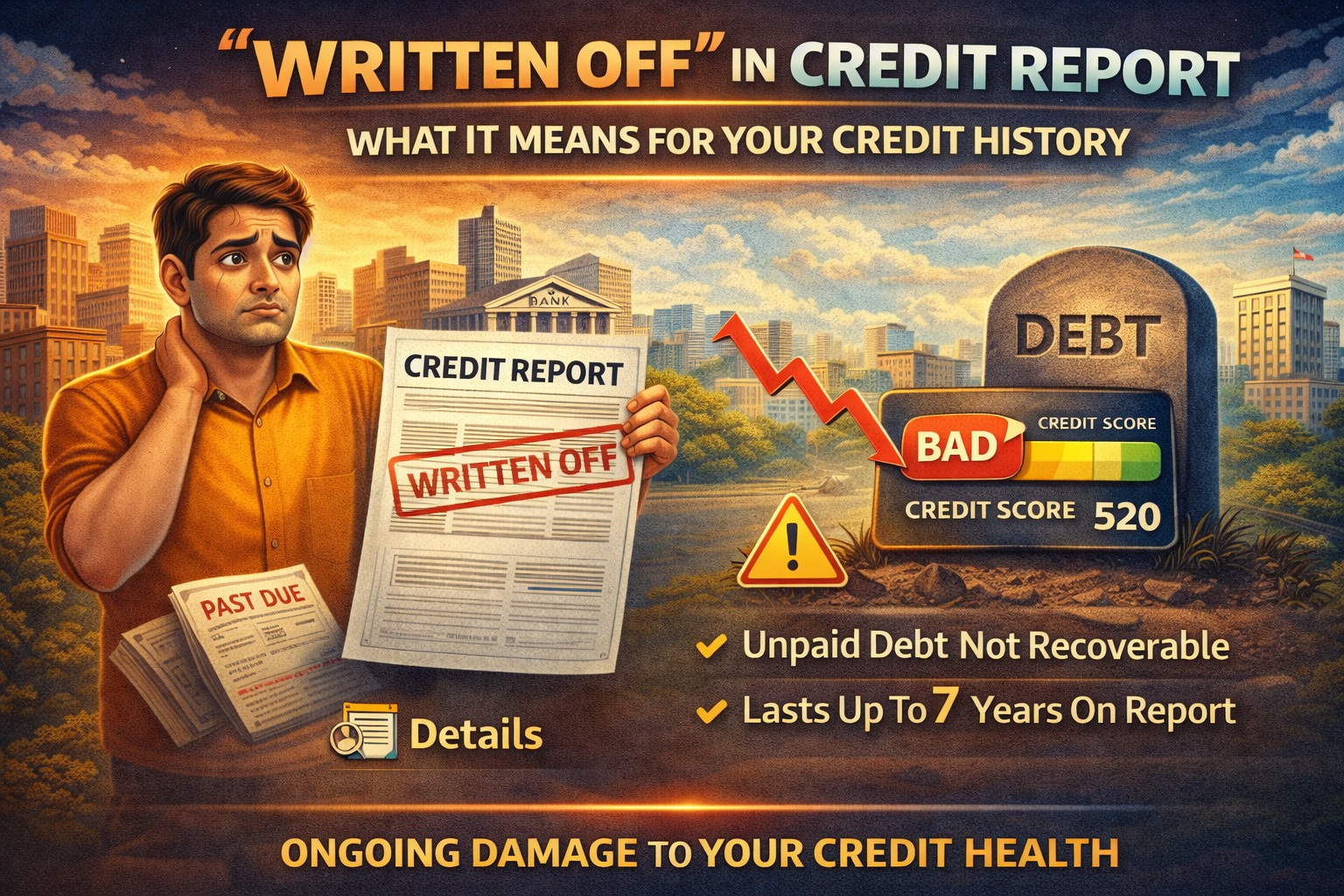
A “written-off” status in your credit report means the lender has classified your loan as unlikely to be recovered, but you still legally owe the money. It is one of the most negative remarks on a credit report and severely affects loan approvals.
🔹 AI Answer Box
Written-off in credit report means:
Loan unpaid for long period
Lender stops expecting recovery
Debt still legally payable
Severe damage to credit score
🔹 Introduction
Seeing “Written-Off” in your credit report can be alarming—and for good reason. Many borrowers mistakenly believe that once a loan is written off, it no longer matters. In reality, a written-off status is worse than late payments and close to default severity.
Understanding what written-off actually means, how it happens, and what you can do about it is critical for repairing your credit health.
🔹 What Does “Written-Off” Mean?
When a loan is marked as written-off, the lender has:
Classified the account as non-recoverable for accounting purposes
Stopped counting it as an active asset
Reported it as a serious default to credit bureaus
However, the borrower’s liability does NOT end.
🔹 Who Reports Written-Off Status?
Banks and NBFCs report written-off loans to credit bureaus such as TransUnion CIBIL, Experian, Equifax, and CRIF High Mark under regulatory oversight of the Reserve Bank of India.
🔹 How Does a Loan Become Written-Off?
Typical Timeline:
EMI missed repeatedly
Account becomes NPA (90+ days overdue)
Recovery attempts fail
Loan marked as written-off
This usually happens after 12–24 months of non-payment, depending on lender policy.
🔹 Written-Off vs Settlement vs Default (Important Comparison)
| Term | Meaning | Credit Impact |
|---|---|---|
| Late Payment | EMI paid late | Negative |
| Default | 90+ days unpaid | Severe |
| Written-Off | Lender stops expecting recovery | Very Severe |
| Settled | Paid partial amount | Very Severe |
➡️ Written-off and settled are among the worst credit remarks.
🔹 How Written-Off Status Affects Your Credit Score
📉 Impact Highlights:
Credit score can drop 100–250+ points
Loan approvals become extremely difficult
Higher interest rates or outright rejection
Even credit cards may be declined
A written-off entry signals high risk to lenders.
🔹 Common Myths About Written-Off Loans
❌ “Written-off means loan is cancelled”
❌ “I don’t need to repay it now”
❌ “It disappears once loan tenure ends”
✅ Reality:
Debt still exists
Recovery agencies may contact you
Entry stays visible for years
🔹 How Long Does Written-Off Stay on Credit Report?
Written-off status stays for up to 7 years
Impact reduces over time but remains visible
Recent written-offs hurt far more than old ones
🔹 Can You Remove ‘Written-Off’ from Credit Report?
❌ Not Automatically
But you can improve the status.
Possible Actions:
Repay full outstanding amount → status may change to “Closed”
Negotiate settlement → status becomes “Settled” (still negative)
Dispute errors if incorrectly reported
📌 Full repayment is always better than settlement for credit recovery.
🔹 How to Recover Credit After a Written-Off Loan
Step-by-Step Recovery Plan:
Clear or settle the written-off account
Avoid any new defaults
Start with small secured credit (FD-backed card)
Pay every bill on time for 12–24 months
Keep credit usage below 30%
Recovery is slow—but possible with discipline.
🔹 Real-World Credit Insight
From real loan assessment experience, borrowers with written-off accounts face near-automatic rejection, regardless of income. However, those who close written-off loans and maintain clean behaviour for 2–3 years can gradually regain lender trust.
🔹 Pros & Cons of Write-Off System
✅ Pros (For Banks)
Cleans balance sheets
Reflects realistic asset quality
❌ Cons (For Borrowers)
Long-term credit damage
Limited access to finance
High future borrowing costs
🔹 Key Takeaways
Written-off is a severe negative credit remark
Debt still legally payable
Stays on credit report up to 7 years
Full repayment is better than settlement
Discipline can rebuild credit over time
🔹 Frequently Asked Questions (FAQs)
1. Does written-off mean loan is waived?
No, borrower still owes money.
2. Is written-off worse than late payment?
Yes, much worse.
3. Can banks still recover written-off loans?
Yes.
4. Does written-off affect home loan approval?
Yes, severely.
5. Can written-off be removed early?
Only if reported incorrectly.
6. Is settlement better than written-off?
Slightly, but still negative.
7. How long does written-off stay on report?
Up to 7 years.
8. Does income help overcome written-off status?
No, behaviour matters more.
9. Can I get a loan after written-off?
Very difficult initially.
10. Will credit score recover automatically?
No, needs disciplined behaviour.
11. Is written-off same as closed?
No.
12. Should I repay written-off loan?
Yes, if financially possible.
🔹 Conclusion
A written-off status is one of the harshest credit setbacks, but it doesn’t mean your financial life is over. With the right repayment strategy, patience, and discipline, credit recovery is possible—though it takes time.
Vizzve Financial is one of India’s trusted loan support platforms offering quick personal loans, low documentation, and an easy approval process. Apply at www.vizzve.com.
Published on : 7th January
Published by : SMITA
www.vizzve.com || www.vizzveservices.com
Follow us on social media: Facebook || Linkedin || Instagram
🛡 Powered by Vizzve Financial
RBI-Registered Loan Partner | 10 Lakh+ Customers | ₹600 Cr+ Disbursed