

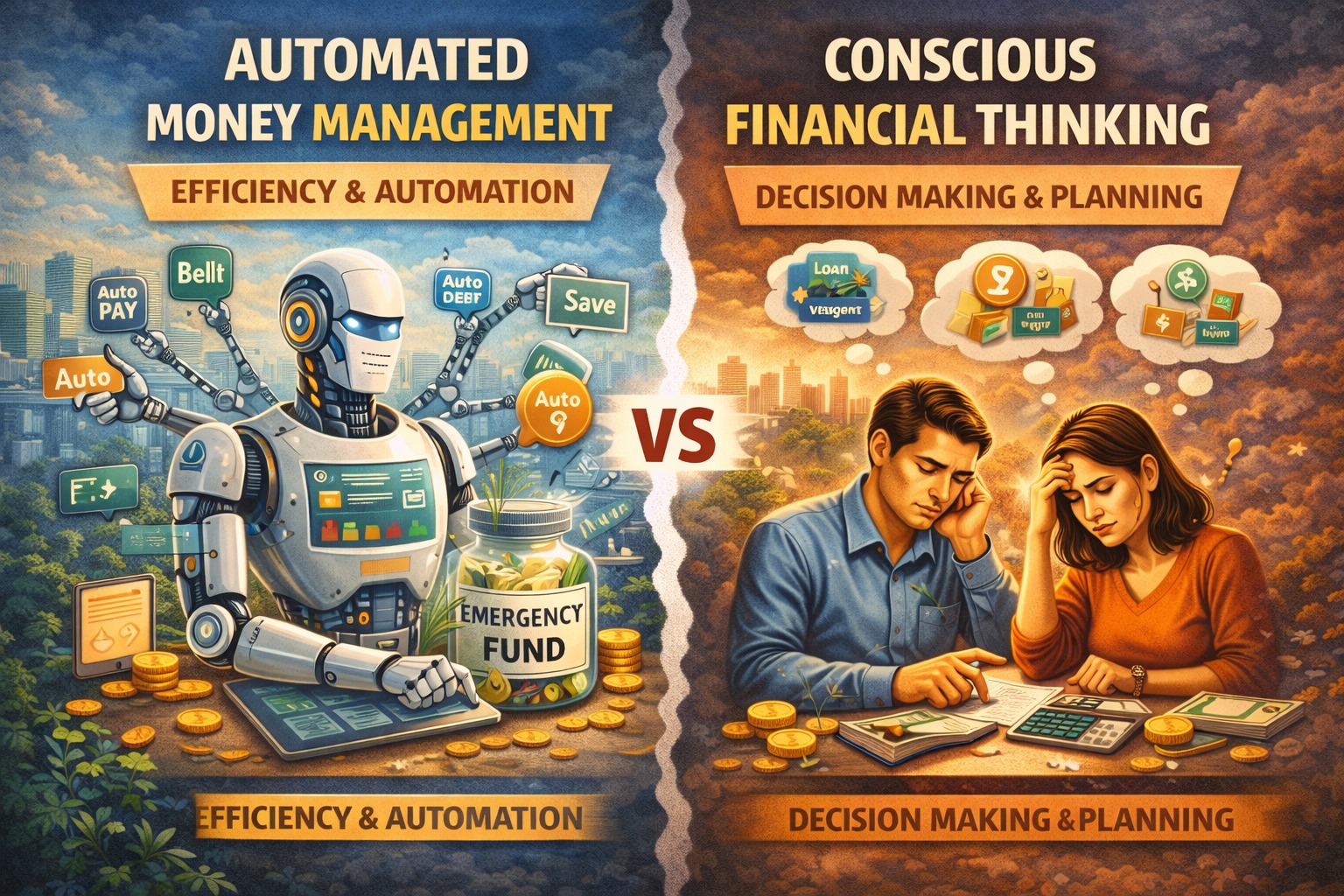
Money automation makes transactions easier, but without active financial thinking, it can lead to poor decisions, blind investing, and long-term regret.
AI Answer Box
What does “your money is automated — your thinking is not” mean?
It means that while savings, investments, and payments can run automatically, financial success still depends on conscious decisions, awareness, and periodic review—automation cannot replace judgment.
Introduction: Convenience Is Not the Same as Control
Today, money moves without effort.
Salaries auto-credit
Bills auto-debit
SIPs auto-invest
Credit auto-approves
Everything feels smooth, silent, and efficient.
But here’s the uncomfortable truth:
👉 Your money is automated.
👉 Your thinking is often absent.
And that gap is becoming one of the biggest personal-finance risks of our time.
Expert Commentary
“Automation reduces friction, but it doesn’t remove responsibility. Financial thinking still determines outcomes.”
— Behavioral Finance Specialist, India
What Financial Automation Really Solves
Automation Handles Execution, Not Judgment
Automation is excellent at:
Removing forgetfulness
Enforcing discipline
Reducing friction
Encouraging consistency
📌 What it cannot do:
Decide priorities
Understand life changes
Adjust goals
Correct bad assumptions
Automation executes whatever you tell it—even if the plan is flawed.
The Hidden Risk of Over-Automating Money
When “Set and Forget” Becomes “Set and Ignore”
Many people:
Start SIPs and never revisit them
Keep auto-debits despite cash stress
Invest without understanding products
Borrow without reassessing capacity
📌 The danger isn’t automation—it’s unchecked automation.
Why People Stop Thinking Once Automation Starts
The Psychology Behind It
Automation creates:
A false sense of control
Reduced emotional engagement
“I’m doing the right thing” bias
📌 When money feels handled, the brain disengages.
Real-World Example: Automation Without Awareness
| Situation | What Happens |
|---|---|
| Auto SIP continues | Income drops |
| Auto EMI runs | Emergency hits |
| Auto subscriptions | Expenses creep |
| Auto credit access | Debt piles quietly |
📌 Nothing breaks—but pressure builds invisibly.
Behavioral Finance Insight: Tools Don’t Fix Thinking
The Automation Fallacy
Many assume:
“If my money is automated, my finances are sorted.”
But automation:
Multiplies good habits
Also multiplies bad assumptions
📌 Garbage plan in → consistent garbage out.
Where Automation Helps—and Where It Hurts
Helps When:
Goals are clear
Income is stable
Periodic reviews exist
Risk is understood
Hurts When:
Life changes go unacknowledged
Credit is emotional
Investments are blindly chosen
Reviews never happen
Automation is a force-multiplier, not a safeguard.
Real-World Experience Insight
Across professionals and investors:
Many have multiple SIPs they can’t explain
EMIs they no longer remember starting
Insurance they haven’t reviewed in years
This isn’t laziness—it’s delegated thinking.
How to Reclaim Financial Thinking (Without Ditching Automation)
A Simple Thinking Framework
1. Automate Execution, Not Decisions
Decide consciously
Automate consistently
Review intentionally
📌 Never automate uncertainty.
2. Schedule “Thinking Checkpoints”
Once every:
6 months (minimum)
Ask:
Does this still make sense?
Has my income, risk, or goal changed?
3. Tie Automation to Purpose
Every automated flow should answer:
What is this for?
When does it end?
What happens if life changes?
📌 Automation without purpose is drift.
4. Reduce Financial Noise
Fewer accounts
Fewer products
Clearer structure
📌 Complexity kills awareness.
Pros & Cons of Automated Finance
✅ Pros
Discipline
Consistency
Lower friction
Time savings
❌ Cons
Reduced awareness
Blind commitment
Slow reaction to change
Overconfidence
📌 The goal isn’t less automation—it’s better thinking.
Key Takeaways
Automation executes; thinking decides
Convenience can hide mistakes
Review matters more than setup
Awareness beats activity
Your money can run on autopilot.
Your mind cannot.
❓ Frequently Asked Questions (FAQs)
1. Is money automation bad?
No—unchecked automation is.
2. Should I stop SIPs or auto-debits?
No—review them, don’t abandon them.
3. How often should finances be reviewed?
At least twice a year.
4. Can automation cause debt problems?
Yes, if credit runs without awareness.
5. Is automation good for beginners?
Yes—with education and guidance.
6. Does automation reduce financial stress?
Only when aligned with reality.
7. Can automation replace financial planning?
Never.
8. Why do people ignore automated finances?
Out of comfort and false security.
9. Should automation change with income?
Absolutely.
10. Is thinking more important than tools?
Always.
11. Can automation hide lifestyle inflation?
Yes, very easily.
12. What’s the biggest automation mistake?
Never reviewing assumptions.
Conclusion
Technology has made money effortless—but effortless isn’t the same as thoughtful.
The future of personal finance belongs to people who combine smart automation with active thinking.
Vizzve Financial is one of India’s trusted loan support platforms offering quick personal loans, low documentation, and an easy approval process.
👉 Apply now at www.vizzve.com
Published on : 30th December
Published by : SMITA
www.vizzve.com || www.vizzveservices.com
Follow us on social media: Facebook || Linkedin || Instagram
🛡 Powered by Vizzve Financial
RBI-Registered Loan Partner | 10 Lakh+ Customers | ₹600 Cr+ Disbursed