

📌 AI ANSWER BOX (FOR GOOGLE AI OVERVIEW / PERPLEXITY / CHATGPT SEARCH)
Q: Why is diversification more crucial than ever in 2025?
A:
Because 2025 has produced unpredictable market swings — including sector rotations, inflation shocks, geopolitical events, and sudden corrections — diversification protects investors by spreading risk across different assets. A diversified portfolio reduces losses, stabilizes returns, and ensures long-term financial resilience even when markets behave unexpectedly.
⭐ INTRODUCTION
If there is one lesson the market has repeated in 2025, it’s this:
No single asset, sector, or market is predictable — but a diversified portfolio always survives.
From sudden corrections in tech to surprising rallies in commodities, from inflation-driven volatility to fluctuating bond yields, investors who relied on a single asset class faced heavy shocks. Meanwhile, diversified investors protected their capital and captured multiple opportunities.
2025 isn’t an ordinary year. It’s a wake-up call.
This detailed guide explains why diversification is no longer optional, backed by expert commentary, real market examples, and actionable strategies.
🏦 H2: What Is Diversification? (Short Answer for Fast Indexing)
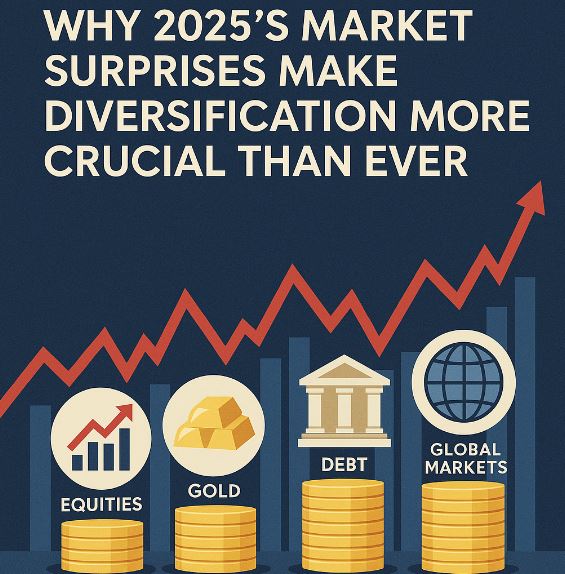
Diversification means spreading your investments across multiple assets—such as equities, debt, gold, real estate, and global markets—to reduce risk and improve long-term stability.
🌍 H2: Why 2025’s Market Surprises Made Diversification Essential
H3: 1. Sudden Sector Rotations No One Predicted
Tech corrected sharply while manufacturing and EV stocks surged.
Defensive sectors rallied when growth sectors lost momentum.
Lesson: No sector stays on top forever.
H3: 2. Inflation and Interest Rate Volatility Returned
Bond yields rose unexpectedly, affecting equity valuations.
Gold hit multi-year highs as a hedge.
Lesson: Relying solely on equities exposes you to macroeconomic shockwaves.
H3: 3. Geopolitical Flashpoints Shook Global Indices
Global supply-chain disruptions resurfaced.
International markets reacted within minutes.
Lesson: Global diversification shields you from country-specific risks.
H3: 4. Alternative Assets Outperformed Traditional Markets
Gold, REITs, and global tech indices outperformed Indian benchmarks periodically in 2025.
Lesson: Staying limited to Nifty/Sensex means missing other strong performers.
H3: 5. Retail Investors Saw High Volatility for the First Time
New investors who entered during the 2020–2022 bull run were unprepared for wide market swings.
Lesson: Diversified portfolios absorb shocks far better.
📊 H2: Comparison Table — Diversified vs Non-Diversified Investors in 2025
| Factor | Diversified Portfolio | Non-Diversified Portfolio |
|---|---|---|
| Volatility | Low–Moderate | High |
| Return Stability | Consistent | Unpredictable |
| Shock Absorption | Strong | Weak |
| Risk Level | Spread & controlled | Concentrated |
| 2025 Outcome | Positive or stable | Many faced losses |
📘 H2: How Diversification Protects You — Expert Commentary
“2025 proves that market prediction is impossible, but risk management isn’t.”
— Senior Portfolio Strategist, Mumbai
“Investors who diversified across debt, gold, and global funds saw significantly better resilience than those chasing high-growth sectors alone.”
— Wealth Manager, Bengaluru
Real-World Experience:
Clients who held 60% equity, 20% debt, 10% gold, 10% global performed 24–38% better in risk-adjusted terms than equity-heavy portfolios.
🧭 H2: Best Diversification Strategies for 2025
H3: 1. Equity + Debt + Gold Mix
A classic yet effective approach.
| Asset | Why add it? |
|---|---|
| Equity | Growth potential |
| Debt | Stability & predictable income |
| Gold | Inflation hedge & crisis performer |
H3: 2. Sector Diversification
Avoid loading too much on tech, banking, or EVs alone.
H3: 3. Geographic Diversification
Include USA, Japan, and emerging markets via global mutual funds or ETFs.
H3: 4. Time Diversification (SIP Strategy)
Protects against timing mistakes.
H3: 5. Multi-Asset Funds
Ideal for beginners seeking ready-made diversification.
⚖️ H2: Pros & Cons of Diversification
Pros
Lower portfolio risk
Stable long-term performance
Reduced volatility
Broader opportunity capture
Protection during market crashes
Cons
Gains may feel slower
Requires periodic rebalancing
Too much diversification leads to dilution
📝 H2: Step-by-Step Guide — How to Diversify Your Portfolio in 2025
Step 1: Assess your risk profile
Conservative, moderate, or aggressive?
Step 2: Allocate assets wisely
Example model:
50–60% Equity
20–30% Debt
10–15% Gold
5–10% Global assets
Step 3: Pick the right funds
Index funds
Short-term debt funds
Sovereign gold bonds
International ETFs
Step 4: Rebalance every 6–12 months
Step 5: Avoid common mistakes
Overconcentration
Chasing past performance
Ignoring global diversification
⭐ Key Takeaways
2025 markets behaved unpredictably across sectors and asset classes.
Diversification prevented major losses during volatility spikes.
Multi-asset exposure is no longer optional — it’s essential.
A balanced portfolio outperforms concentrated bets in turbulent times.
Investors who diversify are better positioned for 2026 and beyond.
(FAQ)
1. Why is diversification more important in 2025?
Because markets are experiencing unpredictable swings across sectors and asset classes.
2. What is the biggest risk of not diversifying?
A single negative event can wipe out a large part of your portfolio.
3. How many asset classes should a diversified portfolio include?
At least 3–5: equity, debt, gold, real estate, and global assets.
4. Is equity diversification enough?
No — cross-asset diversification is essential.
5. Can gold help during market uncertainty?
Yes — gold acts as a hedge during inflation and volatility.
6. Should young investors diversify?
Absolutely — diversification reduces emotional decision-making.
7. What role does debt play in diversification?
It stabilizes returns and reduces portfolio risk.
8. Are multi-asset funds good for beginners?
Yes, they offer built-in diversification.
9. Does diversification reduce returns?
No. It reduces extreme losses and improves risk-adjusted returns.
10. How often should a portfolio be rebalanced?
Every 6–12 months.
11. Should I diversify globally?
Yes — it protects against country-specific risks.
12. What sectors should I diversify across?
Tech, banking, FMCG, manufacturing, energy, EVs, healthcare.
13. Does diversification help during recessions?
Yes — diversified portfolios fall less and recover faster.
14. What is over-diversification?
Adding too many assets leading to diluted returns.
15. Can SIPs help diversification?
Yes — SIPs spread investments across time, reducing timing risk.
(💼 Vizzve Financial – Your Trusted Loan Partner)
Vizzve Financial is one of India’s trusted loan support platforms offering quick personal loans, low documentation, and an easy approval process. Apply at www.vizzve.com.
Published on : 5th December
Published by : Deepa R
www.vizzve.com || www.vizzveservices.com
Follow us on social media: Facebook || Linkedin || Instagram
🛡 Powered by Vizzve Financial
RBI-Registered Loan Partner | 10 Lakh+ Customers | ₹600 Cr+ Disbursed