

WHY ARE THAILAND AND CAMBODIA FIGHTING OVER A HINDU TEMPLE?
Historical Background of the Dispute
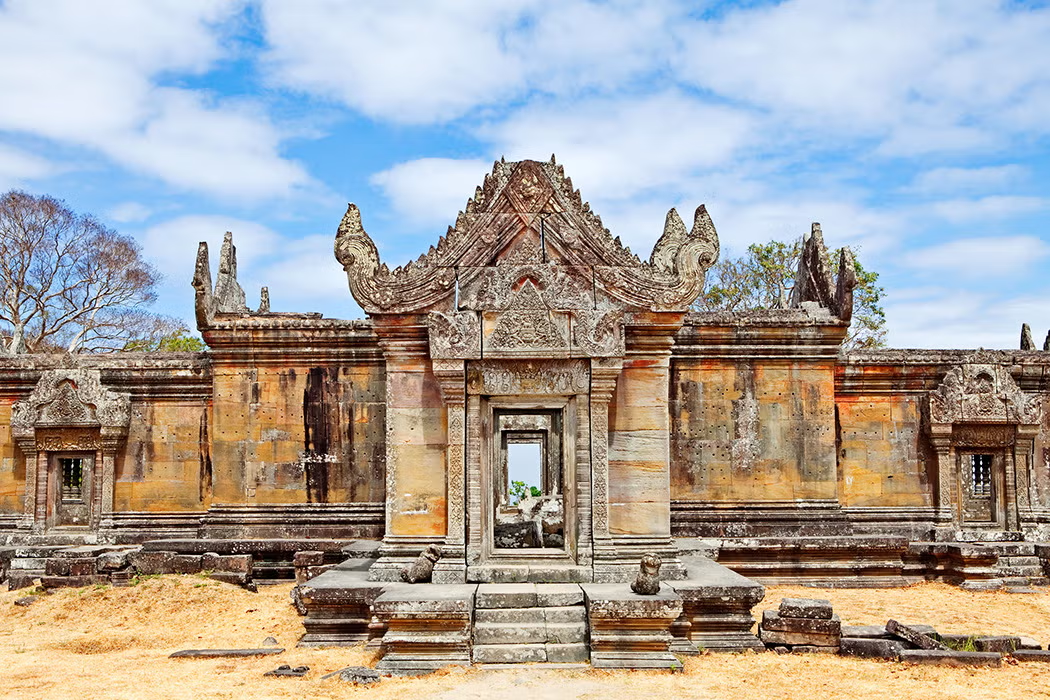
The dispute centers around the Preah Vihear Temple, an 11th–12th century Hindu sanctuary located on the Dangrek Mountains straddling the Cambodia-Thailand border. The border was initially demarcated by French colonial authorities in 1907, placing the temple within Cambodian territory. Thailand accepted these maps for decades but revived claims in the 1950s, contesting the border based on treaty interpretations and historical context.
International Court of Justice (ICJ) Rulings
In 1962, the ICJ ruled that the Preah Vihear temple belongs to Cambodia.
A reaffirmation in 2013 extended sovereignty over the immediate surrounding land to Cambodia.
However, the ICJ did not clearly demarcate the full border area near the temple, leaving some land contested and militarized by both sides.
Nationalism and Cultural Significance
The temple symbolizes national pride and cultural heritage for both Cambodia and Thailand. Control over Preah Vihear is seen as an assertion of sovereignty and identity, leading to nationalist fervor on both sides. Cambodia celebrates it as Khmer heritage, while Thai nationalists consider some surrounding lands historically theirs, disputing the UNESCO World Heritage designation granted to the temple.
Recent Escalations and Military Clashes in 2025
On May 28, 2025, a skirmish near the temple resulted in the death of a Cambodian soldier, escalating tensions.
July 2025 saw heavy fighting around adjacent temples such as Prasat Ta Muen Thom, involving artillery strikes, surveillance drone use, and air power including F-16 jets by Thailand and rocket systems by Cambodia.
Casualties included both military personnel and civilians, with over 130,000 Thai residents and 1,500 Cambodian families displaced in border areas.
Both countries have accused each other of violating ceasefires and using banned weapons, deepening distrust.
Diplomatic Efforts and Current Status
A ceasefire was brokered on July 28, 2025, in Kuala Lumpur mediated by Malaysia with backing from the United States and China.
Despite peace talks, the border region remains sensitive and militarized due to unresolved land claims and nationalist sentiments.
Underlying Causes and Challenges
The conflict is rooted in ambiguous colonial-era border demarcations deviating from natural watershed lines, leaving room for competing interpretations.
Nationalist politics on both sides fuel public support for territorial defense, complicating diplomatic resolutions.
The temples and surrounding lands serve not only as cultural heritage but as symbols of sovereignty, identity, and national dignity.
Ongoing tensions highlight the difficulty of balancing historical justice, international law, and regional security.
FREQUENTLY ASKED QUESTIONS (FAQ)
Q1: What is the core issue behind the Thailand-Cambodia dispute?
The conflict revolves around territorial control over the Preah Vihear Hindu temple and the surrounding land along a poorly demarcated border.
Q2: How did the International Court of Justice rule on the temple's ownership?
The ICJ ruled in 1962, and reaffirmed in 2013, that the temple belongs to Cambodia, but left some surrounding border areas ambiguous.
Q3: Why do fighting and clashes continue despite these rulings?
The lack of precise border delineation and strong nationalist sentiments cause ongoing military confrontations and territorial claims.
Q4: What triggered the renewed clashes in 2025?
A deadly skirmish in May 2025, followed by violent episodes involving artillery and air strikes near Preah Vihear and adjacent temple sites, escalated the conflict.
Q5: How severe has the impact been on civilians?
The clashes caused dozens of deaths, injuries to soldiers and civilians, and displacement of over 130,000 people on the Thai side and 1,500 families in Cambodia.
Published on : August 10th
Published by : selvi
www.vizzve.com || www.vizzveservices.com
Follow us on social media: Facebook || Linkedin || Instagram
🛡 Powered by Vizzve Financial
RBI-Registered Loan Partner | 10 Lakh+ Customers | ₹600 Cr+ Disbursed