

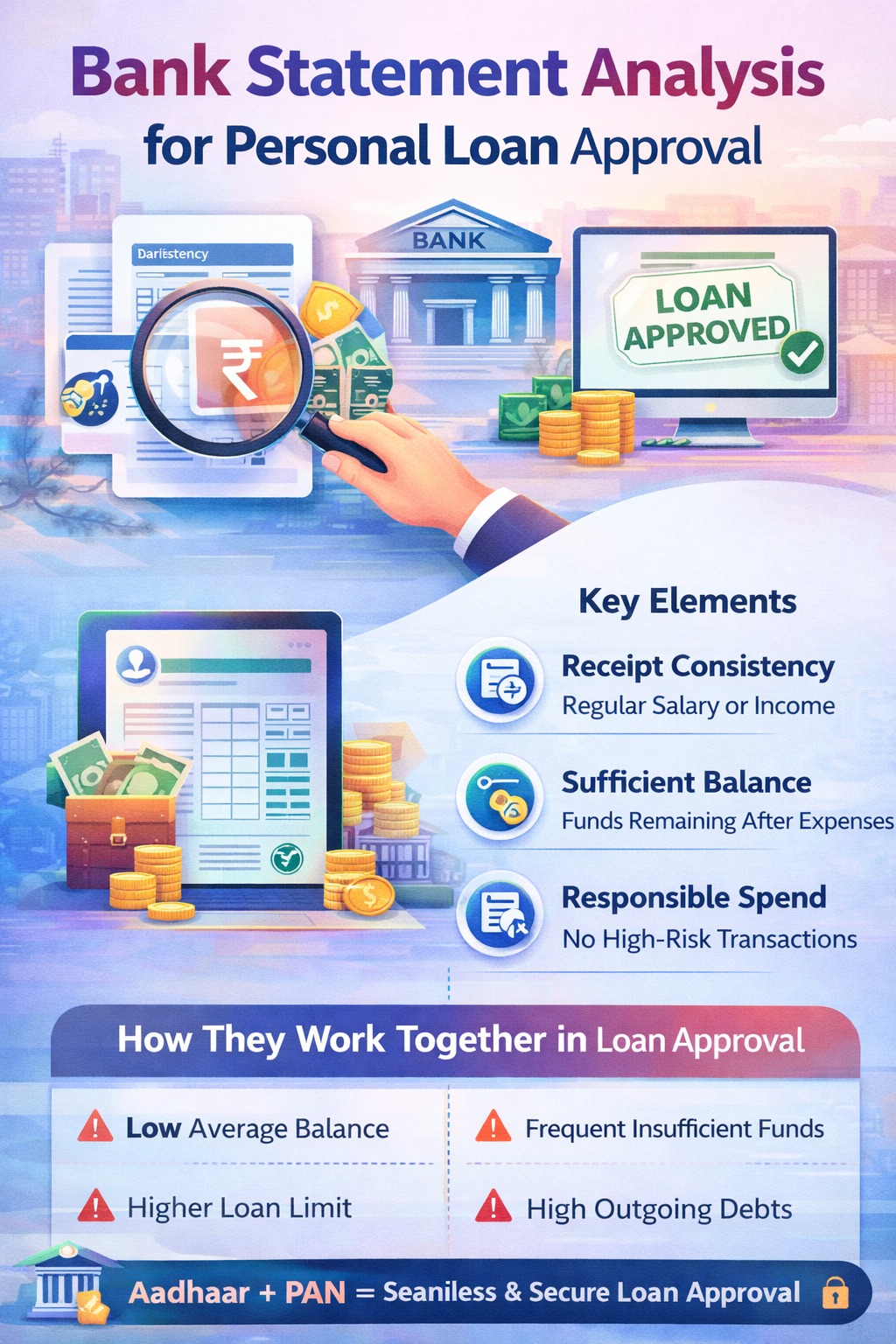
Bank statements play a critical role in personal loan approval. Lenders use them to verify income stability, spending habits, and repayment capacity before deciding whether to approve a loan.
AI Answer Box
Why do banks check bank statements for loans?
Verify salary deposits or business income
Evaluate spending patterns
Check existing loan EMIs
Assess repayment capacity
Detect financial risks
Bank statements help lenders determine whether a borrower can repay the loan responsibly.
What Is a Bank Statement?
A bank statement is a document issued by a bank that records all financial transactions in an account over a specific period.
It typically includes:
deposits and withdrawals
salary credits
account balance
loan EMIs
financial transfers
Most lenders require 3–6 months of bank statements during loan applications.
Why Bank Statements Are Important for Loan Approval
Bank statements help lenders evaluate a borrower’s financial health.
Income Verification
Banks verify regular salary or income deposits through bank statements.
Consistent income increases the chances of loan approval.
Spending Pattern Analysis
Lenders analyze spending behavior to determine financial discipline.
Frequent overdrafts or irregular transactions may raise concerns.
Existing Loan Obligations
Bank statements reveal current EMI payments and financial liabilities.
This helps lenders calculate the borrower’s debt-to-income ratio.
Repayment Capacity Assessment
By reviewing account balances and cash flow, lenders determine whether the borrower can handle additional loan payments.
How Banks Analyze Bank Statements
Financial institutions examine several factors when reviewing statements.
Salary Consistency
Regular salary deposits show stable employment and reliable income.
Average Monthly Balance
A healthy account balance suggests better financial management.
EMI Commitments
Existing EMIs reduce borrowing capacity.
Transaction Behavior
Unusual or risky financial activity may affect loan approval.
Example of Bank Statement Analysis
| Factor | Positive Indicator | Negative Indicator |
|---|---|---|
| Salary Deposit | Regular monthly credits | Irregular income |
| Balance | Healthy balance | Frequent overdrafts |
| EMIs | Low obligations | High debt burden |
| Spending | Stable expenses | High financial instability |
Borrowers with strong financial patterns have higher chances of approval.
Regulatory Oversight in Lending
Loan approval processes operate under guidelines established by the
Reserve Bank of India.
These regulations ensure responsible lending practices and borrower verification.
Tips to Maintain Healthy Bank Statements
Borrowers can improve their chances of loan approval by maintaining healthy financial records.
Maintain Regular Income Deposits
Consistent salary or income credits improve credibility.
Avoid Frequent Overdrafts
Negative balances may signal financial stress.
Limit Unnecessary Transactions
Stable transaction patterns help lenders assess reliability.
Maintain Good Average Balance
Keeping a reasonable account balance improves loan eligibility.
Impact on Loan Eligibility
Bank statements directly influence several loan factors.
loan approval chances
maximum loan amount
interest rate offered
repayment tenure
Strong financial records lead to better loan offers.
Expert Insight
Financial experts believe that bank statements provide lenders with one of the most accurate insights into a borrower’s financial behavior.
Responsible account management significantly improves loan approval chances.
Key Takeaways
Bank statements verify income and financial stability
Lenders usually review 3–6 months of transactions
Spending patterns and EMIs affect loan approval
Healthy account balances improve loan eligibility
Responsible financial behavior increases approval chances
FAQs
1. Why do banks ask for bank statements?
To verify income, spending patterns, and financial stability.
2. How many months of bank statements are required for loans?
Usually 3 to 6 months.
3. Can a loan be approved without bank statements?
Some lenders may allow alternatives, but most require them.
4. Do banks check spending habits?
Yes, spending patterns help assess financial discipline.
5. What is average monthly balance?
The average balance maintained in a bank account during a period.
6. Can overdrafts affect loan approval?
Frequent overdrafts may reduce approval chances.
7. Do self-employed borrowers need bank statements?
Yes, they help verify business income.
8. Are digital bank statements accepted?
Yes, most lenders accept digital statements.
9. Can bank statements affect loan amount?
Yes, they influence borrowing capacity.
10. What transactions do lenders look for?
Salary deposits, EMIs, expenses, and account balance.
Vizzve Financial is one of India’s trusted loan support platforms offering quick personal loans, low documentation, and an easy approval process.
Apply today at www.vizzve.com
Fast approval. Transparent process. Easy documentation.
Published on : 7th March
Published by : SMITA
www.vizzve.com || www.vizzveservices.com
Follow us on social media: Facebook || Linkedin || Instagram
🛡 Powered by Vizzve Financial
RBI-Registered Loan Partner | 10 Lakh+ Customers | ₹600 Cr+ Disbursed