

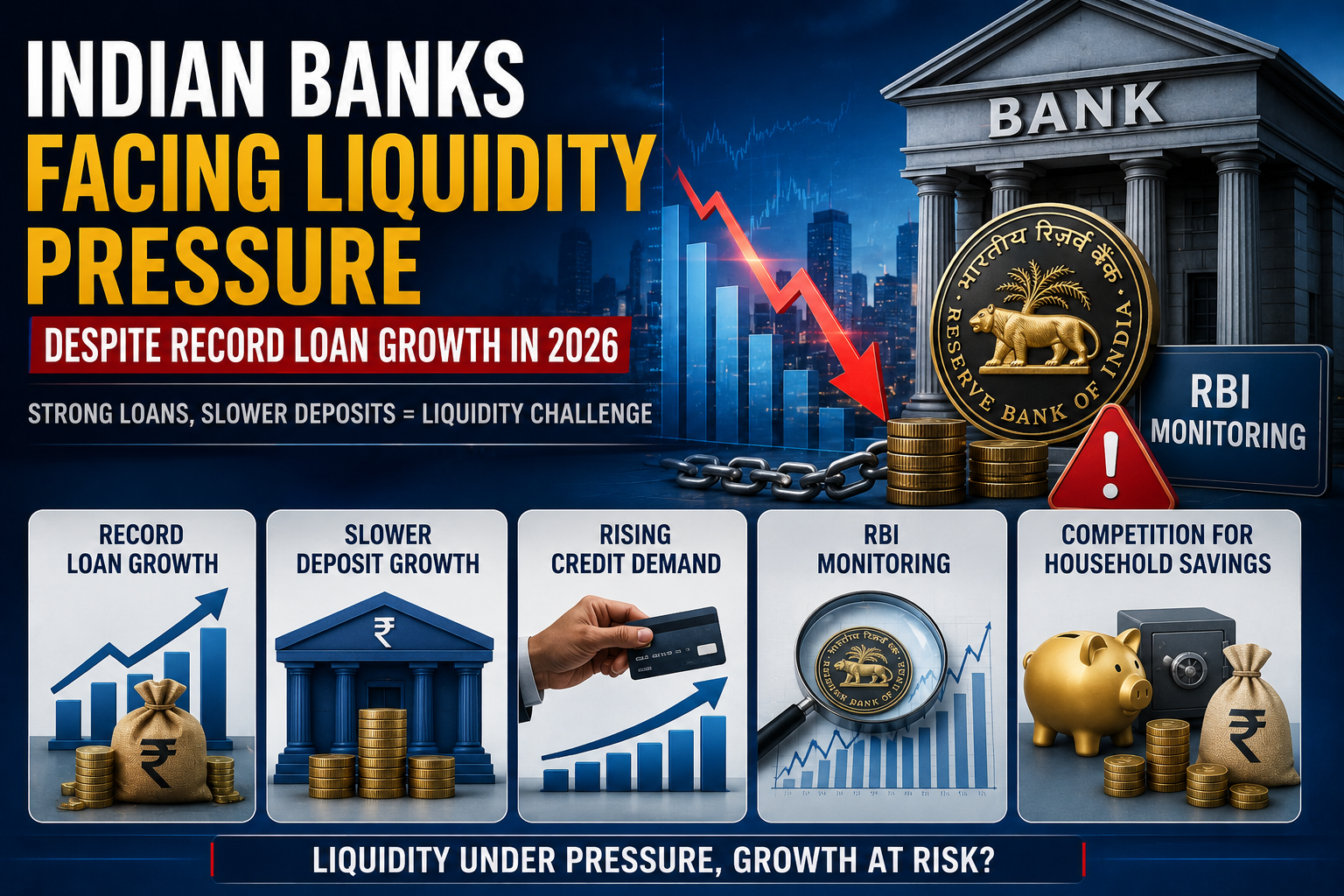
India's banking sector is witnessing a surprising trend in 2026.
Banks are reporting strong loan growth and record credit demand, yet many institutions are simultaneously facing liquidity pressure and intense competition for deposits.
At first glance, this may seem contradictory.
If banks are lending more money than ever before, shouldn't they be earning more and becoming stronger?
The answer lies in the growing gap between credit growth and deposit growth, a challenge that is becoming one of the most important stories in India's financial sector.
AI Answer Box
Why are banks facing liquidity pressure?
Loan growth is expanding faster than deposit growth, meaning banks are lending money at a quicker pace than they are attracting fresh deposits.
Is this a banking crisis?
No. Most experts view this as a liquidity management challenge rather than a solvency or financial stability crisis.
Why does it matter?
Liquidity affects lending rates, deposit rates, profitability, and overall economic activity.
Understanding How Banks Work
Banks operate using a relatively simple model:
Step 1
Customers deposit money.
Step 2
Banks lend a portion of those deposits.
Step 3
Banks earn income from the difference between deposit costs and loan interest rates.
For this model to function smoothly, deposit growth and loan growth should remain reasonably balanced.
The Current Problem: Loans Are Growing Faster Than Deposits
One of the biggest challenges facing banks today is the mismatch between:
Credit Growth
Growing rapidly.
Deposit Growth
Expanding more slowly.
As a result, banks need more funds to continue supporting loan demand.
Credit Growth vs Deposit Growth
| Indicator | Trend |
|---|---|
| Loan Growth | Strong |
| Personal Loans | Rising |
| Business Lending | Expanding |
| Deposit Growth | Slower |
| Liquidity Conditions | Tightening |
Why Loan Demand Is Surging
Several factors are fueling borrowing.
Consumer Demand
More individuals are borrowing for:
- Homes
- Vehicles
- Personal expenses
- Education
Corporate Expansion
Businesses continue investing in:
- Manufacturing
- Infrastructure
- Capacity expansion
Government Spending
Large public-investment programs also stimulate credit demand.
Why Deposits Are Not Growing as Fast
This is where the challenge begins.
Several factors are contributing to slower deposit growth.
1. Investors Have More Choices
Consumers today have numerous alternatives beyond traditional bank deposits.
Popular options include:
- Mutual funds
- Bonds
- Equity markets
- Insurance-linked investments
- Digital investment platforms
Some investors are moving savings away from deposits in search of higher returns.
2. Rising Popularity of Financial Markets
Strong participation in:
- Stock markets
- SIPs
- Mutual funds
has attracted household savings that previously might have remained in bank deposits.
3. Competition for Household Savings
Banks are now competing against:
- Asset management companies
- Insurance firms
- Fintech investment platforms
This competition has intensified significantly over the past decade.
Why Liquidity Matters
Liquidity is the ability of banks to meet funding needs and continue lending.
When liquidity tightens:
Banks May
- Raise deposit rates
- Increase competition for savings
- Adjust lending strategies
Liquidity management becomes a key priority.
What Is the Credit-Deposit Ratio?
One closely watched metric is the Credit-Deposit Ratio (CD Ratio).
Formula
CDRatio=TotalLoansTotalDepositsCD\ Ratio = \frac{Total\ Loans}{Total\ Deposits}CDRatio=TotalDepositsTotalLoans
A rising ratio suggests banks are lending a larger share of available deposits.
Higher ratios can indicate stronger credit demand but may also signal funding pressure.
How RBI Is Responding
The Reserve Bank of India closely monitors liquidity conditions.
Possible tools include:
Liquidity Operations
Injecting funds into the banking system when required.
Policy Guidance
Encouraging prudent lending and funding management.
Market Operations
Supporting orderly financial-market conditions.
The central bank's goal is to ensure adequate liquidity while maintaining financial stability.
Impact on Borrowers
Liquidity pressure can affect consumers and businesses.
Possible Effects
- Higher lending rates
- Stricter loan approvals
- Increased focus on deposit mobilization
However, competition among lenders continues providing borrowers with multiple financing options.
Impact on Deposit Holders
The situation may benefit savers.
Why?
Banks seeking additional deposits often offer:
- Higher fixed-deposit rates
- Promotional savings products
- Attractive deposit schemes
This can improve returns for depositors.
Impact on Bank Profitability
Liquidity pressure creates both opportunities and challenges.
Positive
- Strong loan demand
- Growing credit volumes
Negative
- Higher funding costs
- Increased competition for deposits
Banks must balance growth with profitability.
Why Investors Are Watching Closely
Banking stocks remain a major part of India's financial markets.
Investors monitor:
- Deposit growth
- Credit growth
- Net interest margins
- Liquidity conditions
These factors influence earnings and valuations.
Is This a Warning Sign for the Economy?
Most economists do not view the situation as a major concern.
In fact, strong loan demand often indicates:
- Economic activity
- Consumer confidence
- Business expansion
The challenge is ensuring that funding sources keep pace with growth.
Expert Commentary
Banking analysts describe the current situation as a byproduct of rapid economic expansion.
Positive Signals
- Strong credit demand
- Business investment
- Consumer spending
Areas to Watch
- Deposit mobilization
- Funding costs
- Liquidity management
Most experts expect banks and regulators to adapt through a combination of deposit growth initiatives and liquidity measures.
Opportunities vs Risks
| Opportunities | Risks |
|---|---|
| Strong Credit Demand | Liquidity Pressure |
| Economic Expansion | Higher Funding Costs |
| Deposit Rate Growth | Margin Compression |
| Banking Sector Growth | Lending Constraints |
| Financial Deepening | Deposit Competition |
Key Takeaways
✅ Indian banks are experiencing strong loan growth.
✅ Deposit growth is not keeping pace with lending.
✅ Liquidity pressure is emerging as a major banking theme.
✅ RBI continues monitoring funding conditions closely.
✅ Savers may benefit from higher deposit rates.
✅ Most experts view this as a liquidity challenge, not a banking crisis.
Future Outlook
The banking sector is expected to remain strong, but several trends will be closely watched:
- Deposit growth
- Credit demand
- RBI liquidity measures
- Interest-rate trends
- Economic growth
If deposits accelerate alongside lending, liquidity pressures could ease significantly.
Conclusion
India's banks are not running short of money because lending is weak—quite the opposite.
The challenge stems from exceptionally strong credit demand growing faster than deposits, creating pressure on funding and liquidity management.
While this situation requires careful monitoring, it also reflects an economy where consumers are borrowing, businesses are investing, and financial activity remains robust.
For investors, borrowers, and depositors, understanding this balance between loans and deposits will be one of the most important banking stories of 2026.
Frequently Asked Questions (FAQs)
1. Why are banks facing liquidity pressure?
Because loans are growing faster than deposits.
2. Is this a banking crisis?
No, it is primarily a liquidity-management challenge.
3. What is the credit-deposit ratio?
A measure comparing loans issued to deposits collected.
4. Why are deposits growing slowly?
Investors have more alternatives such as mutual funds and equities.
5. Can deposit rates rise?
Yes, banks may offer higher rates to attract funds.
6. Will loan rates increase?
Funding pressures can influence lending rates.
7. How does RBI help?
Through liquidity operations and monetary policy tools.
8. Is strong loan growth positive?
Generally yes, as it reflects economic activity.
9. Which sectors are borrowing the most?
Consumers, housing, infrastructure, and businesses.
10. What should investors monitor?
Deposit growth, liquidity trends, and RBI actions.
Published on : 12th June
Published by : SMITA
www.vizzve.com || www.vizzveservices.com
Follow us on social media: Facebook || Linkedin || Instagram
🛡 Powered by Vizzve Financial
RBI-Registered Loan Partner | 10 Lakh+ Customers | ₹600 Cr+ Disbursed