

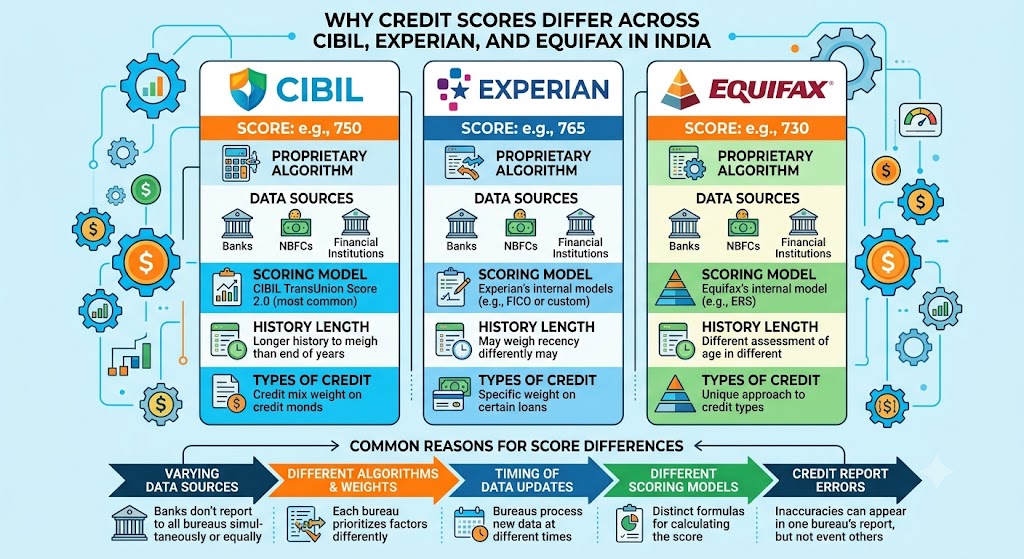
Your credit score may differ across CIBIL, Experian, and Equifax, even when all three credit bureaus evaluate your financial history. These differences are common and do not automatically mean that your credit report contains an error.
In India, credit scores are used by banks and financial institutions to assess a borrower's creditworthiness. However, each credit bureau may use different scoring models, reporting dates, and available credit information. Understanding these differences can help you manage your credit profile more effectively.
What Is a Credit Score?
A credit score is a numerical representation of your credit history and repayment behaviour. In India, credit scores generally range from 300 to 900, depending on the bureau and its scoring system.
Lenders may consider your credit score along with your income, employment stability, existing EMIs, repayment capacity, and other eligibility criteria when reviewing a loan application.
Why Do Credit Scores Differ Across Credit Bureaus?
1. Different Credit Scoring Models
CIBIL, Experian, and Equifax may use different scoring methodologies to evaluate your credit history. Each bureau can assign different weights to factors such as repayment history, credit utilisation, length of credit history, and credit enquiries.
As a result, the same financial behaviour may produce different scores across bureaus.
2. Different Reporting Dates
Banks and lenders do not necessarily update every credit bureau at the same time. One bureau might reflect your latest EMI payment, while another may still show an earlier reporting period.
For example, if you recently paid a credit card bill or loan EMI, the updated payment may appear in one report before the others.
3. Differences in Credit Information
Credit bureaus depend on information reported by banks, NBFCs, and other credit institutions. If a lender's information is updated or recorded differently across bureaus, your scores may vary.
Differences can relate to loan balances, payment history, account status, or recently opened and closed credit accounts.
4. Credit Utilisation Ratio
Your credit utilisation ratio measures how much of your available revolving credit you use.
For example, if your credit card limit is ₹1,00,000 and your outstanding balance is ₹40,000, your utilisation ratio is 40%.
Differences in the balances or credit limits recorded by bureaus can affect your credit scores. Keeping utilisation low is generally beneficial for your credit profile.
5. Hard Credit Enquiries
When you apply for a loan or credit card, the lender may make a hard enquiry on your credit report. Multiple applications within a short period can affect how lenders assess your credit profile and may influence your score.
If enquiries are reported at different times or are not reflected consistently, your scores may differ temporarily.
6. Errors in Your Credit Report
Incorrect personal details, duplicate accounts, outdated loan balances, or wrongly reported missed payments can cause discrepancies between credit reports.
If you notice an unfamiliar account or an incorrect repayment entry, contact the relevant lender and raise a dispute with the credit bureau concerned.
CIBIL vs Experian vs Equifax
|
Feature |
CIBIL |
Experian |
Equifax |
|---|---|---|---|
|
Credit bureau |
TransUnion CIBIL |
Experian India |
Equifax India |
|
Main purpose |
Assess credit history |
Assess credit history |
Assess credit history |
|
Score differences |
Possible |
Possible |
Possible |
|
Information source |
Credit institutions |
Credit institutions |
Credit institutions |
|
Loan approval |
Lender's overall assessment |
Lender's overall assessment |
Lender's overall assessment |
All three are credit information companies operating in India. Their scores should not be expected to match exactly.
Example: Why Your Credit Scores May Be Different
Suppose a borrower checks their credit scores and receives the following results:
|
Credit bureau |
Illustrative score |
|---|---|
|
CIBIL |
780 |
|
Experian |
755 |
|
Equifax |
768 |
These figures are only an example, not actual credit report data.
The difference might occur because one bureau has received a more recent loan repayment update, uses a different scoring model, or holds slightly different account information.
A lower score at one bureau does not automatically mean that your creditworthiness has suddenly deteriorated. Review the underlying reports before drawing conclusions.
How to Manage Differences in Credit Scores
Follow these practical steps to maintain a healthy credit profile:
-
Pay EMIs and credit card bills on time: Consistent repayments help build a positive credit history.
-
Keep credit utilisation low: Avoid using most of your available credit limit.
-
Avoid frequent loan applications: Apply for credit only when necessary.
-
Check all available credit reports: Compare account balances, repayment records, and enquiry details.
-
Correct reporting errors: Raise disputes with the relevant bureau and lender.
-
Maintain older credit accounts responsibly: A longer, well-managed credit history can be beneficial.
-
Monitor outstanding loans: Ensure closed loans are reported correctly.
Does a Different Credit Score Affect Loan Approval?
Yes, it can, depending on the lender's policies and which credit report or scoring system it uses. However, credit score is only one part of a loan application.
Lenders may also evaluate income, job or business stability, existing debt obligations, KYC verification, repayment capacity, and internal eligibility requirements.
Even a borrower with a strong credit score may face rejection if their income or repayment capacity does not meet the lender's criteria.
Frequently Asked Questions (FAQs)
1. Why is my CIBIL score different from my Experian score?
The bureaus may use different scoring models, receive lender updates at different times, or hold different credit information.
2. Which credit bureau is most accurate?
No single bureau is automatically the most accurate in every situation. Review each report for completeness and correctness.
3. Is it normal to have different credit scores?
Yes. Small or moderate differences can occur because of differences in scoring methods and reporting timelines.
4. Does checking my own credit score reduce it?
Checking your own score is generally considered a soft enquiry and does not lower your credit score.
5. Can my credit score change every month?
Yes. Your score may change as lenders report new balances, repayments, enquiries, and account updates.
6. What should I do if one bureau shows an incorrect loan?
Contact the lender and raise a dispute with the bureau displaying the incorrect information. Keep any supporting documents.
7. Will paying my EMI improve all my credit scores immediately?
Not necessarily. The payment must be reported and reflected in each bureau's records, and score changes may vary.
8. Can a high CIBIL score guarantee loan approval?
No. Lenders also consider income, existing EMIs, employment, documentation, and their own lending policies.
9. Do all banks use CIBIL scores?
No. Lenders may use reports or scores from different credit information companies, depending on their policies.
10. How often should I check my credit report?
Reviewing your credit reports periodically and before major loan applications can help you identify discrepancies early.
Conclusion
Credit scores differ because CIBIL, Experian, and Equifax may use different scoring models, receive information at different times, and maintain different versions of your credit history. These variations are not necessarily signs of a problem.
Published on : 18th October 2026
Published by : Yogendra
www.vizzve.com || www.vizzveservices.com
Follow us on social media: Facebook || Linkedin || Instagram
🛡 Powered by Vizzve Financial
RBI-Registered Loan Partner | 10 Lakh+ Customers | ₹600 Cr+ Disbursed