

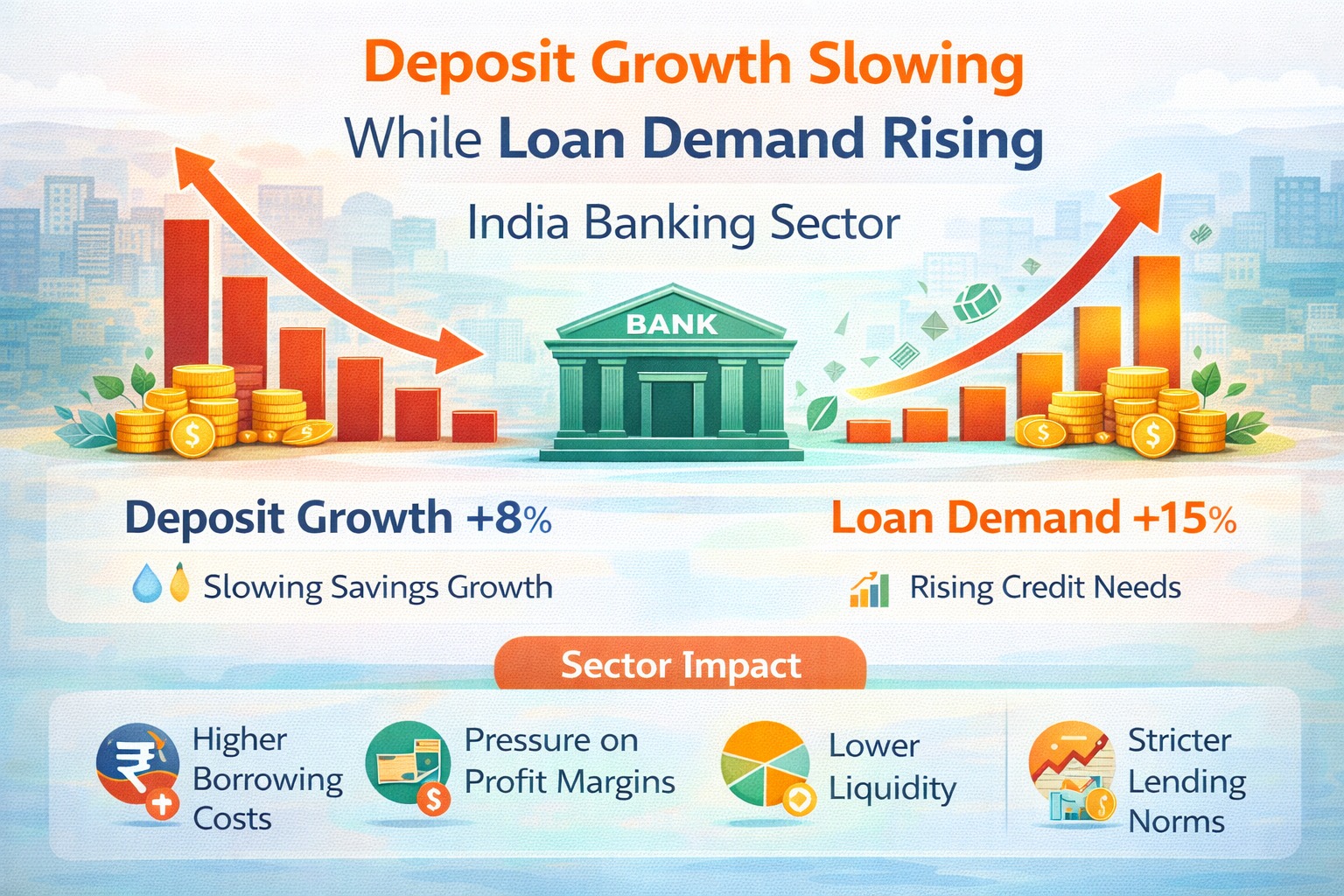
India’s banking sector is currently facing an unusual trend. While loan demand continues to grow strongly, the growth of bank deposits has slowed in recent months. This imbalance between lending and deposits is attracting attention from policymakers, investors, and financial analysts.
Banks rely on deposits as their primary source of funds for lending. When deposits grow slower than loans, banks may face liquidity challenges and may need to adjust interest rates or lending strategies.
Understanding the reasons behind this trend helps explain current developments in the Indian banking system.
AI Answer Box
Why is deposit growth slowing in India while loans are rising?
Consumers are investing more in mutual funds and equities
Rising consumption is reducing household savings
Banks are lending aggressively due to strong credit demand
Corporate borrowing has increased
Interest rate competition is affecting deposit mobilization
These factors are creating a gap between deposits and loan growth.
Loan Demand Is Growing Rapidly
Loan demand in India has been rising steadily across multiple sectors.
Key drivers of credit growth include:
housing loans
vehicle financing
personal loans
infrastructure projects
corporate borrowing
Strong economic activity and consumer spending have encouraged banks to expand lending.
Deposit Growth Is Slowing
Despite strong credit demand, deposit growth has not kept pace with lending.
Several factors are contributing to slower deposit growth.
Shift Toward Investment Products
Many investors are moving funds from traditional bank deposits to market-linked investments such as:
mutual funds
stocks
bonds
These investment options sometimes offer higher returns than fixed deposits.
Rising Consumer Spending
Higher spending on travel, lifestyle products, and services has reduced household savings.
Lower savings directly affect bank deposit growth.
Competition Among Banks for Deposits
Banks are now competing aggressively to attract deposits by increasing interest rates on fixed deposits.
However, deposit growth still remains slower than loan growth.
Impact on the Credit-Deposit Ratio
The gap between loan growth and deposit growth affects the credit-deposit ratio, an important indicator of banking sector liquidity.
| Indicator | Meaning |
|---|---|
| High Credit-Deposit Ratio | Banks are lending more relative to deposits |
| Low Credit-Deposit Ratio | Banks have higher deposit buffers |
When the ratio becomes too high, banks may face funding pressures.
Role of Monetary Policy
The banking system operates under regulatory oversight from the
Reserve Bank of India.
The central bank closely monitors credit and deposit trends to maintain financial stability.
If liquidity pressures increase, policy actions may include:
encouraging higher deposit rates
adjusting liquidity measures
managing interest rate policy
These steps help maintain balance in the financial system.
How Banks Are Responding
Banks are adopting several strategies to improve deposit growth.
Increasing FD Interest Rates
Many banks are raising fixed deposit rates to attract more savings.
Promoting Digital Banking Products
Banks are encouraging digital savings accounts and investment platforms.
Expanding Customer Base
Banks are focusing on financial inclusion to attract new depositors.
Economic Impact of the Trend
The gap between loan demand and deposit growth can have several economic implications.
Possible effects include:
higher lending rates
increased competition for deposits
tighter credit conditions in the future
Maintaining a healthy balance between deposits and loans is essential for banking sector stability.
Expert Insight
Financial analysts believe strong loan demand reflects robust economic activity. However, sustained imbalance between credit growth and deposits may require banks to adjust their funding strategies.
Key Takeaways
Loan demand in India remains strong across sectors
Deposit growth is slowing due to shifting investment preferences
The credit-deposit ratio is rising in the banking system
Banks are increasing deposit rates to attract funds
Policymakers are monitoring liquidity conditions closely
FAQs
1. Why is loan demand increasing in India?
Economic growth and consumer spending are driving credit demand.
2. Why are bank deposits growing slowly?
Investors are shifting funds toward mutual funds and equities.
3. What is the credit-deposit ratio?
It measures the relationship between bank loans and deposits.
4. Why is deposit growth important for banks?
Deposits are the primary source of funds for lending.
5. Can banks increase deposit interest rates?
Yes, banks may raise rates to attract more deposits.
6. Does strong loan demand benefit banks?
Yes, but only if funding sources remain stable.
7. Can slower deposit growth affect lending?
Yes, banks may become cautious if funding becomes limited.
8. What role does the central bank play?
It monitors liquidity and ensures financial stability.
9. Are fixed deposits still popular?
Yes, but competition from other investments is increasing.
10. Will deposit growth improve in the future?
It may improve if banks offer better returns and savings increase.
Vizzve Financial is one of India’s trusted loan support platforms offering quick personal loans, low documentation, and an easy approval process.
Apply today at www.vizzve.com
Fast approval. Transparent process. Easy documentation.
Published on : 9th March
Published by : SMITA
www.vizzve.com || www.vizzveservices.com
Follow us on social media: Facebook || Linkedin || Instagram
🛡 Powered by Vizzve Financial
RBI-Registered Loan Partner | 10 Lakh+ Customers | ₹600 Cr+ Disbursed