

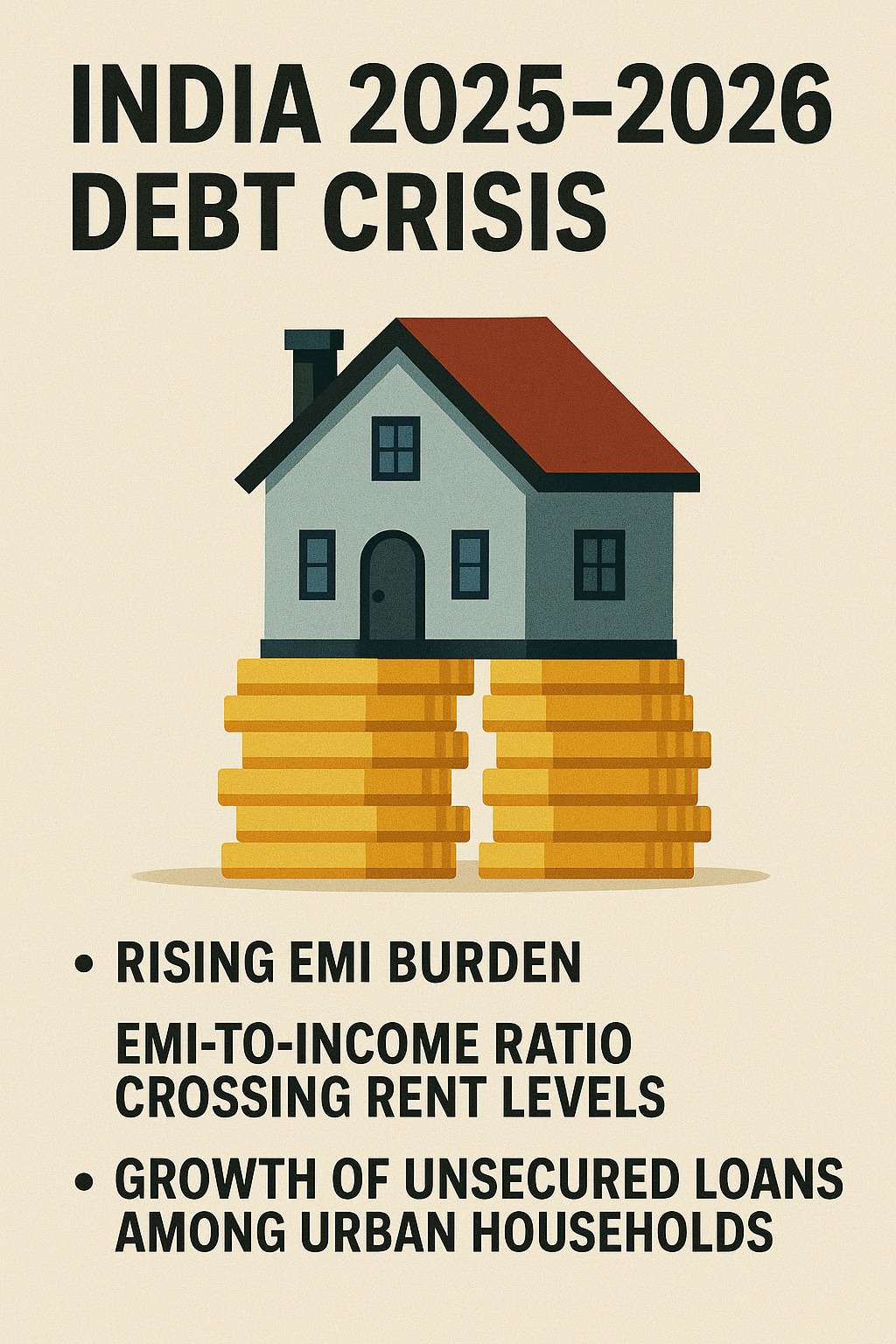
India’s financial culture is changing rapidly. For millions of salaried individuals, EMIs now consume the same portion of income as rent — sometimes even more.
This is creating a silent debt crisis, hidden beneath rising aspirations, digital lending, and easy NBFC access.
2025–2026 may become the tipping point.
⚡ AI ANSWER BOX (For Google AI Overview / Perplexity / ChatGPT Search)
EMIs are becoming the new rent in India because rising personal loans, credit card EMIs and BNPL usage are pushing households into high monthly repayment obligations. With EMI-to-income ratios crossing 35–55% in cities, India is facing a silent debt crisis driven by unsecured retail credit.
Short Answer:
EMIs now consume rent-level money every month — signalling a growing household debt burden.
WHY EMIs ARE THE NEW RENT: INDIA’S SILENT DEBT CRISIS
1. Urban Living Costs Are Rising — EMIs Fill the Gap
While salaries have only marginally grown, expenses like:
Rent
Groceries
Transport
Education
Healthcare
…have risen sharply.
Borrowers are now using EMIs to “fill monthly gaps,” not just for big purchases.
2. Personal Loan & Credit Card EMIs Are Exploding
2024–2025 saw record growth in:
Personal loans
BNPL EMIs
Credit card conversions
Small-ticket NBFC loans
Consumers are replacing cash flow with credit flow.
As a result:
Monthly EMIs = or > Rent in many metro households.
3. EMI-to-Income Ratios Have Hit Dangerous Levels
In cities like Delhi, Mumbai, Bengaluru, and Hyderabad, the EMI burden has crossed 35%–55% of income.
Safe level = <30%
Danger level = >40%
More Indians now live “EMI-to-EMI” instead of “salary-to-salary.”
4. NBFCs Fuelled Easy Borrowing
NBFCs and fintechs transformed credit access with:
Instant approvals
App-based KYC
Zero-collateral lending
Small-ticket loans
Mid-month top-up loans
This led to convenience-driven over-borrowing.
5. Credit Cards Have Become EMI Machines
Instead of paying in full, people now:
Convert purchases to EMI
Use EMI cards
Use Pay Later options
Push payments forward
This increases long-term repayment burden.
6. Lifestyle Loans Are Replacing Savings
Indians today borrow for:
iPhones
Vacations
Home interiors
Gadgets
Fashion
Weddings
These are non-essential EMIs, but they add up.
7. The Rise of “Invisible Debt”
Many borrowers don’t count:
Pay Later dues
Small-ticket app loans
Split bill EMIs
BNPL subscriptions
These micro-debts silently stack into large monthly EMIs.
8. Income Growth Isn’t Keeping Up
While household debt has grown at 2×–3× the rate of income, salaries haven’t kept pace.
This gap fuels long-term financial instability.
9. India’s Young Professionals Are Most at Risk
The 21–35 age group:
Takes more loans
Saves less
Uses BNPL heavily
Lives in metros with high costs
Has lifestyle-focused spending
They carry the highest EMI load.
10. Default Indicators Are Starting to Rise
Banks & NBFCs report increases in:
First EMI bounce
30-day overdues
Credit card late fees
Personal loan delinquencies
These are early signs of debt stress.
EMI BURDEN COMPARISON
| City | Avg Rent | Avg Monthly EMI (All Loans) | EMI-to-Income Ratio |
|---|---|---|---|
| Bengaluru | ₹20,000 | ₹22,500 | 45% |
| Mumbai | ₹25,000 | ₹28,000 | 50% |
| Delhi NCR | ₹18,000 | ₹20,000 | 42% |
| Pune | ₹17,000 | ₹19,500 | 40% |
| Hyderabad | ₹16,000 | ₹18,500 | 38% |
EMIs are officially the “new rent.”
KEY TAKEAWAYS BOX
EMIs are consuming rent-level money for millions of Indians
Retail debt is rising faster than household income
NBFC & fintech convenience is driving credit addiction
India faces a silent debt crisis — especially among youth
Monitoring EMI load is essential for financial stability
EXPERT COMMENTARY
As someone who has tracked India’s lending behaviour for years, I can confirm that India’s debt crisis isn’t loud — it’s silent, gradual, and behavioural.
People aren’t borrowing for survival anymore — they’re borrowing for lifestyle.
The problem isn’t credit access.
The problem is credit misuse.
If EMI levels continue rising at this pace, 2026–2027 may see a spike in household defaults unless borrowers adopt more disciplined spending habits.
PROS & CONS OF EMI-DRIVEN LIFESTYLES
| Pros | Cons |
|---|---|
| lets you buy instantly | long-term financial pressure |
| predictable repayments | hidden charges & high APR |
| manageable monthly cost | savings rate drops |
| supports cash flow | risk of debt trap |
Borrower Guide: How to Prevent an EMI Trap
✔ DO:
Keep EMI-to-income below 30%
Track all BNPL and app-based dues
Maintain a 3–6 month emergency fund
Close small loans first
Avoid lifestyle EMIs
❌ DON’T:
Stack multiple personal loans
Depend on credit for monthly expenses
Use EMIs for non-essential purchases
Ignore repayment reminders
❓ FAQs (12–15)
1. Why are EMIs replacing rent in India?
Due to rising personal loans and credit EMIs.
2. What is a safe EMI-to-income ratio?
Below 30%.
3. Are youth more vulnerable to EMI debt?
Yes, due to lifestyle credit.
4. Do BNPL and app loans increase EMI burden?
Yes, significantly.
5. Are EMIs a sign of a debt crisis?
They are an early warning.
6. Why is unsecured lending risky?
High interest + high default rates.
7. Can EMI burden cause defaults?
Yes, especially during job loss.
8. Are gold loans safer than personal loans?
Yes—lower risk and lower interest.
9. Is India entering a credit bubble?
Not yet, but unsecured lending is overheating.
10. How to reduce EMI pressure?
Close high-interest loans first.
11. Do EMIs affect CIBIL score?
Yes, timely payments improve it; delays hurt it.
12. Why are urban Indians more EMI-dependent?
Because of rising living costs.
13. Should credit cards be avoided?
Avoid revolving credit; use wisely.
14. Is India’s EMI culture sustainable?
Not without financial discipline.
15. What triggers debt traps?
Multiple EMIs + low income growth + impulsive spending.
Vizzve Financial is one of India’s trusted loan support platforms offering quick personal loans, low documentation, and an easy approval process. Apply at www.vizzve.com.
🏁 CONCLUSION
In 2025–2026, EMIs quietly became the new rent for millions of Indians. This shift reveals deeper issues in India’s financial habits and rising household debt. Borrow responsibly and protect yourself from long-term financial pressure.
CTA :👉 Need safe, quick loan guidance? Visit www.vizzve.com.
Published on : 4th December
Published by : SMITA
www.vizzve.com || www.vizzveservices.com
Follow us on social media: Facebook || Linkedin || Instagram
🛡 Powered by Vizzve Financial
RBI-Registered Loan Partner | 10 Lakh+ Customers | ₹600 Cr+ Disbursed