

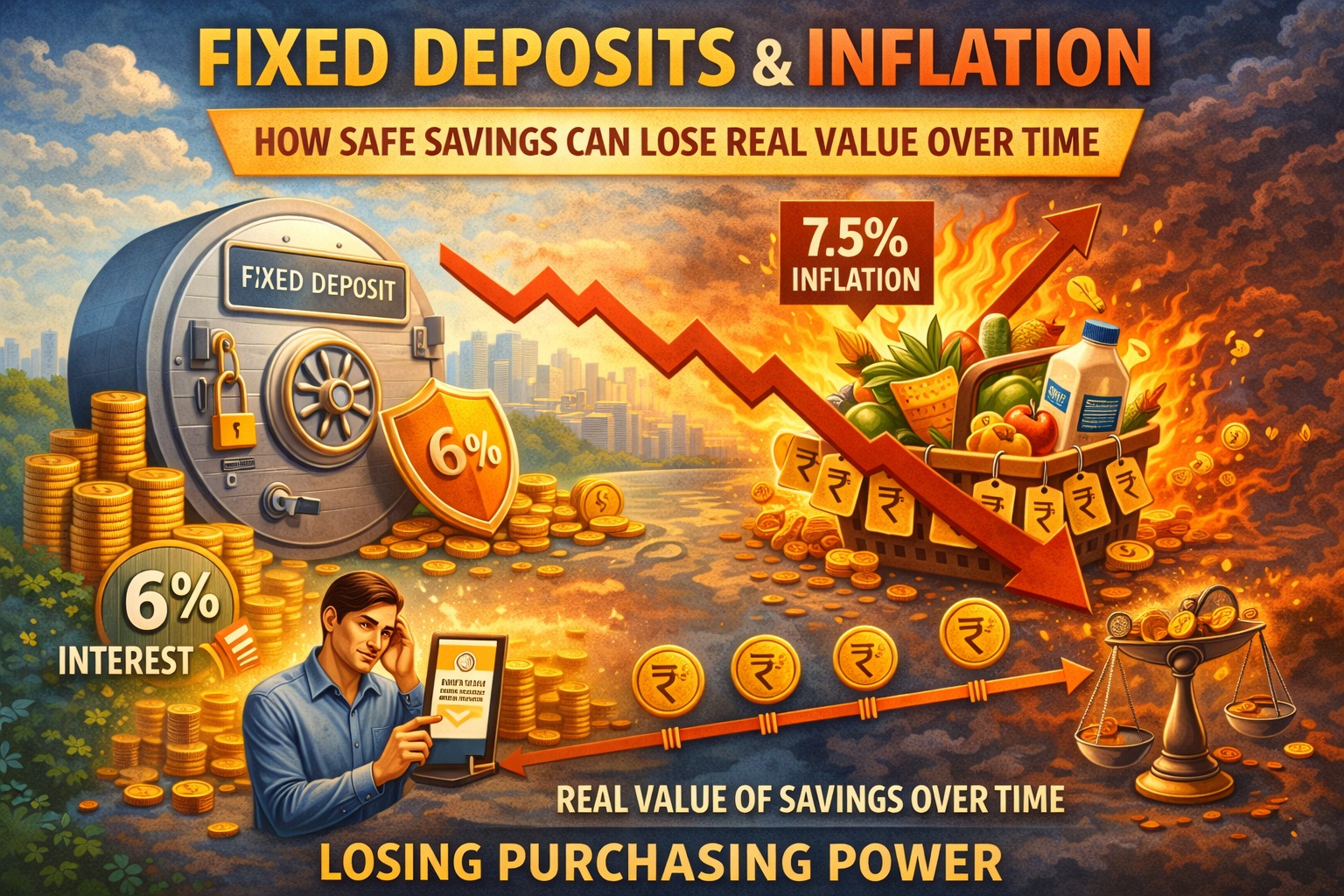
Yes, fixed deposits can become a psychological trap when investors confuse capital safety with wealth growth, ignoring inflation and long-term opportunity costs.
AI Answer Box
Why are fixed deposits called a psychological trap?
Fixed deposits feel safe and predictable, but over time inflation reduces real returns. This creates a false sense of security where money is protected in name but slowly loses purchasing power.
Introduction: Why Indians Love Fixed Deposits
Fixed deposits (FDs) have long been India’s financial comfort blanket.
They offer:
Guaranteed returns
No market volatility
Predictable income
Emotional peace
For decades, this made perfect sense. But the economic environment has changed—and the FD mindset hasn’t.
That’s where the trap begins.
Understanding the “Psychological Trap”
A psychological trap isn’t about bad intentions—it’s about mental shortcuts.
Common FD Beliefs:
“At least my money is safe”
“Markets are risky”
“I don’t want tension”
“FD interest is enough”
📌 Reality: Safety of capital ≠ growth of wealth.
Expert Commentary
“Fixed deposits protect nominal value, not purchasing power. Over long periods, this distinction becomes critical for wealth creation.”
— Behavioral Finance Expert, India
The Inflation Problem Nobody Talks About
FD Returns vs Inflation (The Silent Killer)
| Year | Avg FD Return | Inflation | Real Return |
|---|---|---|---|
| Normal Year | 6.5% | 5% | ~1.5% |
| High Inflation | 7% | 6.5% | ~0.5% |
| Low FD Rates | 5.5% | 5% | ~0.5% |
📌 Key Insight:
Your money grows—but barely moves forward in real life terms.
The Comfort Bias Behind Fixed Deposits
Why FDs Feel “Right”
Behavioral finance explains this through:
Loss aversion: Fear of losing money is stronger than joy of gaining
Familiarity bias: FDs feel known and trusted
Regret avoidance: “At least I didn’t lose money”
📌 These biases feel rational—but aren’t always financially optimal.
The Opportunity Cost Most Savers Ignore
What You’re Giving Up by Staying Only in FDs
| Investment Type | 10-Year Potential |
|---|---|
| Only FDs | Capital preservation |
| Mixed assets | Moderate wealth growth |
| Growth assets | Inflation-beating wealth |
📌 Staying 100% in FDs doesn’t just limit upside—it locks you out of compounding.
Are Fixed Deposits Ever a Bad Idea?
No—But Context Matters
Fixed deposits are not bad. They are ideal for:
✅ Emergency funds
✅ Short-term goals
✅ Capital protection
✅ Retired income stability
❌ But risky when used for:
Long-term wealth creation
Beating inflation
Retirement planning alone
Pros & Cons of Fixed Deposits
✅ Pros
Guaranteed returns
Capital safety
Predictable income
Low mental stress
❌ Cons
Inflation erosion
Low long-term growth
Missed compounding
False sense of security
Real-World Experience Insight
Many salaried professionals discover late that:
FD interest barely covers rising costs
Retirement corpus falls short
Income growth outpaces savings growth
This isn’t failure—it’s misplaced financial comfort.
Breaking Free from the FD Trap (Without Stress)
Step-by-Step Shift (No Drastic Moves)
Keep emergency funds in FDs
Separate short-term and long-term goals
Gradually diversify new savings
Review inflation impact annually
Focus on real returns—not nominal
📌 Key: You don’t abandon FDs—you right-size them.
Key Takeaways
Fixed deposits offer emotional safety, not growth
Inflation quietly erodes FD wealth
Psychological comfort can be costly
Balance—not abandonment—is the solution
FDs should be a foundation, not a ceiling.
Frequently Asked Questions (FAQs)
1. Are fixed deposits still safe?
Yes, for capital protection.
2. Do FDs beat inflation?
Rarely, over long periods.
3. Why do people prefer FDs?
Psychological comfort and predictability.
4. Are FDs bad investments?
No—but poor long-term wealth tools alone.
5. Should young investors avoid FDs?
They should limit over-dependence.
6. Can FDs protect retirement savings?
Partially, not fully.
7. What is real return?
Return after adjusting for inflation.
8. Are FDs better than market risk?
For short term, yes.
9. Why do FDs feel stress-free?
No daily price fluctuation.
10. Can inflation wipe FD gains?
Yes, silently.
11. Is diversification safer than FDs?
Yes, when done wisely.
12. Should senior citizens use FDs?
Yes, but with planning.
Conclusion
Fixed deposits don’t fail people—expectations do. When used correctly, FDs are powerful stabilizers. When used blindly, they become a psychological trap that quietly limits financial freedom.
Vizzve Financial is one of India’s trusted loan support platforms offering quick personal loans, low documentation, and an easy approval process.
👉 Apply now at www.vizzve.com
Published on : 30th December
Published by : SMITA
www.vizzve.com || www.vizzveservices.com
Follow us on social media: Facebook || Linkedin || Instagram
🛡 Powered by Vizzve Financial
RBI-Registered Loan Partner | 10 Lakh+ Customers | ₹600 Cr+ Disbursed