

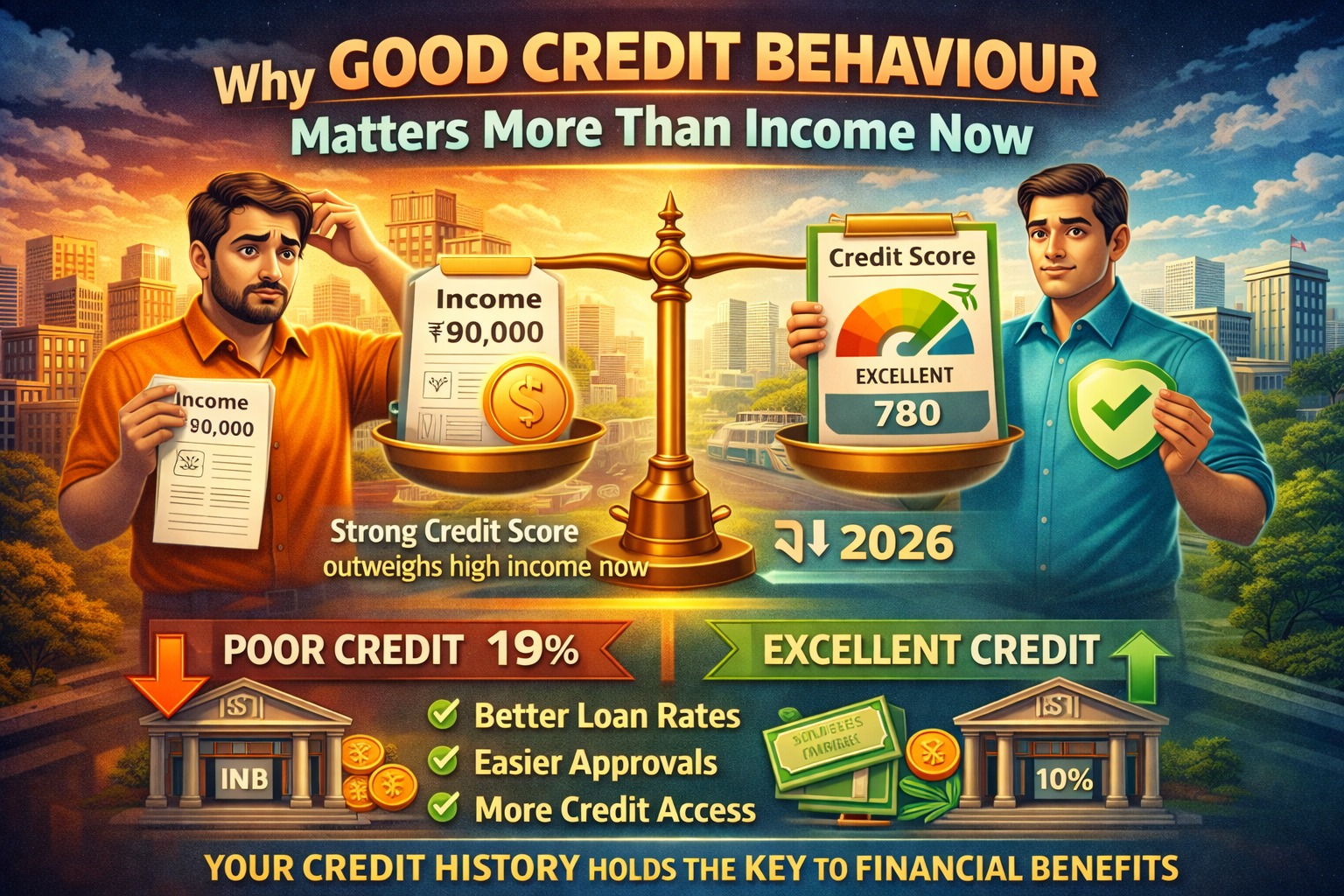
In today’s lending environment, good credit behaviour matters more than income because lenders prioritize repayment discipline, credit history, and risk control over just how much you earn.
AI Answer Box
Why credit behaviour matters more than income:
Shows repayment reliability
Reduces lender risk
Improves loan approval chances
Lowers interest rates
Protects long-term financial access
Introduction
There was a time when a high salary almost guaranteed easy loan approval. That reality has changed. In 2026, lenders are far more cautious, data-driven, and focused on how you handle credit—not just how much you earn.
A borrower earning ₹40,000 with perfect credit behaviour can often get better loan terms than someone earning ₹1 lakh with poor repayment habits. Here’s why this shift is happening—and what it means for you.
What Is Credit Behaviour?
Credit behaviour refers to how responsibly you use and repay borrowed money over time.
Key Elements of Credit Behaviour:
Timely EMI and credit card payments
Credit utilization ratio
Number of active loans
Frequency of loan applications
Length and consistency of credit history
These factors together form your credit score and credit profile.
Why Income Alone Is No Longer Enough
1️⃣ Rising Loan Defaults
High-income borrowers are defaulting too—often due to:
Lifestyle inflation
Multiple EMIs
Overuse of credit cards
Income does not guarantee repayment discipline.
2️⃣ Data-Driven Lending Models
Banks and NBFCs now rely on:
Credit bureau data
Repayment patterns
Behavioural scoring models
These tools predict future repayment ability better than salary slips.
3️⃣ Regulatory & Risk Focus
The Reserve Bank of India has consistently emphasized:
Responsible lending
Risk-based pricing
Borrower behaviour monitoring
This has pushed lenders to reward good credit behaviour over high income.
Credit Behaviour vs Income: Real Comparison
| Factor | High Income, Poor Credit | Moderate Income, Good Credit |
|---|---|---|
| Loan Approval | Difficult | Easier |
| Interest Rate | Higher | Lower |
| EMI Flexibility | Limited | Better |
| Trust Level | Low | High |
| Long-Term Access | Weak | Strong |
How Good Credit Behaviour Benefits You
✅ Faster Loan Approvals
Clean credit history speeds up underwriting.
✅ Lower Interest Rates
Better scores = lower risk = cheaper loans.
✅ Higher Loan Eligibility
Lenders are willing to extend more credit responsibly.
✅ Financial Resilience
Good behaviour protects you during income shocks.
Common Credit Behaviour Mistakes
Paying only minimum credit card dues
Missing EMIs by a few days
Applying for multiple loans at once
Maxing out credit limits
Ignoring small overdue amounts
These actions damage trust—even if income is high.
How to Build Strong Credit Behaviour (Step-by-Step)
Pay all EMIs and bills on time
Keep credit card usage below 30%
Avoid unnecessary loan applications
Close unused credit lines responsibly
Monitor your credit report regularly
Consistency matters more than perfection.
Real-World Credit Insight
From real loan assessment experience, lenders increasingly reject high-income applicants with unstable credit behaviour, while approving lower-income borrowers with clean repayment records. Credit behaviour reflects financial discipline, which is the strongest predictor of repayment success.
Pros & Cons of Behaviour-Based Lending
✅ Pros
Fairer loan access
Encourages discipline
Reduces debt stress
❌ Cons
Past mistakes take time to correct
Limited flexibility for new borrowers
Key Takeaways
Income shows capacity; behaviour shows reliability
Credit behaviour now drives loan decisions
Good habits beat high salary in lending
Discipline today protects future borrowing
Frequently Asked Questions (FAQs)
1. Does income still matter for loans?
Yes, but less than credit behaviour.
2. Can low-income borrowers get loans easily?
Yes, with strong credit behaviour.
3. What matters more: salary or credit score?
Credit score and repayment history.
4. Can one missed EMI hurt loan chances?
Yes, especially recent defaults.
5. Do lenders check spending behaviour?
Indirectly, through credit data.
6. Is credit behaviour more important for personal loans?
Yes, because they are unsecured.
7. How long does it take to improve credit behaviour?
3–12 months with discipline.
8. Does prepaying loans help credit score?
Yes, if done properly.
9. Are credit cards bad for behaviour?
No, misuse is the problem.
10. Can RBI rules affect this trend?
Yes, RBI encourages risk-based lending.
11. Do NBFCs value behaviour too?
Yes, increasingly.
12. Is credit behaviour important even without loans?
Yes, it builds future eligibility.
Conclusion + CTA
In today’s financial system, how you borrow matters more than how much you earn. Good credit behaviour reflects discipline, responsibility, and reliability—qualities lenders trust far more than income figures.
Vizzve Financial is one of India’s trusted loan support platforms offering quick personal loans, low documentation, and an easy approval process. Apply at www.vizzve.com.
Published on : 7th January
Published by : SMITA
www.vizzve.com || www.vizzveservices.com
Follow us on social media: Facebook || Linkedin || Instagram
🛡 Powered by Vizzve Financial
RBI-Registered Loan Partner | 10 Lakh+ Customers | ₹600 Cr+ Disbursed