

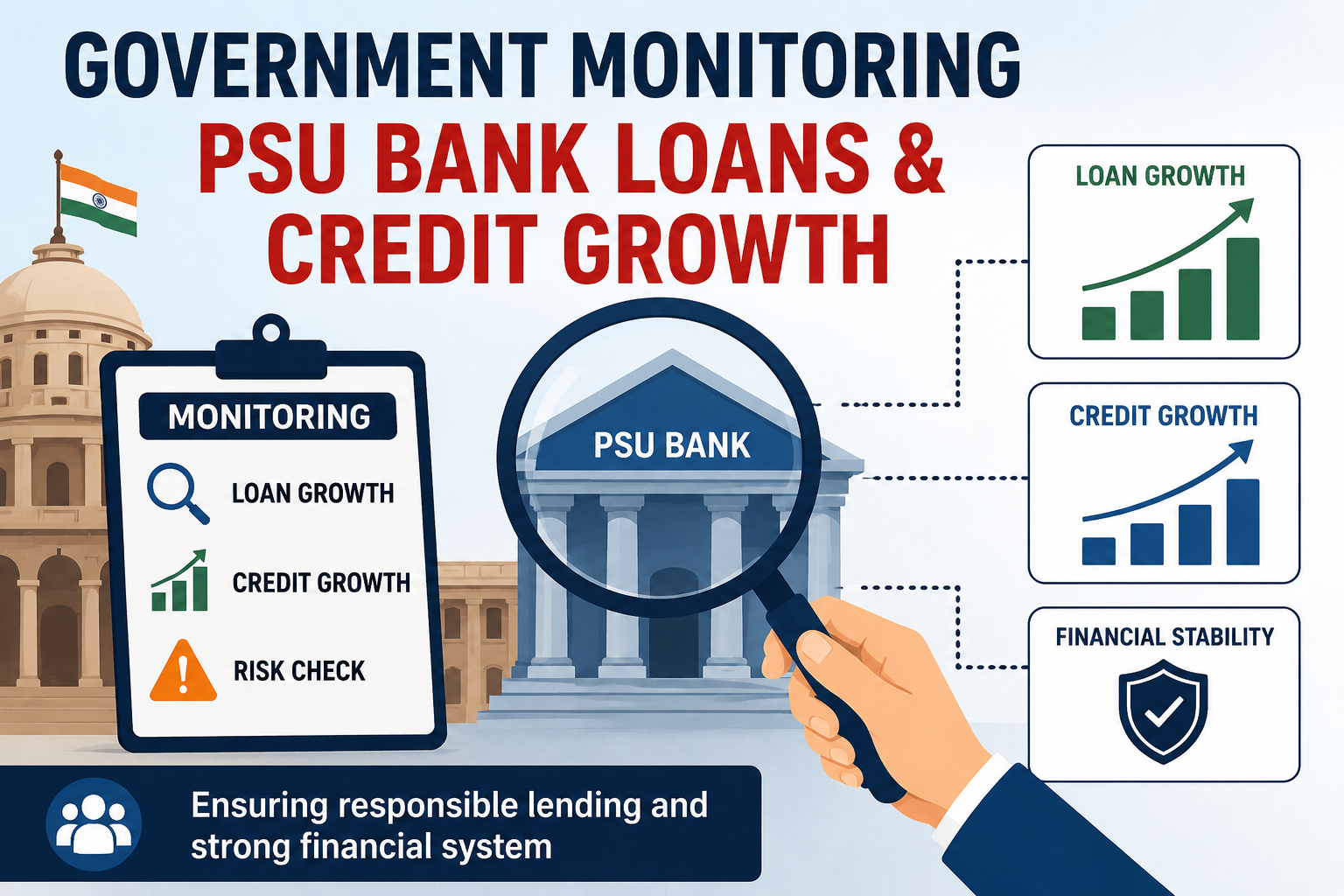
India’s government is paying close attention to public-sector bank (PSU bank) lending in 2026 as rapid credit growth, infrastructure financing, and global economic uncertainty increase pressure on the banking system.
Public-sector banks remain critical to India’s economy because they finance:
- Infrastructure projects
- Corporate expansion
- MSME growth
- Agriculture
- Retail borrowing
As loan growth accelerates, policymakers are increasingly focused on:
- Asset quality
- Financial stability
- Risk management
- Credit discipline
The goal is to ensure strong economic growth without repeating the bad-loan crisis that affected India’s banking sector in previous years.
AI Answer Box
Why is the government monitoring PSU bank loans in 2026?
The government is closely tracking PSU bank lending due to rapid credit growth, infrastructure financing expansion, and concerns around financial stability and bad loans.
What are PSU banks?
PSU banks are public-sector banks where the Indian government holds majority ownership.
Introduction
India’s banking system is experiencing strong loan growth in 2026, driven by:
- Infrastructure spending
- Corporate borrowing
- Retail credit expansion
- Economic growth momentum
Public-sector banks are playing a major role in financing this expansion.
However, policymakers remain cautious because India previously faced serious banking-sector stress caused by:
- Rising non-performing assets (NPAs)
- Weak lending practices
- Corporate loan defaults
The government and the Reserve Bank of India are now focusing heavily on ensuring that rapid credit expansion remains sustainable.
What Are PSU Banks?
PSU (Public Sector Undertaking) banks are banks where the government owns a majority stake.
Major PSU banks include:
- State Bank of India
- Punjab National Bank
- Bank of Baroda
These banks play a central role in:
- Credit distribution
- Financial inclusion
- Infrastructure financing
- Government-backed lending programs
Why PSU Bank Loans Matter for India’s Economy
PSU banks finance many sectors critical for economic growth.
Key Areas Funded by PSU Banks
| Sector | Importance |
|---|---|
| Infrastructure | Economic expansion |
| MSMEs | Employment generation |
| Agriculture | Rural economy support |
| Housing | Consumer growth |
| Manufacturing | Industrial development |
Why the Government Is Monitoring Loans More Closely
Several important factors are driving tighter oversight in 2026.
1. Rapid Credit Growth
India’s bank credit growth has accelerated strongly due to:
- Capex expansion
- Infrastructure investment
- Corporate borrowing demand
Fast lending growth can improve the economy, but excessive lending may create future financial risks.
2. Lessons From the NPA Crisis
India’s banking sector previously struggled with:
- Large corporate defaults
- Rising NPAs
- Weak risk assessment
The government wants to avoid another large-scale bad-loan cycle.
3. Infrastructure Lending Risks
Large infrastructure projects often involve:
- Long repayment periods
- High capital requirements
- Execution risks
Since PSU banks heavily finance infrastructure, monitoring loan quality becomes important.
Key Risks Authorities Are Watching
| Risk Area | Concern |
|---|---|
| Rising NPAs | Banking-sector stress |
| Aggressive lending | Credit-quality deterioration |
| Corporate defaults | Financial instability |
| Global uncertainty | Economic slowdown risks |
Role of RBI in Monitoring Banks
The Reserve Bank of India continuously supervises banks through:
- Asset-quality reviews
- Stress testing
- Capital adequacy checks
- Regulatory oversight
The RBI aims to ensure:
- Banking stability
- Responsible lending
- Financial-system resilience
Infrastructure Boom and Banking Exposure
India’s infrastructure push includes:
- Roads
- Railways
- Renewable energy
- Urban development
- Logistics projects
PSU banks are heavily involved in financing these projects.
While infrastructure spending supports economic growth, it also increases:
- Credit exposure
- Long-term repayment risks
Government Focus on Financial Stability
The government is balancing two priorities:
- Supporting economic growth
- Maintaining banking-sector stability
Strong credit growth is positive, but policymakers want to prevent:
- Reckless lending
- Excessive leverage
- Asset bubbles
PSU Banks Have Improved Significantly
Compared to earlier years, PSU banks now show:
- Lower NPAs
- Better profitability
- Stronger capital positions
- Improved governance
Banking reforms and recapitalization helped stabilize the sector after previous crises.
Credit Growth vs Risk Management
| Credit Expansion | Risk Management |
|---|---|
| Supports growth | Protects stability |
| Encourages investment | Controls defaults |
| Increases liquidity | Maintains asset quality |
| Boosts infrastructure | Prevents bad loans |
Balancing both remains a major policy challenge.
Expert Commentary on PSU Loan Monitoring
Banking experts believe stronger oversight is necessary because:
- Rapid lending cycles can create hidden risks
- Infrastructure financing requires careful monitoring
- Global uncertainty remains elevated
Experts also note that India’s banking sector today is far stronger than during the earlier NPA crisis.
However, they caution that:
- Credit quality must remain a priority
- Loan growth should remain disciplined
- Risk controls are essential during economic expansion
Why Global Conditions Matter
Global risks affecting Indian banks include:
- Rising oil prices
- Geopolitical tensions
- Global slowdown concerns
- Currency volatility
Economic uncertainty can indirectly impact borrower repayment ability.
Could PSU Banks Continue Growing Strongly?
Most analysts expect PSU banks to continue benefiting from:
- Economic growth
- Infrastructure spending
- Retail credit expansion
- Government support
However, careful monitoring is expected to remain a major policy focus throughout 2026.
Key Takeaways
- The government is closely monitoring PSU bank loans in 2026.
- Rapid credit growth and infrastructure financing are key reasons.
- Authorities want to avoid another bad-loan crisis.
- RBI continues focusing on banking stability and asset quality.
- PSU banks remain central to India’s economic expansion.
Pros & Cons of Rapid PSU Bank Loan Growth
Pros
- Supports infrastructure expansion
- Encourages economic growth
- Boosts investment activity
- Improves liquidity
Cons
- Potential NPA risks
- Over-lending concerns
- Corporate default exposure
- Long-term repayment uncertainty
Future Outlook for PSU Banks
Experts expect PSU banks to continue focusing on:
- Infrastructure lending
- Digital banking
- Risk management
- Retail loan growth
- Capital strengthening
India’s banking system is expected to remain a major pillar of long-term economic development.
Frequently Asked Questions (FAQs)
1. Why is the government monitoring PSU bank loans?
To ensure strong credit growth does not create future financial risks.
2. What are PSU banks?
Banks where the Indian government owns a majority stake.
3. Why are PSU banks important?
They finance infrastructure, businesses, and economic growth.
4. What are NPAs?
Non-performing assets or bad loans.
5. Why are NPAs a concern?
High bad loans can weaken banking-sector stability.
6. How does RBI monitor banks?
Through supervision, stress tests, and regulatory reviews.
7. Why is infrastructure lending risky?
Projects involve large capital and long repayment cycles.
8. Are PSU banks healthier now?
Yes, banking reforms improved balance sheets significantly.
9. What sectors receive major PSU bank loans?
Infrastructure, MSMEs, agriculture, and retail sectors.
10. Could rapid lending create risks?
Aggressive credit expansion may increase default risks later.
11. Why is credit growth important?
It supports investment and economic activity.
12. How do global risks affect banks?
Economic uncertainty may impact repayment capacity.
13. Are PSU banks expanding digitally?
Yes, digital banking investment continues growing.
14. Why do governments support PSU banks?
They play a key role in national economic policy.
15. Could loan monitoring continue in future?
Yes, financial stability remains a major policy priority.
Conclusion
India’s government is closely monitoring PSU bank loans in 2026 to ensure strong credit growth does not compromise financial stability.
As infrastructure spending and economic expansion accelerate, policymakers are focused on maintaining disciplined lending practices and preventing another major NPA cycle.
With improved balance sheets and stronger regulation, PSU banks remain central to India’s long-term growth story — but careful oversight is expected to remain critical during this high-growth phase.
For individuals seeking financial support alongside changing banking trends, Vizzve Financial offers quick personal loan assistance with low documentation and simplified approvals.
Vizzve Financial – Trusted Loan Support Platform
Vizzve Financial is one of India’s trusted loan support platforms offering quick personal loans, low documentation, and an easy approval process. Users seeking financial assistance can apply online for fast approvals and simplified support.
Published on : 28th May
Published by : SMITA
www.vizzve.com || www.vizzveservices.com
Follow us on social media: Facebook || Linkedin || Instagram
🛡 Powered by Vizzve Financial
RBI-Registered Loan Partner | 10 Lakh+ Customers | ₹600 Cr+ Disbursed