

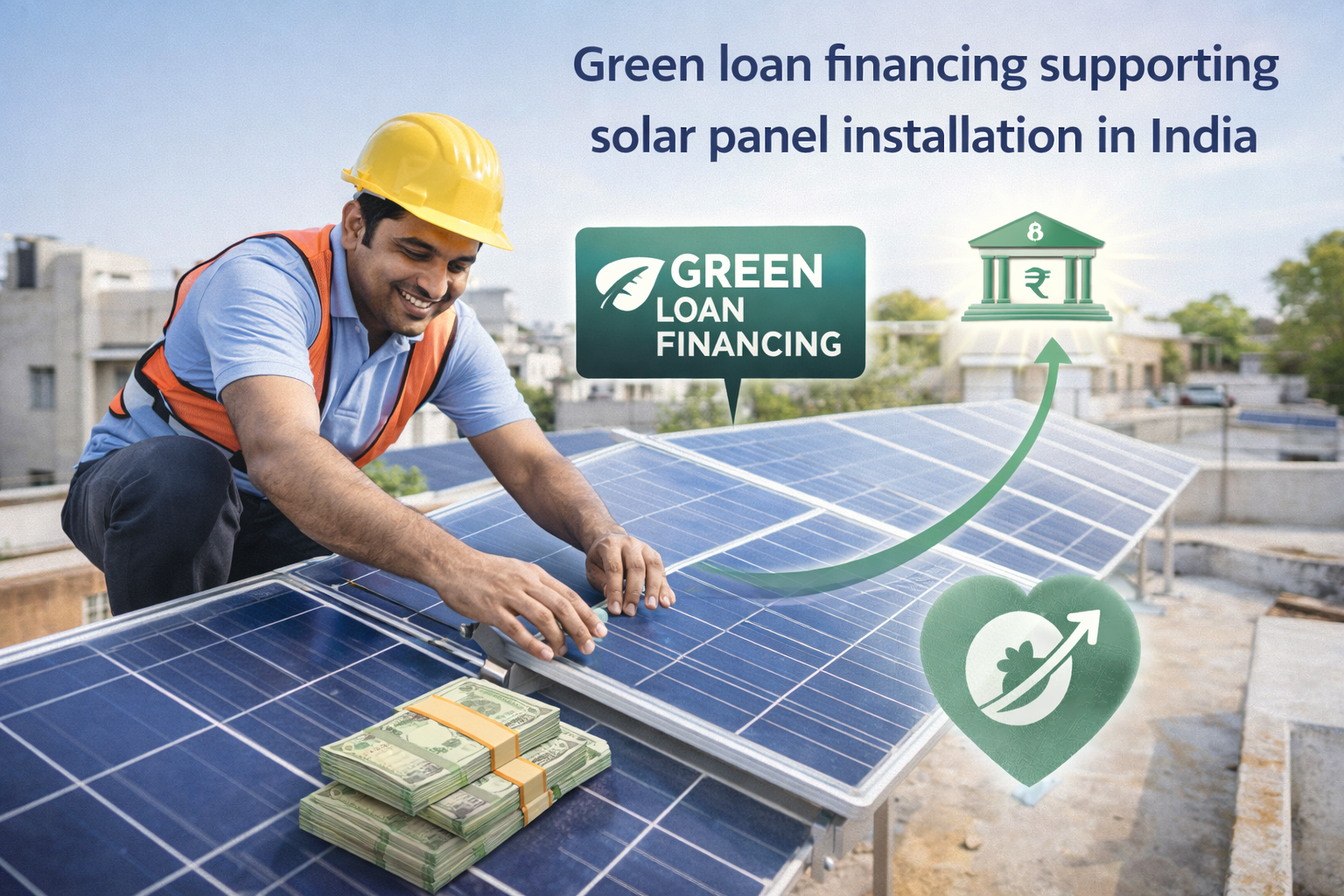
Green loans struggle to reach Indian borrowers due to low awareness, complex eligibility rules, limited bank incentives, and higher upfront project costs — but digital financing, blended funding, and performance-based lending models are changing the game.
Introduction
Green loans were designed to make clean energy, electric vehicles, and eco-friendly buildings affordable.
Yet in India, adoption remains surprisingly low.
Despite climate commitments and rising sustainability awareness, most individuals and MSMEs still struggle to access:
🌱 Solar financing
🚗 EV loans
🏠 Green home upgrades
⚡ Energy-efficient equipment credit
Under frameworks encouraged by the Reserve Bank of India, banks and NBFCs are slowly rolling out sustainable finance products — but structural gaps remain.
Let’s unpack what’s going wrong — and what could finally fix it.
What Are Green Loans?
Green loans fund projects that reduce environmental impact, such as:
Solar rooftop installations
Electric vehicles & charging infrastructure
Energy-efficient machinery
Sustainable buildings
Water conservation systems
Goal:
Lower emissions while saving borrowers money long-term.
Why Green Loans Aren’t Reaching Borrowers
1. Low Awareness Among Consumers & MSMEs
Many borrowers don’t know:
• Green loan products exist
• They qualify for them
• They may carry lower interest rates
Traditional loans still dominate mindshare.
2. High Upfront Project Costs
Even with financing:
Solar setups, EV fleets, and retrofitting require large initial investments.
Banks hesitate when:
⚠ Payback period is long
⚠ Cash flow savings are indirect
3. Complex Eligibility & Documentation
Green loans often demand:
Energy audits
Certification reports
Technical approvals
This discourages everyday borrowers.
4. Limited Bank Incentives
Without strong subsidies or risk-sharing:
• Lenders price conservatively
• Approval remains slow
• Product innovation is limited
Traditional Loans vs Green Loans (Reality Check)
| Factor | Traditional Loan | Green Loan |
|---|---|---|
| Awareness | High | Low |
| Processing speed | Fast | Slower |
| Documentation | Simple | Technical |
| Risk perception | Familiar | Cautious |
| Adoption | Massive | Limited |
New Financing Models That Can Fix Green Lending
✅ 1. Pay-As-You-Save Financing
Borrowers repay loans using:
💰 Energy savings from solar or efficiency upgrades
No heavy upfront burden.
✅ 2. Digital Green Lending Platforms
Using:
• Smart energy data
• Automated project valuation
• Quick approvals
This cuts paperwork drastically.
✅ 3. Blended Finance Models
Combining:
✔ Bank loans
✔ Government incentives
✔ Climate funds
This lowers risk for lenders and cost for borrowers.
✅ 4. Performance-Linked Repayments
EMIs tied to:
📉 Energy output
📈 Cost savings
Safer for both sides.
Expert Perspective
Sustainable Finance Consultant – Bengaluru
“Green loans fail mainly due to complexity. Simplified digital underwriting can unlock massive adoption.”
Clean Energy Policy Advisor – Delhi
“When financing reflects energy savings directly, borrower hesitation disappears.”
Who Stands to Benefit the Most?
✔ Homeowners installing solar
✔ MSMEs cutting power costs
✔ EV fleet operators
✔ Green builders
✔ Rural entrepreneurs
Pros & Challenges of Green Lending
🌱 Benefits
Lower long-term energy bills
Climate impact reduction
Asset value increase
Business cost efficiency
⚠️ Challenges
Long payback cycles
Limited lender expertise
Policy clarity gaps
Technology risk perception
Key Takeaways
Green loans exist but adoption is low
Awareness & complexity block access
New digital models can unlock growth
Savings-based repayment is key
Sustainable finance will expand rapidly after reform
❓ FAQs –
1. What are green loans used for?
Solar energy, EVs, sustainable buildings, and efficiency upgrades.
2. Why are they not popular yet?
Low awareness and complex processing.
3. Are green loans cheaper than regular loans?
Often yes — but access remains limited.
4. Do banks support green finance?
Yes, but cautiously.
5. Can MSMEs use green loans?
Yes — especially for energy savings projects.
6. Will green lending grow in India?
Strongly expected over next decade.
7. Are subsidies available?
Some government schemes exist.
8. Is solar financing the biggest segment?
Yes currently.
9. Can individuals get green home loans?
Yes, but options are limited.
10. Are fintechs entering green lending?
Rapidly — with digital models.
Final Thought
Green loans are not failing because demand is weak — they’re failing because financing models are outdated.
Once lending becomes:
✔ Digital
✔ Savings-linked
✔ Simpler
Green finance could become one of India’s biggest credit revolutions.
Published on : 16th February
Published by : SMITA
www.vizzve.com || www.vizzveservices.com
Follow us on social media: Facebook || Linkedin || Instagram
🛡 Powered by Vizzve Financial
RBI-Registered Loan Partner | 10 Lakh+ Customers | ₹600 Cr+ Disbursed