

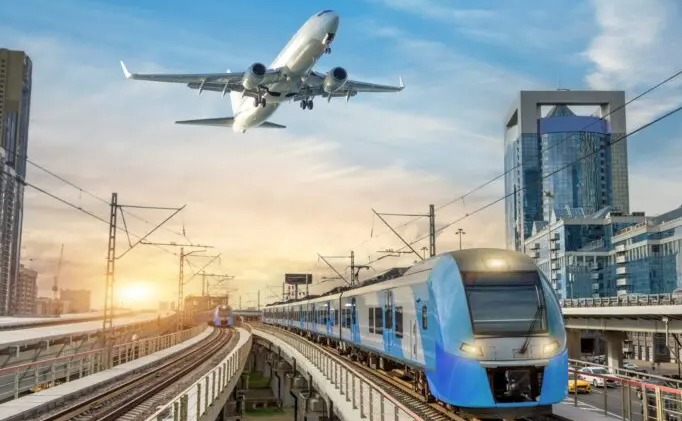
The global race toward sustainability has transformed how we view transportation. Trains, long celebrated as a low-emission mode of travel, are now positioned as a cornerstone of “green mobility.” Meanwhile, the aviation sector is under intense pressure to decarbonize through cleaner fuels and more efficient aircraft.
However, the conversation around transport emissions often stops too early. Focusing solely on the energy efficiency of the vehicle — an electric train or a biofuel-powered jet — misses a critical layer: infrastructure emissions. These hidden carbon costs are embedded in the tracks, tunnels, terminals, airports, and manufacturing processes that make modern travel possible.
The Hidden Carbon Behind Infrastructure
When comparing rail and air travel, it’s tempting to focus only on operational emissions — the CO₂ emitted per passenger per kilometer. By that metric, trains often outperform planes by a wide margin. But to understand true climate impact, we must consider the entire lifecycle.
Construction and Civil Works: Building railways involves extensive use of steel, cement, and concrete — materials with high embodied carbon. Similarly, airports require massive runways, terminals, and access roads, each contributing heavily to emissions long before a single trip takes place.
Embedded and Maintenance Emissions: Regular maintenance of rail lines, signaling systems, and rolling stock adds recurring emissions. In aviation, ongoing airport expansion and maintenance create similar long-term carbon footprints.
Energy Source Dependency: Even an electric train is only as green as the electricity grid powering it. If the grid relies heavily on coal or natural gas, its “clean” reputation diminishes.
Utilization and Efficiency: A high-speed rail line with low passenger occupancy or underused capacity can, paradoxically, emit more per traveler than expected once infrastructure costs are included.
Rail vs Air: A Complex Comparison
1. Per-Passenger Emissions:
Generally, trains emit significantly less CO₂ per passenger-kilometer than planes, especially for short to medium distances. But that comparison assumes high train occupancy, efficient energy use, and minimal construction amortization per trip.
2. Infrastructure Lifespan:
Rail infrastructure has a long lifecycle and can amortize emissions over decades of usage. However, the initial “carbon debt” from building high-speed lines, bridges, and tunnels remains substantial.
3. Aviation’s Persistent Challenges:
Aircraft efficiency has improved, and sustainable aviation fuels (SAFs) are slowly entering the market, but high-altitude effects, contrails, and radiative forcing amplify aviation’s climate footprint far beyond simple CO₂ accounting.
4. Land Use & Ecosystem Impact:
Rail expansion often involves large-scale land modification, tunneling, and deforestation. Airports, too, demand vast tracts of land — but their expansion is usually concentrated around existing hubs, while rail development spreads geographically.
Why ‘Green Tech’ Isn’t the Whole Solution
1. Technology Without System Change Is Incomplete
Building electric trains or efficient aircraft addresses operational emissions but not the systemic emissions tied to construction, maintenance, and land-use change.
2. Energy Mix Determines True Impact
If “green” transport runs on a dirty energy mix, emissions reduction is limited. Decarbonizing electricity and fuel supply chains is as critical as innovating vehicles.
3. Behavior and Policy Matter More Than Hardware
The greatest climate gains come from modal shifts — replacing high-carbon trips (short flights or long car journeys) with lower-carbon options. Without policy incentives or infrastructure integration, green tech won’t drive large-scale change.
4. Infrastructure Equity and Utilization
Many countries build high-speed rail lines or modern airports before achieving the ridership or utilization needed to justify the embedded carbon. “Build it and they will come” isn’t a climate strategy — it’s a gamble with long-term carbon consequences.
The Policy and Planning Takeaway
Measure Full Lifecycle Emissions: Governments must evaluate transport projects not just on fuel efficiency but on their full carbon footprint, including construction, materials, and land-use change.
Prioritize Electrification Powered by Renewables: Electrified rail powered by clean energy is far more sustainable than systems dependent on fossil-fuel-driven grids.
Encourage Modal Shifts: Incentivize travelers to replace short-haul flights with rail journeys by improving speed, affordability, and comfort.
Avoid Overbuilding: Balance development with realistic demand projections to avoid infrastructure that adds emissions without sufficient usage.
Invest in Multi-Modal Integration: Seamless connectivity between rail, metro, and aviation systems reduces redundancy and maximizes efficiency.
The Broader Perspective
The debate between rail and air travel isn’t just about which mode is greener — it’s about rethinking how we measure sustainability. Technology can reduce emissions per trip, but without accounting for infrastructure, materials, and behavior, the total carbon equation remains incomplete.
Rail has clear advantages in energy efficiency and potential for decarbonization, but large-scale projects still carry heavy environmental costs upfront. Aviation, meanwhile, must confront its unique atmospheric effects even as it adopts cleaner fuels.
True climate responsibility demands a systems approach — one that factors in technology, infrastructure, policy, and human behavior as interconnected pieces of the same carbon puzzle.
Conclusion
“Green tech” alone won’t decarbonize travel. While trains are often labeled the heroes of sustainable transport, their infrastructure carries its own carbon legacy. Similarly, aviation’s innovation race — from biofuels to electric prototypes — cannot offset the sheer scale of infrastructure and operational impact.
To create genuinely sustainable mobility, we must think beyond the train versus plane debate and focus on the entire ecosystem of travel — from the energy grid to the construction site, from public policy to personal choice.
The future of low-carbon mobility lies not just in greener machines but in smarter infrastructure, cleaner energy, and collective behavioral change.
FAQs
Q1. Are trains always more sustainable than flights?
A: Generally yes, especially for short to medium distances — but only when occupancy rates are high and electricity comes from renewable sources.
Q2. Why do infrastructure emissions matter so much?
A: Because construction materials like steel and concrete release large amounts of CO₂, often making up a significant portion of total lifecycle emissions.
Q3. Can aviation ever be as clean as rail?
A: Aviation can improve with sustainable fuels and technology, but its inherent high-altitude emissions make it harder to reach rail’s efficiency levels.
Q4. What is the best way to reduce travel emissions overall?
A: Combine cleaner technology with smarter infrastructure, renewable energy, and policy incentives that encourage travelers to choose lower-carbon modes.
Q5. How should governments balance development with sustainability?
A: By evaluating lifecycle carbon costs, prioritizing renewable energy, and promoting high-efficiency, high-usage transport projects over prestige infrastructure.
Published on : 12th November
Published by : SMITA
www.vizzve.com || www.vizzveservices.com
Follow us on social media: Facebook || Linkedin || Instagram
🛡 Powered by Vizzve Financial
RBI-Registered Loan Partner | 10 Lakh+ Customers | ₹600 Cr+ Disbursed