

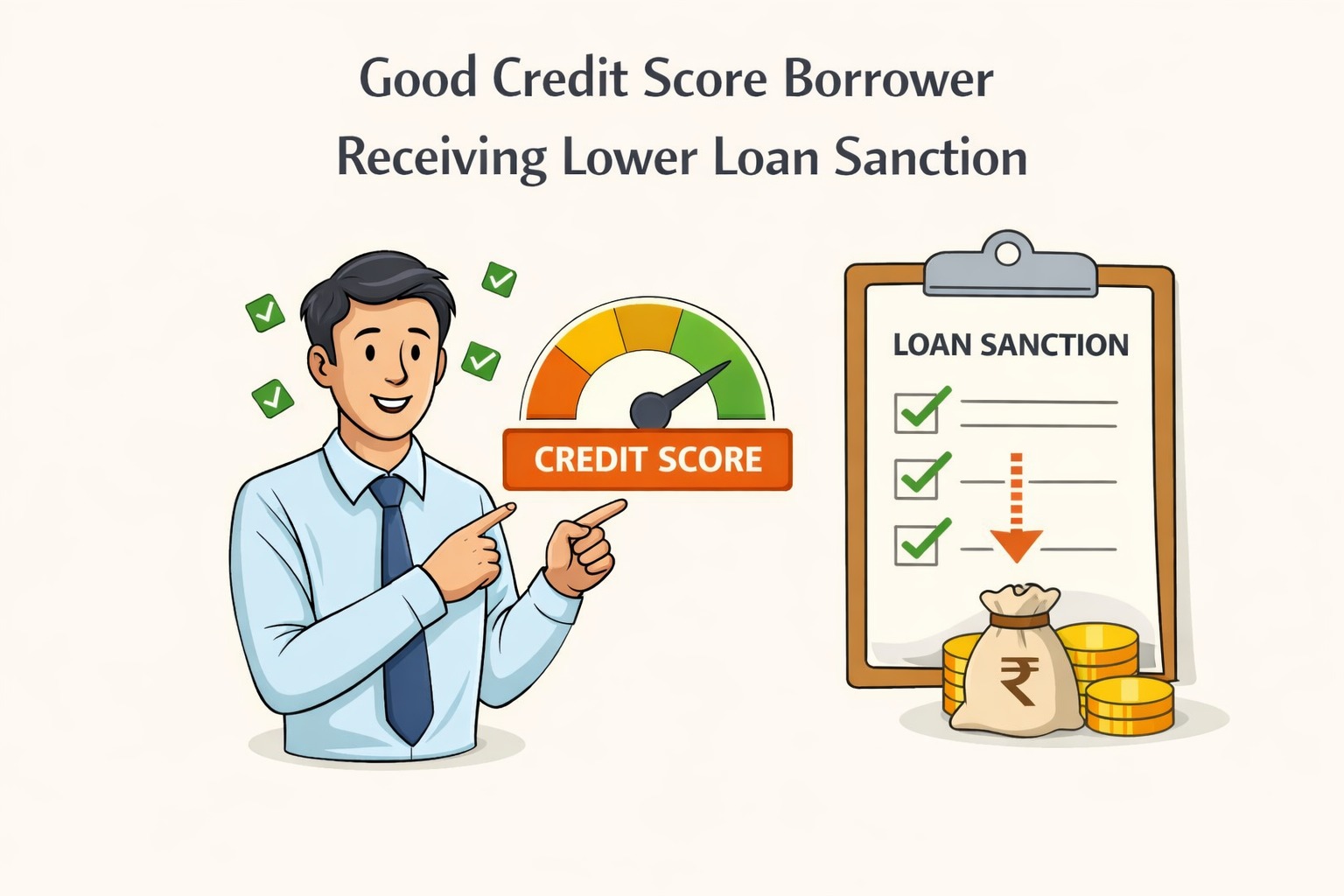
A high credit score no longer guarantees a high loan amount.
In 2026, many borrowers with 750+ credit scores, stable jobs, and clean repayment history are seeing lower-than-expected loan sanctions. This isn’t random—it reflects a fundamental change in how Indian banks assess risk.
This article explains why good borrowers are affected, what banks are worried about, and how you can protect your borrowing power.
AI Answer Box
Short Answer:
Even good borrowers are seeing lower loan sanctions because banks now prioritise affordability, EMI-to-income ratio, and credit quality over credit scores alone.
The Old Rule vs the New Reality
Earlier Lending Model
Credit score was king
Income proof was sufficient
Higher income = higher sanction
2026 Lending Reality
Credit score is just an entry filter
EMI burden is the main decision driver
Stress testing has become standard
📌 Banks now ask: “Can this borrower handle stress?”, not just “Did they repay earlier loans?”
Top Reasons Good Borrowers Are Getting Lower Sanctions
1. EMI-to-Income Ratio Has Become a Hard Stop
Banks increasingly cap total EMIs at 30–40% of net income.
Even disciplined borrowers:
Carry existing home loans
Have credit cards & BNPL exposure
Use personal loans for liquidity
All EMIs are aggregated, shrinking eligibility.
2. Rising Household Leverage
Banks are seeing:
Higher unsecured loan usage
Stacking of small loans
Lifestyle credit expansion
Under guidance from the Reserve Bank of India, lenders are reducing exposure to over-leveraged profiles, even if repayment history is clean.
3. Stress Testing Is Now Standard
Loan approvals now factor:
Job loss scenarios
Income variability
Interest rate shock impact
If a borrower fails stress tests, sanction amounts are cut—even with excellent credit.
4. Shift From Credit Growth to Credit Quality
Indian banks are no longer chasing volumes.
Instead, they focus on:
Risk-adjusted returns
Capital efficiency
Long-term asset quality
This means smaller, safer loans.
5. Unsecured Credit Is Viewed Cautiously
Personal loans, credit cards, and BNPL:
Carry higher default risk
Are capped aggressively
Reduce headroom for new loans
📌 A borrower with a home loan + personal loan often sees lower incremental sanction.
Good Credit Score ≠ High Eligibility Anymore
| Factor | Importance in 2026 |
|---|---|
| EMI-to-Income Ratio | Very High |
| Income Stability | High |
| Credit Score | High (but not decisive) |
| Existing Unsecured Loans | Negative |
| Loan Purpose | Medium |
| Employer Stability | Medium |
Real-World Lending Insight
From hands-on credit evaluation, borrowers with ₹1 lakh income and ₹40,000 EMIs are often sanctioned less than borrowers earning ₹70,000 with ₹15,000 EMIs—despite similar credit scores.
Affordability beats income size.
Impact on Different Loan Types
Personal Loans
Sanctions reduced sharply
Higher scrutiny on usage
Home Loans
Longer tenures used to manage EMI
Co-applicants encouraged
Top-Up Loans
Most affected
Often rejected outright
What Borrowers Can Do to Improve Sanction Amount
Step-by-Step Strategy
Reduce unsecured loan exposure
Prepay small high-interest loans
Avoid new credit before applying
Add co-applicant for large loans
Choose realistic loan amounts
Pros & Cons of Lower Loan Sanctions
✅ Pros
Prevents over-borrowing
Reduces future stress
Improves long-term credit health
❌ Cons
Delays purchases or expansion
Frustrates good borrowers
Requires financial re-planning
Key Takeaways
Credit scores alone don’t decide loans
EMI burden is the biggest filter
Banks are lending cautiously, not unfairly
Lower sanction ≠ rejection
Borrower discipline matters more than history
Frequently Asked Questions
1. Why did my loan amount get reduced despite good credit?
Due to high EMI-to-income ratio or stress test failure.
2. Is this happening to many borrowers?
Yes, across banks and NBFCs.
3. Does RBI mandate lower sanctions?
Indirectly, through risk and supervision norms.
4. Are banks avoiding good borrowers?
No, they are limiting risk exposure.
5. Do credit cards affect loan eligibility?
Yes, minimum dues are counted as EMIs.
6. Can co-applicants help?
Yes, significantly.
7. Are unsecured loans the main issue?
Yes, especially multiple ones.
8. Will sanctions improve later?
If EMI burden reduces, yes.
9. Does income growth help?
Only if EMIs don’t rise proportionally.
10. Should I close old loans first?
Yes, before applying for new ones.
11. Is this trend temporary?
No, it’s structural.
12. Is lower sanction better than rejection?
Yes, it preserves credit access.
Conclusion: A New Lending Reality
In 2026, banks are clear:
👉 Being a good borrower means being a low-stress borrower.
Lower loan sanctions are not punishment—they are preventive discipline. Borrowers who adapt early will retain access, flexibility, and long-term financial health.
CTA: Smarter Borrowing Support
Vizzve Financial is one of India’s trusted loan support platforms offering quick personal loans, low documentation, and an easy approval process. Apply at www.vizzve.com.
Published on : 23rd January
Published by : SMITA
www.vizzve.com || www.vizzveservices.com
Follow us on social media: Facebook || Linkedin || Instagram
🛡 Powered by Vizzve Financial
RBI-Registered Loan Partner | 10 Lakh+ Customers | ₹600 Cr+ Disbursed