

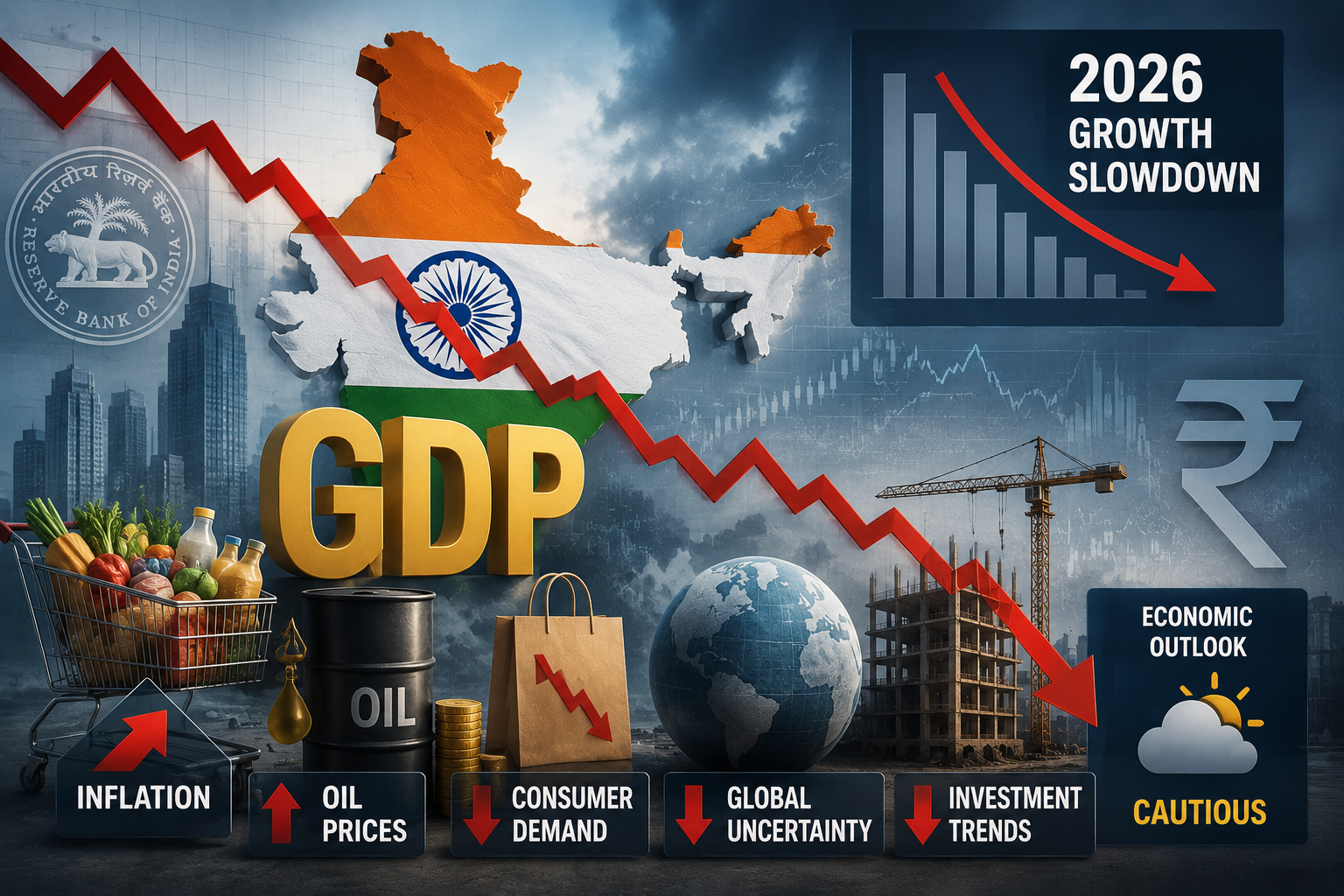
India remains one of the world's fastest-growing major economies, but recent GDP data suggests that growth momentum has moderated compared with previous periods.
While the economy continues expanding, policymakers, businesses, and investors are closely examining the factors contributing to slower growth in 2026.
A combination of global uncertainty, inflation pressures, uneven consumption trends, and external economic challenges has created headwinds for growth.
Understanding these factors is important because GDP growth influences employment, investment, government finances, corporate earnings, and overall economic confidence.
AI Answer Box
Why is India's GDP growth slowing?
The slowdown is being driven by factors such as global economic uncertainty, high oil prices, inflation pressures, weaker export demand, and moderation in consumer spending.
Is India still growing?
Yes. India remains among the fastest-growing major economies globally, but growth has slowed compared with earlier expectations.
What does slower GDP growth mean?
It can affect business investment, employment creation, corporate profits, and market sentiment, although moderate growth remains positive for the economy.
Understanding GDP Growth
GDP (Gross Domestic Product) measures the total value of goods and services produced within a country.
GDP growth reflects:
- Consumer spending
- Business investment
- Government expenditure
- Exports and imports
When growth slows, it does not necessarily mean the economy is shrinking. It simply means expansion is occurring at a slower pace.
Why GDP Growth Matters
Economic growth influences nearly every part of daily life.
GDP Growth Supports
- Job creation
- Wage growth
- Business expansion
- Tax revenue
- Infrastructure investment
Slower growth can reduce economic momentum if it persists for an extended period.
1. Global Economic Uncertainty
One of the biggest challenges facing India in 2026 is a weaker global environment.
Several economies continue dealing with:
- Slower growth
- High interest rates
- Geopolitical tensions
- Trade disruptions
Since India is integrated into global markets, international weakness can affect domestic growth.
Impact on Exports
Global demand influences Indian exports.
Key Export Sectors
- Information technology
- Pharmaceuticals
- Engineering goods
- Textiles
- Manufacturing
When overseas demand weakens, export growth often slows as well.
2. Rising Crude Oil Prices
Higher oil prices remain a major concern.
India imports a large portion of its energy requirements, making the economy vulnerable to global oil-price movements.
Effects of Higher Oil Prices
- Increased import costs
- Higher inflation
- Pressure on the rupee
- Reduced consumer purchasing power
These factors can limit economic growth.
Oil and Economic Growth
| Oil Prices | Economic Impact |
|---|---|
| Higher Oil | Growth Pressure |
| Lower Oil | Growth Support |
| Rising Fuel Costs | Inflation Risk |
| Higher Import Bill | Fiscal Pressure |
3. Inflation Pressures
Although inflation has moderated compared with previous peaks, it remains an important concern.
Higher prices can affect:
- Consumer spending
- Household budgets
- Business costs
- Investment decisions
When inflation remains elevated, economic activity may slow as consumers become more cautious.
4. Consumer Spending Growth Has Moderated
Consumption is the largest driver of India's economy.
Recent data suggests demand remains healthy, but growth has become more uneven across sectors.
Areas Showing Moderation
- Discretionary spending
- Premium consumer goods
- Some retail segments
Consumers continue spending, but at a more measured pace.
5. Private Investment Remains Selective
Business investment remains positive but not uniformly strong.
Companies continue evaluating:
- Global demand conditions
- Financing costs
- Economic outlook
Many firms are prioritizing efficiency and productivity rather than aggressive expansion.
Business Investment Challenges
| Factor | Impact |
|---|---|
| Global Uncertainty | Cautious Spending |
| Financing Costs | Investment Delays |
| Demand Visibility | Reduced Expansion |
| Market Volatility | Risk Management |
6. Foreign Investment Volatility
Foreign investment flows remain important for India's economy.
While India continues attracting significant capital, global investors have become more selective due to:
- Interest-rate trends
- Currency movements
- Global market volatility
This can affect investment activity and market sentiment.
7. Geopolitical Tensions
Global geopolitical developments continue influencing markets.
Potential impacts include:
- Supply-chain disruptions
- Commodity-price volatility
- Energy-market uncertainty
- Investor caution
These factors contribute to slower economic momentum worldwide.
Areas of Strength in India's Economy
Despite slower growth, several sectors remain resilient.
Positive Indicators
- Strong GST collections
- Infrastructure spending
- Digital economy expansion
- Services-sector growth
- Financial-sector stability
These strengths continue supporting overall economic activity.
Strong Economic Drivers
| Growth Driver | Current Trend |
|---|---|
| Infrastructure | Strong |
| Digital Economy | Expanding |
| Services Sector | Positive |
| Financial Services | Stable |
| Government Spending | Supportive |
What the Slowdown Means for Businesses
Businesses may face:
- More cautious consumer spending
- Selective investment decisions
- Increased competition
However, sectors linked to infrastructure, technology, financial services, and essential consumption continue finding growth opportunities.
Impact on Financial Markets
Investors closely monitor GDP growth because it affects:
- Corporate earnings
- Interest-rate expectations
- Stock valuations
- Investment sentiment
Moderate growth remains positive, but markets prefer strong and sustainable expansion.
What Policymakers Are Doing
Authorities continue supporting growth through:
- Infrastructure investment
- Economic reforms
- Digital initiatives
- Investment promotion
- Financial-sector strengthening
The goal is to maintain long-term growth momentum while managing short-term challenges.
Expert Commentary
Economists generally believe India's slowdown should be viewed in context.
While growth has moderated, India continues to outperform many major economies.
Key points include:
Challenges
- Oil-price volatility
- Global uncertainty
- Inflation pressures
Strengths
- Large domestic market
- Infrastructure spending
- Digital transformation
- Strong services sector
Many experts believe the slowdown is more of a moderation than a severe economic weakness.
Key Takeaways
✅ India's GDP growth has slowed but remains positive.
✅ Global uncertainty continues affecting economic activity.
✅ Rising oil prices are creating pressure.
✅ Inflation remains a factor influencing growth.
✅ Consumer demand is growing more moderately.
✅ Infrastructure and digital sectors remain strong.
Pros & Cons of Slower GDP Growth
Pros
- Reduced overheating risks
- More sustainable growth path
- Improved inflation management
Cons
- Slower job creation
- Reduced business expansion
- Weaker investment sentiment
- Lower corporate earnings growth
Future Outlook
India's long-term growth story remains supported by:
- Demographics
- Infrastructure development
- Digital transformation
- Expanding financial inclusion
- Economic reforms
However, the near-term outlook will depend on:
- Oil prices
- Inflation trends
- Global economic conditions
- Investment activity
If these factors improve, growth momentum could strengthen again in the coming quarters.
Conclusion
India's economic growth slowdown in 2026 reflects a combination of domestic and global challenges rather than a fundamental weakness in the economy.
While rising oil prices, inflation concerns, and global uncertainty have weighed on growth, strong domestic demand, infrastructure spending, and ongoing reforms continue providing important support.
For investors and businesses, the focus should remain on long-term trends rather than short-term fluctuations. India's growth may have slowed, but its position as one of the world's most dynamic major economies remains intact.
Frequently Asked Questions (FAQs)
1. Why is India's GDP growth slowing?
Global uncertainty, oil prices, inflation, and weaker demand are key reasons.
2. Is India's economy shrinking?
No, the economy is still growing, just at a slower pace.
3. How do oil prices affect GDP?
Higher oil prices increase costs and inflation pressures.
4. Does inflation slow growth?
It can reduce consumer spending and business activity.
5. What sectors remain strong?
Infrastructure, digital economy, and services.
6. How does GDP affect investors?
It influences earnings, markets, and economic sentiment.
7. Are exports contributing to the slowdown?
Global demand weakness has affected some export sectors.
8. Is consumer spending still growing?
Yes, but growth has moderated in certain categories.
9. What is the government's response?
Infrastructure spending and economic reforms continue.
10. What is the outlook for India's economy?
Long-term growth prospects remain positive despite near-term challenges.
Published on : 7th June
Published by : SMITA
www.vizzve.com || www.vizzveservices.com
Follow us on social media: Facebook || Linkedin || Instagram
🛡 Powered by Vizzve Financial
RBI-Registered Loan Partner | 10 Lakh+ Customers | ₹600 Cr+ Disbursed