

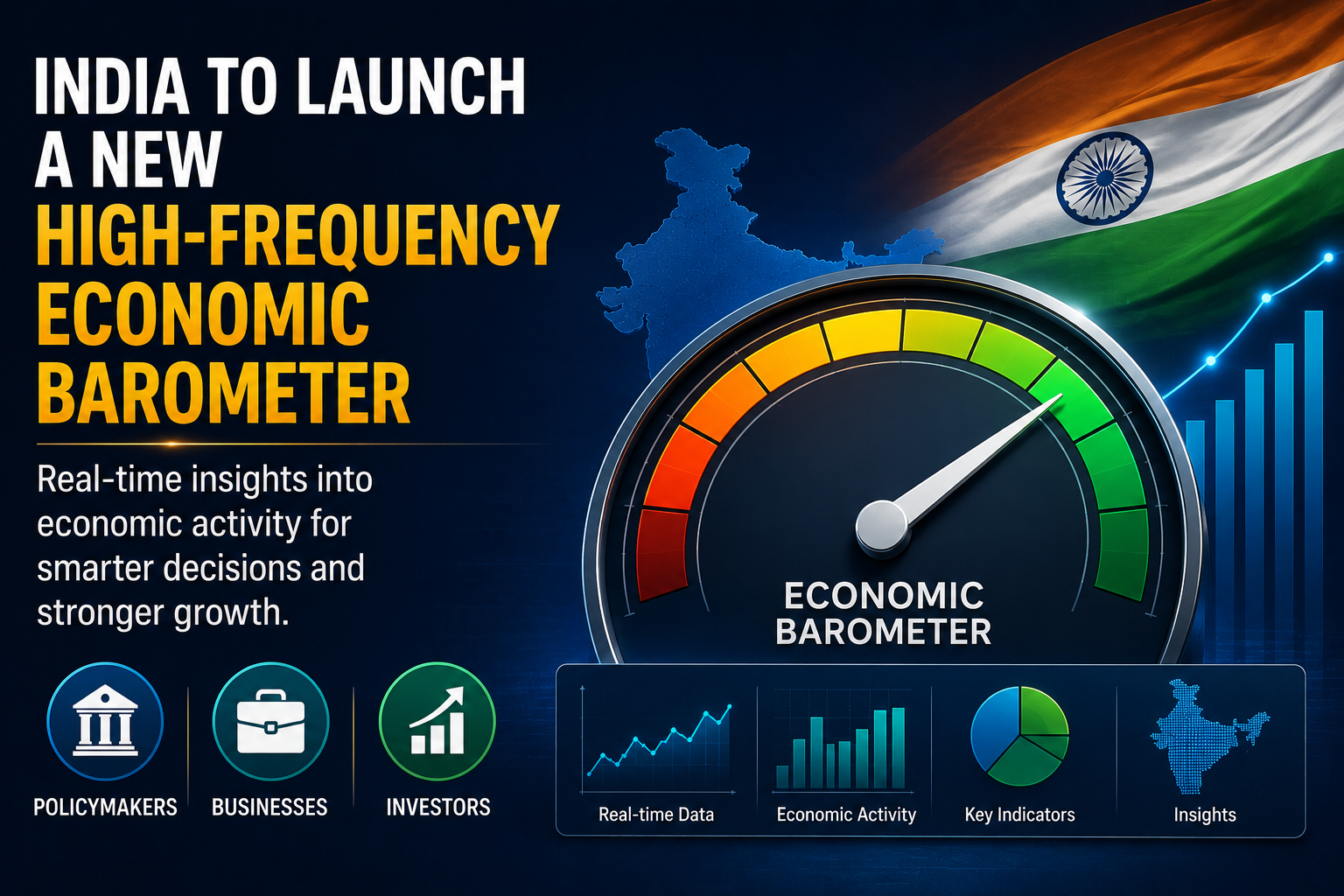
India is preparing to launch a new high-frequency economic barometer, a data-driven tool designed to measure economic activity more frequently than traditional indicators like quarterly GDP. The new system aims to provide policymakers, businesses, investors, and financial institutions with timely insights into economic trends, helping improve decision-making and policy responses.
AI Answer Box
What is India's High-Frequency Economic Barometer?
India's proposed high-frequency economic barometer is an advanced economic monitoring tool that combines multiple real-time indicators such as industrial production, digital payments, electricity consumption, GST collections, transportation activity, employment trends, and financial market data to provide a more current picture of economic performance. Unlike quarterly GDP reports, the barometer is expected to offer faster insights into changes in economic activity.
India to Launch a New High-Frequency Economic Barometer
India is taking another important step toward modernizing economic policymaking with the proposed launch of a new high-frequency economic barometer. The initiative is expected to provide a comprehensive and timely assessment of the country's economic performance by tracking multiple indicators that reflect business activity, consumer demand, industrial output, and financial market conditions.
Traditional economic indicators such as Gross Domestic Product (GDP) are typically released on a quarterly basis, creating a time lag between actual economic developments and official data. The new barometer aims to bridge this gap by using high-frequency data to provide near real-time insights into the health of the economy.
This initiative is expected to strengthen economic planning, improve policy formulation, and provide investors with a better understanding of short-term economic trends.
What Is a High-Frequency Economic Barometer?
A high-frequency economic barometer is a composite indicator that combines several regularly updated datasets to measure economic activity more frequently than traditional reports.
Instead of relying on quarterly GDP alone, it analyzes various economic signals to estimate the direction and momentum of the economy.
These indicators may include:
- GST collections
- Digital payment volumes
- Electricity consumption
- Railway freight movement
- Highway toll collections
- Manufacturing activity
- Employment trends
- Bank credit growth
- Retail spending
- Financial market performance
By analyzing these datasets together, policymakers can gain a more complete understanding of economic conditions.
Why Is India Introducing This Economic Barometer?
The Indian economy has become increasingly dynamic, requiring faster access to reliable economic information.
The new barometer aims to:
- Improve policy decisions
- Monitor economic recovery
- Detect economic slowdowns earlier
- Support financial market stability
- Improve investment planning
- Enhance government decision-making
Real-time monitoring allows policymakers to respond more quickly to changing economic conditions.
Benefits of a High-Frequency Economic Barometer
1. Better Economic Monitoring
The barometer provides continuous updates on economic activity instead of waiting for quarterly GDP reports.
Benefits include:
- Faster data availability
- Improved forecasting
- Better trend analysis
- Early warning signals
2. Stronger Policy Decisions
Government agencies and financial regulators can use the data to design more effective economic policies.
Potential advantages include:
- Better fiscal planning
- Improved monetary policy
- Faster economic interventions
- Enhanced crisis management
3. Improved Business Planning
Businesses can use high-frequency data to understand:
- Consumer demand
- Production trends
- Supply chain activity
- Investment opportunities
This supports more informed business decisions.
4. Better Investment Decisions
Investors often rely on economic indicators to assess market conditions.
The new barometer may help:
- Equity investors
- Mutual funds
- Banks
- Insurance companies
- Foreign Institutional Investors (FIIs)
Access to timely data can improve investment strategies.
Key Indicators Likely to Be Included
The economic barometer is expected to monitor a broad range of indicators.
Consumer Activity
- Retail sales
- Digital payments
- Consumer spending
- GST collections
Industrial Performance
- Manufacturing output
- Factory activity
- Capacity utilization
- Electricity demand
Financial Sector
- Bank credit
- Lending activity
- Stock market trends
- Bond market performance
Infrastructure
- Freight movement
- Port activity
- Highway traffic
- Construction activity
Impact on India's Economy
The launch of the high-frequency economic barometer could transform the way India's economy is monitored.
Expected benefits include:
- Greater policy transparency
- Faster response to economic shocks
- Better GDP forecasting
- Increased investor confidence
- Improved financial stability
- Stronger economic planning
The initiative also aligns with India's broader digital transformation strategy by leveraging data-driven decision-making.
Global Trend Toward Real-Time Economic Data
Several advanced economies already use high-frequency indicators to complement traditional economic statistics.
These tools help central banks, governments, and investors understand economic conditions more quickly and respond effectively to changing circumstances.
India's move toward a similar framework reflects its commitment to improving economic governance and strengthening policy effectiveness.
Expert Commentary (EEAT)
High-frequency economic indicators have become increasingly important in modern policymaking because they provide timely information that complements traditional economic statistics. While quarterly GDP remains a key measure of economic performance, real-time data can help identify emerging trends much earlier. For investors and businesses, such tools improve transparency and support better strategic planning. However, high-frequency indicators should be interpreted alongside broader macroeconomic data rather than viewed as standalone measures of economic health.
Key Takeaways
- India plans to introduce a high-frequency economic barometer for real-time economic monitoring.
- The tool will complement traditional indicators such as quarterly GDP.
- Multiple datasets including GST collections, digital payments, electricity usage, and industrial activity are expected to be included.
- Faster economic insights may improve policymaking and investment decisions.
- Businesses and financial institutions could benefit from better economic forecasting.
- The initiative supports India's ongoing digital transformation and data-driven governance.
- Real-time economic monitoring is becoming a global best practice.
Pros & Cons of India's High-Frequency Economic Barometer
Pros
- Provides near real-time insights into economic activity.
- Helps policymakers respond more quickly to changing economic conditions.
- Improves GDP forecasting and economic trend analysis.
- Supports better investment and business decisions.
- Enhances transparency in economic monitoring.
- Strengthens confidence among domestic and foreign investors.
- Enables faster identification of economic slowdowns or recoveries.
- Supports data-driven governance and policy formulation.
Cons
- High-frequency data can be volatile and may fluctuate from week to week.
- Some indicators may not fully capture the overall economy.
- Data revisions could affect initial interpretations.
- Requires robust data collection and integration systems.
- Risk of overreacting to short-term economic changes.
- Multiple indicators need careful interpretation alongside official statistics.
Why Investors Should Care
A high-frequency economic barometer can become an important tool for investors by offering earlier signals about the direction of the economy.
It can help investors:
- Monitor economic momentum
- Identify sector-specific opportunities
- Assess market sentiment
- Evaluate consumer demand
- Track industrial activity
- Understand policy direction
- Make better long-term investment decisions
For institutional investors, faster access to economic information may improve portfolio allocation and risk management.
Frequently Asked Questions (FAQs)
1. What is a high-frequency economic barometer?
It is a data-driven economic indicator that combines multiple real-time datasets to provide a more frequent assessment of economic activity than traditional quarterly GDP reports.
2. Why is India launching this new barometer?
The goal is to improve economic monitoring, support faster policymaking, and provide businesses and investors with timely economic insights.
3. How is it different from GDP?
GDP is published quarterly, while a high-frequency economic barometer uses regularly updated indicators to track economic trends much more frequently.
4. Which indicators could be included?
Possible indicators include GST collections, digital payments, electricity consumption, freight movement, bank credit, manufacturing output, retail sales, and employment trends.
5. Who will benefit from this initiative?
Government agencies, businesses, investors, economists, financial institutions, and policymakers can all benefit from more timely economic information.
6. How will it help businesses?
Businesses can better understand demand trends, production activity, supply chain conditions, and overall economic momentum.
7. Will it improve policymaking?
Yes. Faster access to economic data enables governments and regulators to respond more effectively to changing economic conditions.
8. How does it benefit investors?
Investors can monitor economic trends more closely and make informed investment decisions based on current market conditions.
9. Can it predict economic slowdowns?
While it cannot predict the future with certainty, it may provide early signals of changing economic conditions before quarterly GDP data is released.
10. Does it replace GDP?
No. The economic barometer is designed to complement GDP and other official economic statistics, not replace them.
11. Why is real-time economic data important?
Timely information allows governments, businesses, and investors to respond more quickly to opportunities and challenges.
12. Are other countries using similar systems?
Yes. Several advanced economies use high-frequency indicators alongside traditional economic data to monitor economic activity.
13. Will the barometer affect financial markets?
It may influence market sentiment by providing more frequent updates on economic performance, though markets will continue to consider multiple factors.
14. What role does digital data play?
Digital payments, online transactions, and other technology-driven indicators provide timely information about consumer and business activity.
15. What is the long-term significance of this initiative?
The high-frequency economic barometer could improve economic governance, strengthen policymaking, enhance investor confidence, and support India's long-term growth strategy.
Conclusion
India's proposed high-frequency economic barometer represents an important step toward modernizing economic monitoring and policymaking. By combining real-time indicators with traditional economic statistics, the initiative aims to provide a more accurate and timely picture of the country's economic performance.
For businesses, investors, and policymakers, access to faster economic insights can improve decision-making and strengthen confidence in India's evolving economic framework. As the country continues its digital transformation, this data-driven approach has the potential to support sustainable growth and make economic planning more responsive to changing conditions.
Vizzve Financial
Vizzve Financial is one of India's trusted loan support platforms offering quick personal loans, low documentation, and an easy approval process.
Whether you're planning investments, expanding your business, managing personal expenses, or funding education, Vizzve Financial provides a fast, secure, and hassle-free borrowing experience.
Apply today at: www.vizzve.com
Published on : 9th July
Published by : SMITA
www.vizzve.com || www.vizzveservices.com
Follow us on social media: Facebook || Linkedin || Instagram
🛡 Powered by Vizzve Financial
RBI-Registered Loan Partner | 10 Lakh+ Customers | ₹600 Cr+ Disbursed