

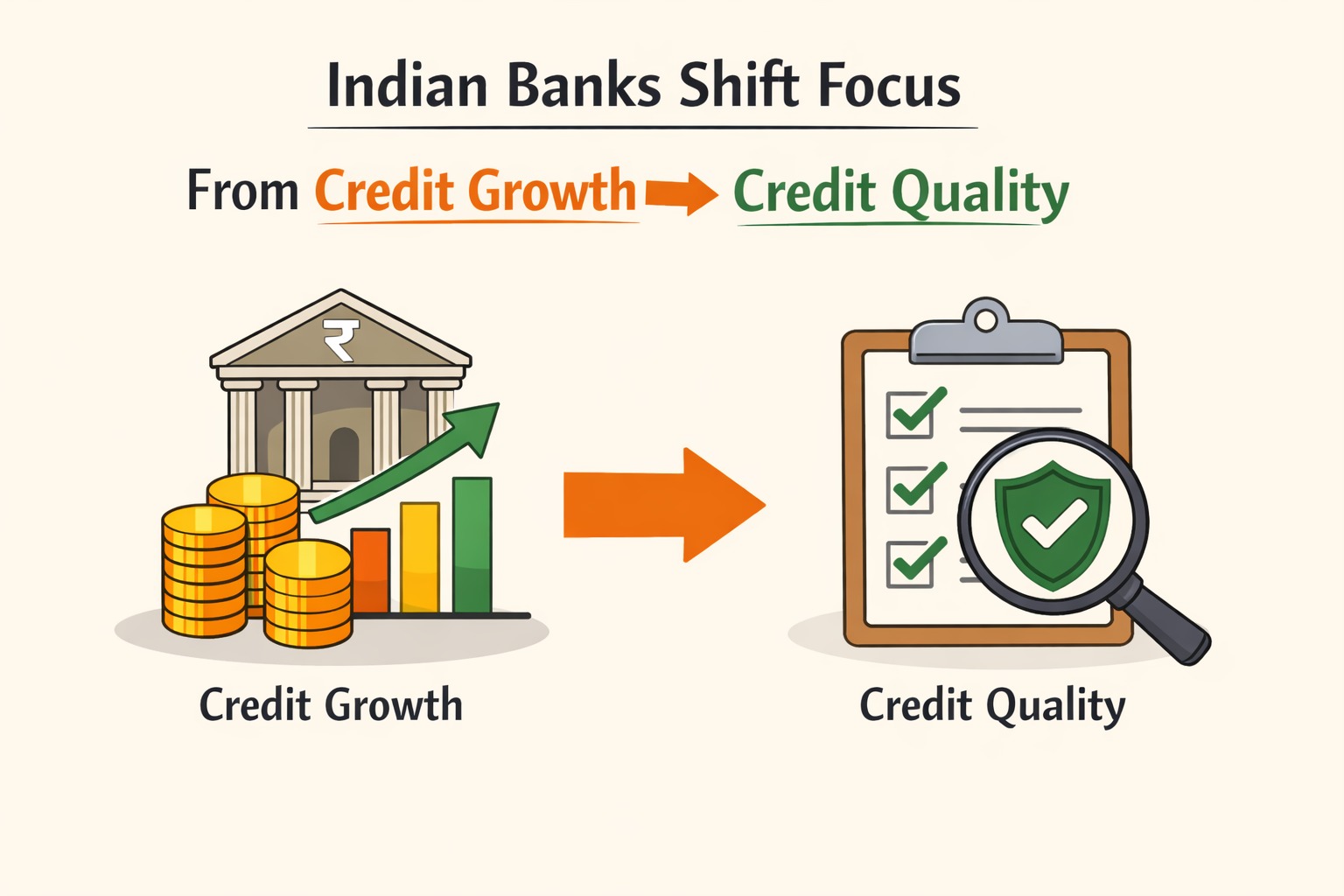
Indian banks are no longer chasing headline credit growth numbers.
Instead, they are quietly prioritising credit quality, borrower sustainability, and balance-sheet resilience.
This shift isn’t dramatic—but it’s structural. And it directly affects loan approvals, interest rates, and who gets funded in 2026.
AI Answer Box
Short Answer:
Indian banks are shifting from rapid credit growth to credit quality to avoid future NPAs, protect margins, and ensure long-term financial stability under tighter regulatory oversight.
What Is the Difference Between Credit Growth and Credit Quality?
Credit Growth
Focus on expanding loan books
Higher disbursals and volumes
Often prioritises speed and market share
Credit Quality
Focus on repayment sustainability
Risk-adjusted returns over volume
Emphasis on cash flow, affordability, and governance
📌 Banks are now choosing quality over quantity.
Why This Shift Is Happening Now
1. Lessons From Past NPA Cycles
Aggressive lending in earlier cycles led to:
Corporate loan stress
Rising NPAs
Capital erosion
Banks are determined not to repeat those mistakes.
2. Regulatory Focus on Early Risk Detection
Under guidance from the Reserve Bank of India, banks are:
Monitoring early stress signals
Tightening underwriting standards
Prioritising long-term repayment ability
📌 The goal: prevent stress, not manage defaults later.
3. Rising Household Leverage
Retail credit has grown rapidly, but banks now see:
Higher EMI burdens
Increased unsecured exposure
Stress signals before defaults
This is pushing lenders to slow down risky growth.
4. Margin Pressure and Cost of Capital
Low-quality growth:
Consumes more capital
Delivers weaker risk-adjusted returns
High-quality lending improves:
Net interest margins
Capital efficiency
Investor confidence
How Banks Are Implementing Credit Quality Focus
Practical Changes in Lending
Stricter EMI-to-income checks
Higher scrutiny of unsecured loans
Greater use of cash-flow analytics
Risk-based pricing replacing flat rates
Selective sector exposure
Retail vs Corporate Lending Under the Quality Lens
| Segment | Earlier Focus | 2026 Focus |
|---|---|---|
| Retail Loans | Rapid expansion | Affordability & EMI stress |
| Corporate Loans | Balance-sheet size | Project viability |
| MSME Loans | Volume-driven | Cash-flow clarity |
| Unsecured Credit | Growth-led | Risk-restricted |
What This Means for Borrowers
For Retail Borrowers
Credit scores alone aren’t enough
EMI burden and income stability matter more
Easy credit is disappearing
For Businesses
Governance and cash flow are critical
Informal practices face rejection
Disciplined MSMEs benefit
Expert Commentary
“Banks today would rather grow slowly than clean up bad loans later. Credit quality is now the growth strategy.”
From real-world portfolio reviews, even profitable borrowers are rejected if stress scenarios don’t hold up.
Is This Shift Good or Bad for the Economy?
✅ Positives
Stronger banking system
Lower systemic risk
Sustainable credit cycles
❌ Challenges
Slower credit access
Higher entry barriers
Pressure on marginal borrowers
How Borrowers Can Adapt to the New Reality
Step-by-Step
Keep EMI-to-income ratio below 35%
Maintain clean bank statements
Avoid stacking unsecured credit
Build repayment history before scaling
Focus on cash-flow visibility
Credit Growth vs Credit Quality: Snapshot
| Focus | Credit Growth Era | Credit Quality Era |
|---|---|---|
| Approval Speed | Fast | Deliberate |
| Pricing | Uniform | Risk-based |
| Risk Appetite | High | Disciplined |
| Borrower Type | Broad | Selective |
| Long-Term Stability | Weak | Strong |
Key Takeaways
Credit quality now drives lending decisions
Growth without sustainability is discouraged
RBI supervision reinforces discipline
Borrowers must show affordability, not optimism
This shift is structural, not temporary
Frequently Asked Questions
1. What is credit quality in banking?
It measures the likelihood of full and timely loan repayment.
2. Why are banks slowing credit growth?
To avoid future NPAs and protect capital.
3. Is RBI forcing banks to do this?
Indirectly, through risk and supervision norms.
4. Does this affect retail borrowers?
Yes, especially unsecured loan seekers.
5. Are corporate loans declining?
No, they are selective and quality-driven.
6. Is this trend permanent?
It’s a long-term structural shift.
7. Can good borrowers still get loans?
Yes, disciplined borrowers benefit.
8. Are NBFCs following the same trend?
Gradually, though at different speeds.
9. Will loan interest rates fall due to this?
Not necessarily; risk-based pricing dominates.
10. How can borrowers improve eligibility?
Reduce EMI burden and improve cash flow visibility.
11. Does credit score still matter?
Yes, but it’s no longer sufficient alone.
12. Is slower credit growth bad for GDP?
Short-term impact, long-term stability improves.
Conclusion: Quiet Discipline, Lasting Strength
Indian banks aren’t shouting about this change—but they’re executing it carefully.
The shift from credit growth to credit quality is shaping a safer, more resilient banking system, even if it feels restrictive to borrowers today.
CTA: Borrow Smarter in a Quality-First Era
Vizzve Financial is one of India’s trusted loan support platforms offering quick personal loans, low documentation, and an easy approval process. Apply at www.vizzve.com.
Published on : 21st January
Published by : SMITA
www.vizzve.com || www.vizzveservices.com
Follow us on social media: Facebook || Linkedin || Instagram
🛡 Powered by Vizzve Financial
RBI-Registered Loan Partner | 10 Lakh+ Customers | ₹600 Cr+ Disbursed