

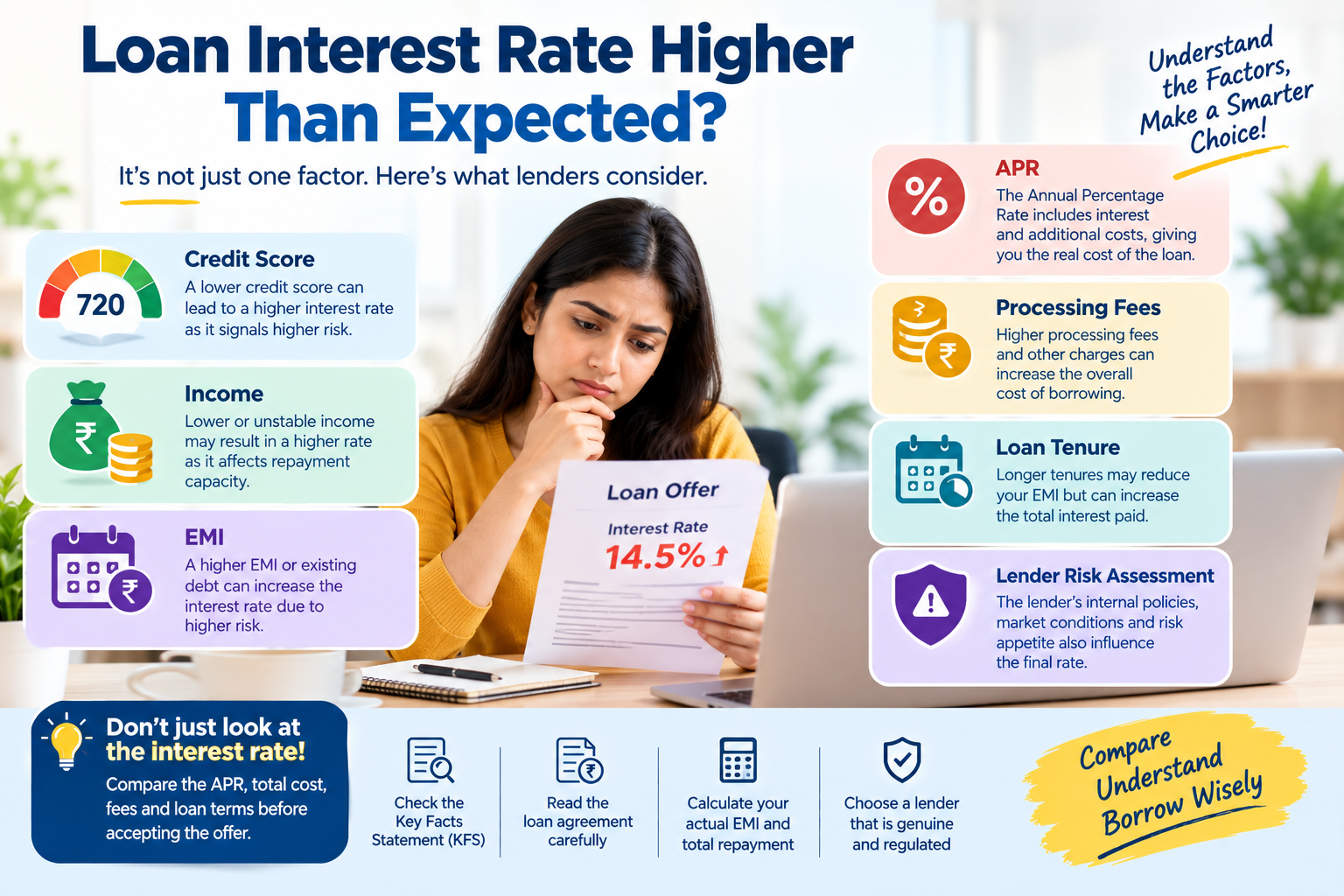
Getting a loan offer with a higher interest rate than expected can be confusing. You may have seen a lower “starting rate” in an advertisement, but the rate offered to you can be different.
The main reason is that lenders generally price loans based on factors such as credit profile, income, repayment capacity, loan amount, tenure, lender policy, and risk assessment. RBI guidance also recognizes risk-based pricing, where different borrowers can receive different interest rates.
Why Can Your Loan Interest Rate Be Higher?
1. Your Credit Profile
Your credit history is one of the factors lenders can consider while assessing risk.
A limited or weaker credit history may result in less favorable pricing because the lender has less information about your previous repayment behavior.
Factors can include:
- Previous repayment history
- Existing loans
- Credit-card balances
- Recent credit enquiries
- Length of credit history
- Previous defaults or overdue payments
A strong credit history does not automatically guarantee the lowest rate, but it can be an important part of the lender's assessment.
2. Your Existing EMIs Are High
If you already have several loans or large monthly EMIs, a lender may consider your repayment capacity more closely.
For example, if a large portion of your monthly income is already committed to EMIs, the lender may consider the new loan relatively higher risk.
What to check: Calculate your total monthly debt obligations before accepting another loan.
3. Your Income May Affect the Offered Rate
Lenders may evaluate income stability and repayment capacity.
For salaried borrowers, this can include salary and employment information. For self-employed borrowers, lenders may review business income, bank transactions, ITRs and other financial documents.
Income level alone does not determine the interest rate. The lender may consider the complete financial profile.
4. The Advertised Rate May Be a Starting Rate
One of the most common reasons for confusion is the difference between an advertised rate and the rate actually offered.
An advertisement may say:
“Personal loan interest rates starting from X%.”
The word “starting” is important. The lowest advertised rate may be available only to borrowers meeting specific eligibility and risk criteria.
Therefore, compare the rate in your actual sanction letter, loan agreement and KFS rather than relying only on an advertisement.
5. Loan Tenure Can Affect the Cost
Loan tenure can affect your total interest cost.
A longer tenure can reduce the monthly EMI but may increase the total interest paid over the life of the loan.
For example:
| Factor | Possible effect |
|---|---|
| Shorter tenure | Higher EMI, potentially lower total interest |
| Longer tenure | Lower EMI, potentially higher total interest |
| Higher interest rate | Higher EMI and total interest |
| Lower interest rate | Lower borrowing cost, all else equal |
Always compare both EMI and total repayment, not just the monthly payment.
6. Loan Amount Can Influence Pricing
The amount you borrow can be part of the lender's overall risk assessment.
A lender may consider the requested amount together with your income, existing obligations, credit history and other eligibility criteria.
Do not automatically borrow the maximum amount offered.
Instead, choose an amount that fits your repayment capacity.
7. Your Employment or Business Profile Matters
Income stability can be relevant to loan underwriting.
A borrower with a stable employment history may be assessed differently from someone with a recently changed job or irregular business income.
For self-employed applicants, lenders may examine business vintage, income records, bank statements and tax-related documents.
8. Floating Interest Rates Can Change
If your loan has a floating interest rate, the rate or EMI can change when the applicable benchmark changes.
RBI's framework for EMI-based floating-rate personal loans requires lenders to communicate the impact of interest-rate resets and provide relevant information to borrowers.
Before accepting a floating-rate loan, check:
- Applicable benchmark
- Spread
- Reset frequency
- EMI impact
- Tenure impact
- Options available after a rate reset
9. Processing Fees Increase the Effective Cost
The interest rate is not always the complete cost of borrowing.
You should also check:
- Processing fee
- Documentation charges
- Verification charges
- Insurance, if applicable
- Late-payment charges
- Foreclosure or prepayment charges where applicable
- Other disclosed fees
RBI guidance emphasizes transparency of loan costs and disclosures.
For digital loans, APR is particularly important because it represents the effective annualized cost and incorporates applicable costs specified under the RBI framework.
Interest Rate vs APR: What's the Difference?
The interest rate tells you the rate charged on the loan balance according to the loan's pricing structure.
The Annual Percentage Rate (APR) provides a broader view of the annualized cost of credit and can include applicable charges.
This is why comparing only interest rates can give an incomplete picture.
Example
Suppose two lenders offer:
| Detail | Lender A | Lender B |
|---|---|---|
| Interest rate | 11% | 10.5% |
| Processing fee | Higher | Lower |
| Other applicable charges | Higher | Lower |
| APR | Check KFS | Check KFS |
| EMI | Compare | Compare |
| Total repayment | Compare | Compare |
The lower headline interest rate does not automatically mean the lower overall borrowing cost.
What Is the KFS and Why Should You Check It?
The Key Facts Statement (KFS) is designed to give borrowers important loan information in a standardized format.
For applicable digital lending products, RBI requires the KFS to be provided before execution of the loan contract, with information including APR and other important terms.
Before accepting a loan, check the KFS for:
- Loan amount
- Tenure
- Interest rate
- APR
- EMI
- Applicable fees
- Repayment terms
- Penal charges
- Other important conditions
Do not accept a loan simply because the application says “approved” or “pre-approved.”
How to Check Why Your Rate Is High
Follow these steps before accepting the offer:
Step 1: Check Your Credit Report
Review your credit report for:
- Incorrect accounts
- Overdue payments
- High outstanding balances
- Multiple recent enquiries
- Errors in personal information
Step 2: Compare the Actual Offers
Compare multiple lenders based on:
- Interest rate
- APR
- EMI
- Processing fee
- Tenure
- Total repayment
- Prepayment conditions
Step 3: Read the KFS
Do not skip the KFS or loan agreement.
Look for the complete cost rather than focusing on the advertised interest rate.
Step 4: Ask the Lender About Pricing
If the offered rate is significantly higher than expected, ask the lender what factors affected the pricing.
The lender's risk-pricing framework and applicable terms should provide more context.
Step 5: Check Whether You Really Need the Full Amount
Borrowing less can reduce your overall repayment burden.
Before accepting the loan, calculate whether the EMI comfortably fits your monthly budget.
Can You Get a Lower Loan Interest Rate?
There is no guaranteed method to obtain a lower rate, but borrowers can improve their overall financial profile by:
- Paying EMIs and credit-card bills on time
- Keeping debt manageable
- Avoiding unnecessary loan applications
- Checking credit-report accuracy
- Maintaining stable income records
- Comparing different lenders
- Negotiating where the lender permits it
- Choosing an affordable loan amount and tenure
Common Mistakes Borrowers Should Avoid
Mistake 1: Looking Only at the Interest Rate
A low interest rate with high fees may not be the cheapest loan.
Mistake 2: Ignoring APR
APR can provide a broader view of the borrowing cost.
Mistake 3: Choosing the Lowest EMI
A low EMI may result from a longer tenure and higher total interest.
Mistake 4: Accepting a Pre-Approved Offer Immediately
Pre-approved does not necessarily mean the offer is the cheapest or that no further verification applies.
Mistake 5: Ignoring the KFS
Always read the KFS and agreement before accepting the loan.
Quick Loan Cost Checklist
Before accepting a loan, ask:
- What is my actual interest rate?
- What is the APR?
- What is my monthly EMI?
- What is the total repayment amount?
- What processing fee applies?
- Are there other charges?
- Is the rate fixed or floating?
- If floating, what is the benchmark?
- How often can the rate reset?
- What happens if I prepay?
- What are the late-payment charges?
- Is the lender a genuine regulated entity or an authorized lending partner?
Key Takeaways
- Your actual loan rate may differ from the advertised starting rate.
- Credit history and repayment capacity can influence loan pricing.
- Income, existing debt and employment or business stability may also matter.
- Longer tenure can reduce EMI but increase total interest.
- Floating rates can change when the applicable benchmark changes.
- Compare APR, EMI, fees and total repayment, not just the interest rate.
- Read the KFS and loan agreement before accepting the offer.
- Never assume that a pre-approved or instant offer is automatically the cheapest option.
FAQs
1. Why did the lender give me a higher interest rate?
The lender may have assessed factors such as credit history, income, existing debt, repayment capacity, loan amount, tenure and its risk-pricing policy.
2. Does a high credit score guarantee a low interest rate?
No. Credit history is only one part of a lender's assessment. Other factors and lender-specific policies can affect the final rate.
3. Why is my rate different from the advertised rate?
Advertisements may show a starting rate that is available only to borrowers meeting particular eligibility or risk criteria.
4. What is APR on a personal loan?
APR is an annualized measure of the cost of credit. For applicable digital loans, RBI defines APR as an all-inclusive annualized cost subject to the framework's inclusions and exclusions.
5. Can my personal loan interest rate increase later?
If your loan has a floating rate, changes in the applicable benchmark can affect the interest rate, EMI or tenure according to the loan terms.
6. Is a lower EMI always better?
No. A lower EMI can result from a longer tenure, which may increase the total interest paid.
7. Should I compare APR or interest rate?
Compare both. The interest rate shows the loan's pricing rate, while APR can provide a broader view of the annualized borrowing cost.
8. What should I check before accepting a loan?
Check the lender, interest rate, APR, KFS, EMI, processing fee, total repayment, tenure, prepayment conditions and other applicable charges.
9. Can I negotiate my personal loan interest rate?
You can ask the lender whether pricing is negotiable, but approval and pricing remain subject to the lender's policies and assessment.
10. What is the safest way to compare loan offers?
Compare actual written offers using the interest rate, APR, EMI, fees, tenure and total repayment amount rather than advertisements alone.
Published on : 25th September 2026
Published by : Shibam Nath
www.vizzve.com || www.vizzveservices.com
Follow us on social media: Facebook || Linkedin || Instagram
🛡 Powered by Vizzve Financial
RBI-Registered Loan Partner | 10 Lakh+ Customers | ₹600 Cr+ Disbursed