

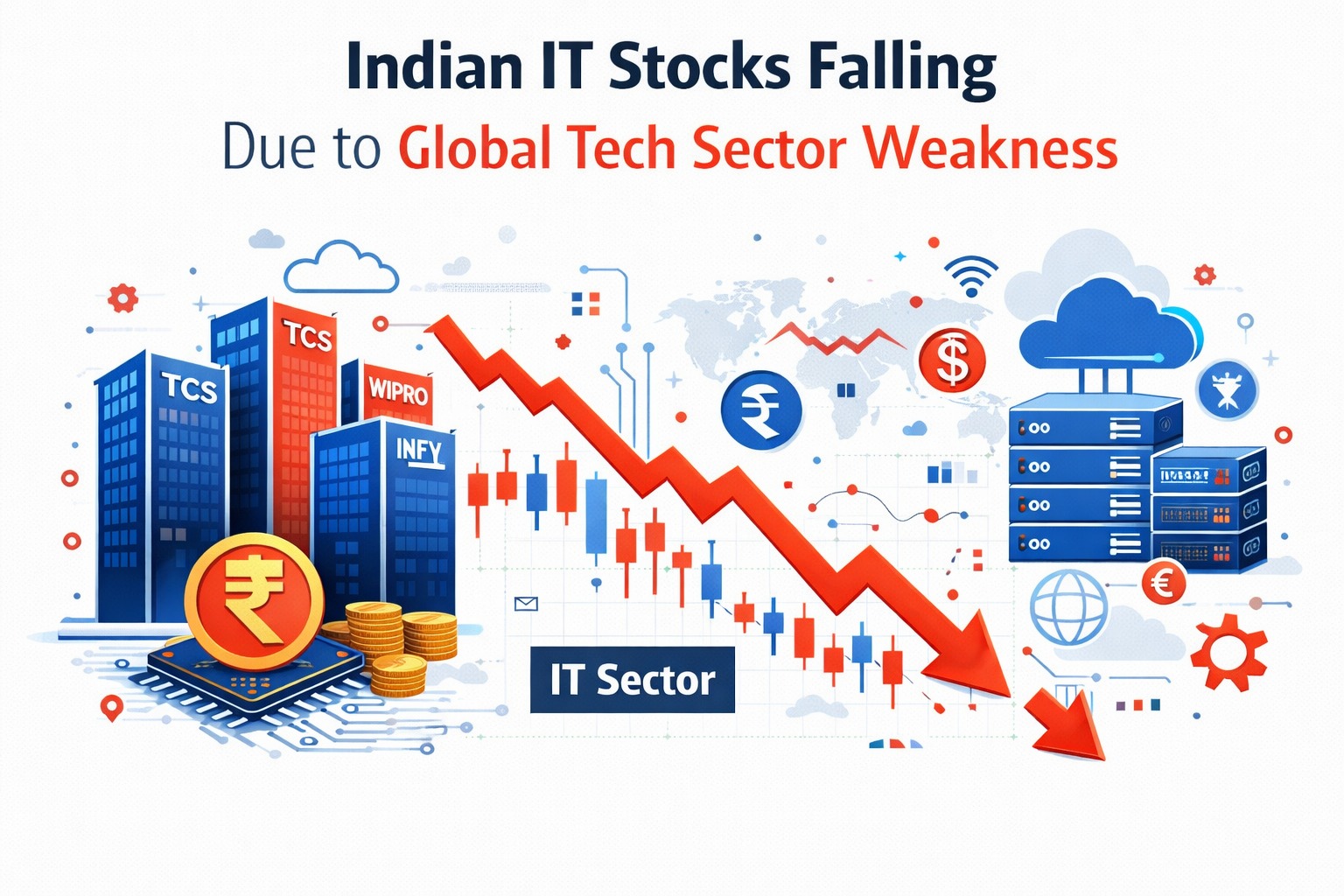
The technology sector has recently come under pressure across global markets, and the impact is clearly visible in Indian IT stocks. Major technology companies worldwide are facing declining valuations as investors react to slowing growth, changing tech demand, and economic uncertainty.
Indian IT giants such as TCS, Infosys, Wipro, and HCLTech have also experienced stock price declines as the global technology sector weakens. The Nifty IT index, which tracks major technology companies in India, has shown significant volatility in recent trading sessions.
Since Indian IT companies generate a large portion of their revenue from global clients, particularly in the United States and Europe, any slowdown in global tech spending directly affects the sector.
AI Answer Box
Why are IT stocks falling in India?
IT stocks are under pressure due to a slowdown in global technology spending, declining tech stock valuations, AI disruption concerns, and cautious corporate IT budgets worldwide.
Key Factors Affecting IT Stocks
| Factor | Impact |
|---|---|
| Global tech sector slowdown | Weak investor sentiment |
| Reduced corporate IT spending | Lower revenue growth expectations |
| AI automation concerns | Business model changes |
| Foreign investor selling | Stock price pressure |
Global Tech Sector Slowdown: What’s Happening?
The global technology sector has seen increased volatility due to economic uncertainty and changing technology trends.
Major global technology companies have recently faced pressure due to:
Slower revenue growth
Reduced enterprise technology spending
Rising interest rates affecting valuations
Investor shift from growth to value stocks
Global Tech Market Impact
| Region | Trend |
|---|---|
| United States | Tech stocks experiencing correction |
| Europe | Slower corporate tech spending |
| Asia | Market volatility impacting tech companies |
Because Indian IT firms are highly dependent on global demand, they react quickly to global technology sector movements.
Why Indian IT Stocks Are Falling
1. Global Tech Stock Correction
The sell-off in global technology stocks has affected investor confidence across the sector.
When major international technology companies decline:
Market sentiment weakens
Investors reduce exposure to tech stocks
Emerging market IT companies see selling pressure
This trend has directly impacted Indian IT stocks.
2. Slower Corporate IT Spending
Many global companies are reducing technology budgets due to economic uncertainty.
Industries Cutting IT Spending
Banking & financial services
Retail & e-commerce
Telecommunications
Manufacturing
Companies are prioritizing cost optimization instead of large IT transformation projects.
3. AI Disruption Concerns
The rise of Artificial Intelligence and automation tools is changing the technology services landscape.
Some analysts believe:
AI could automate certain software development tasks
Traditional outsourcing services may evolve
IT companies will need to adapt their business models
However, AI also creates new opportunities in cloud computing, cybersecurity, and data analytics.
4. Foreign Investor Selling
Foreign Portfolio Investors (FPIs) play a significant role in Indian stock markets.
During global uncertainty:
Investors often shift funds to safer assets
Emerging market stocks experience outflows
Technology stocks become more volatile
This has added additional pressure on the IT sector.
Major IT Companies Impacted
Several leading Indian IT companies have seen stock corrections.
| Company | Market Reaction |
|---|---|
| TCS | Stock volatility amid global slowdown |
| Infosys | Decline due to cautious outlook |
| Wipro | Weak demand sentiment |
| HCLTech | Pressure from global clients |
| Tech Mahindra | Telecom spending slowdown |
Despite short-term declines, these companies remain global leaders in technology services.
Impact on the Indian Stock Market
The IT sector has historically been one of the largest contributors to Indian stock market growth.
Importance of IT Sector
| Indicator | Value |
|---|---|
| Contribution to exports | Major share of services exports |
| Employment | Millions of skilled professionals |
| Global clients | Fortune 500 companies |
Because of its size and influence, weakness in IT stocks can affect overall market sentiment.
Long-Term Outlook for Indian IT Sector
Despite the current pressure, the long-term outlook for the sector remains positive.
Key Growth Drivers
Artificial Intelligence solutions
Cloud computing services
Digital transformation
Cybersecurity demand
Data analytics and automation
Industry projections suggest that the Indian IT services market could continue growing steadily in the coming years.
Pros and Cons of Current IT Sector Situation
| Pros | Cons |
|---|---|
| Opportunity for long-term investors | Short-term stock volatility |
| AI innovation potential | Slower global tech spending |
| Digital transformation demand | Reduced enterprise budgets |
Market corrections sometimes create buying opportunities for long-term investors.
Real-World Market Insights
Financial analysts suggest that IT companies with strong:
Global client relationships
Cloud and AI capabilities
Digital transformation services
are likely to perform better even during periods of sector volatility.
Large IT companies also benefit from diversified global revenue streams, which helps them manage economic slowdowns.
Key Takeaways
IT stocks are under pressure due to a global technology sector slowdown.
Declining global tech stock valuations are affecting investor sentiment.
Slower corporate technology spending is impacting revenue expectations.
AI transformation may reshape the IT services industry.
Long-term growth prospects remain positive due to digital transformation demand.
Frequently Asked Questions (FAQs)
1. Why are IT stocks falling in India?
IT stocks are falling due to global tech sector weakness, slower corporate technology spending, and foreign investor selling.
2. What is the Nifty IT index?
The Nifty IT index tracks the performance of major technology companies listed on the Indian stock market.
3. Which Indian IT companies are affected?
Companies like TCS, Infosys, Wipro, HCLTech, and Tech Mahindra have experienced stock pressure.
4. How does global tech slowdown affect India?
Indian IT firms rely heavily on international clients, so global tech spending directly impacts their revenues.
5. Is AI disrupting the IT services industry?
AI is transforming the industry by automating tasks but also creating new technology opportunities.
6. Are IT stocks good for long-term investment?
Many analysts believe strong IT companies remain attractive for long-term investors.
7. What industries use Indian IT services the most?
Banking, financial services, retail, healthcare, and telecom sectors.
8. How important is the US market for Indian IT companies?
The US contributes a significant portion of revenue for many Indian IT firms.
9. Will IT sector recover soon?
Recovery depends on global economic conditions and technology spending trends.
10. What technologies will drive future IT growth?
Artificial Intelligence, cloud computing, cybersecurity, and data analytics.
11. How does foreign investment affect IT stocks?
Foreign investors influence stock prices through capital inflows and outflows.
12. Why are tech stocks volatile?
Tech stocks often react quickly to changes in growth expectations and economic conditions.
13. Does global recession impact IT sector?
Yes, reduced corporate spending during recessions can affect IT services demand.
14. What should investors watch in the IT sector?
Technology spending trends, AI adoption, and global economic conditions.
Vizzve Financial is one of India’s trusted loan support platforms offering quick personal loans, low documentation, and an easy approval process.
Whether you need funds for personal expenses or financial planning, you can easily apply online.
👉 Apply now at www.vizzve.com
Published on : 17th March
Published by : SMITA
www.vizzve.com || www.vizzveservices.com
Follow us on social media: Facebook || Linkedin || Instagram
🛡 Powered by Vizzve Financial
RBI-Registered Loan Partner | 10 Lakh+ Customers | ₹600 Cr+ Disbursed