

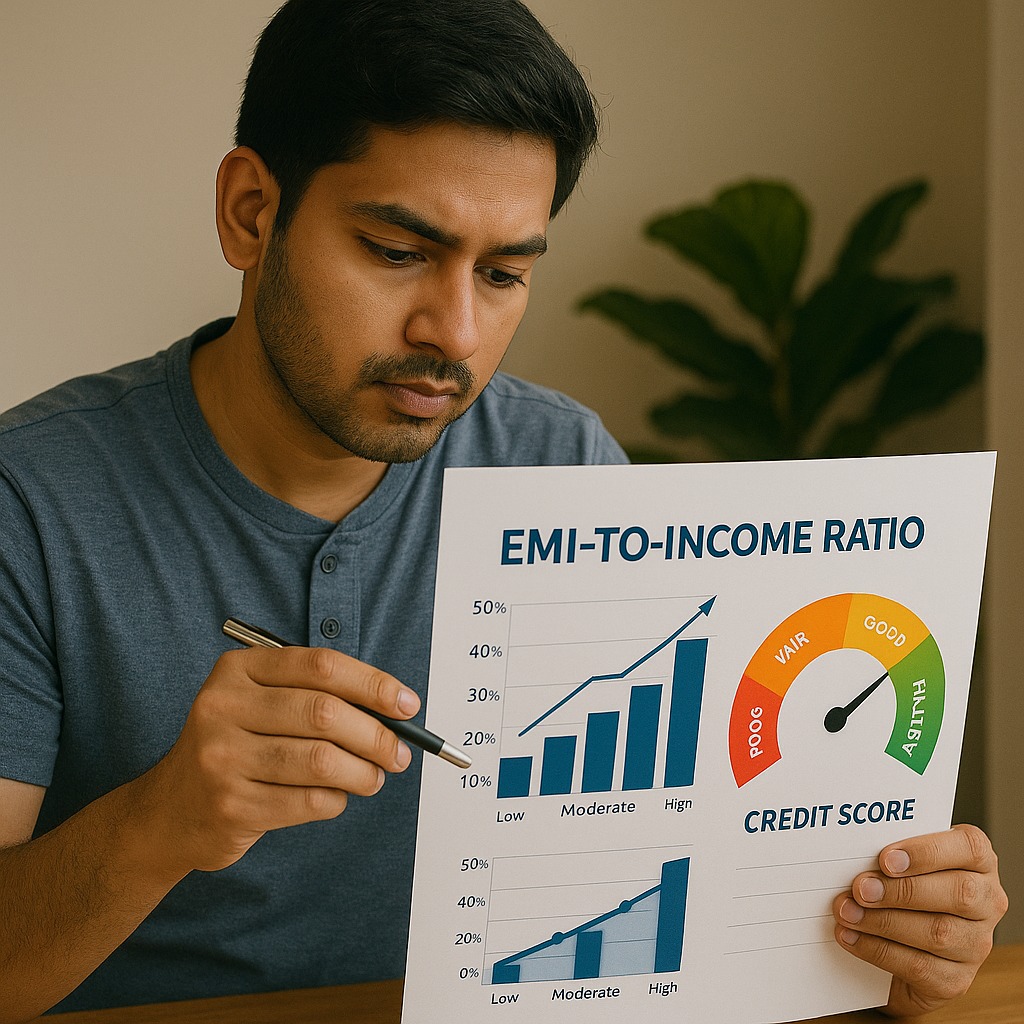
Most borrowers assume that a high CIBIL score is the ultimate key to loan approval. While a strong score is important, lenders often look beyond it — especially at the EMI-to-Income Ratio (also called FOIR: Fixed Obligations to Income Ratio). In many real loan evaluations, your repayment-to-income capacity becomes more important than just your past repayment record.
This is because credit score shows history, but EMI-to-income ratio shows present & future affordability.
What Is EMI-to-Income Ratio?
It is the percentage of your monthly income committed toward EMIs and other fixed financial obligations.
Example:
If monthly income is ₹60,000 and total EMIs = ₹22,000,
EMI-to-Income Ratio = 22,000 ÷ 60,000 × 100 = 36.67%
Why Lenders Value This Ratio So Much
1️⃣ Measures Real-Time Repayment Capacity
Even with a high CIBIL score, if your EMI burden is already high, lenders may worry about cash-flow stress.
2️⃣ Helps Prevent Over-Borrowing
It protects both borrower and lender from future repayment difficulties, defaults or restructuring.
3️⃣ Indicates Lifestyle & Expense Cushion
A reasonable ratio shows that you still have enough monthly surplus for living costs and emergencies.
4️⃣ Predicts Behaviour Under Financial Stress
Low FOIR borrowers are considered resilient even if income fluctuates or unexpected expenses arise.
5️⃣ Supports Responsible Lending Compliance
Banks and NBFCs follow risk & prudential norms, making this ratio a core underwriting metric.
Ideal EMI-to-Income Benchmark
| Borrower Category | Safe EMI-to-Income Range |
|---|---|
| Salaried | 25% – 40% |
| Self-employed | 20% – 35% |
| Seasonal-income | 15% – 30% |
Anything above 50% is usually considered high risk unless backed by very strong collateral or co-borrower.
EMI-to-Income vs CIBIL — Comparison Snapshot
| Factor | CIBIL Score | EMI-to-Income Ratio |
|---|---|---|
| Measures | Past repayment history | Current & future affordability |
| Key Insight | Credit discipline | Cash-flow health |
| Changeability | Slow to improve | Can be adjusted quickly |
| Main Use | Behaviour prediction | Risk & strain evaluation |
| Lending Weight | High | Very High |
Real-Life Example
Borrower A
CIBIL: 780 (excellent)
EMI-to-Income Ratio: 63% (high risk)
Borrower B
CIBIL: 700 (acceptable)
EMI-to-Income Ratio: 32% (healthy)
Borrower B may get approval quicker, and possibly at a better interest rate, despite a lower CIBIL score.
How to Improve Your EMI-to-Income Ratio
✔ Increase income or add co-applicant
✔ Close small active loans first
✔ Transfer high-interest loans for lower EMI
✔ Extend tenure (only if total interest impact is acceptable)
✔ Avoid unnecessary BNPL & card EMIs
✔ Maintain emergency buffer funds
❓ FAQs
Q1: Can a high CIBIL score guarantee loan approval?
No, lenders check multiple parameters, especially affordability.
Q2: Can EMI-to-income ratio be negotiated?
Yes, by restructuring loan amount, tenure, or adding income proofs.
Q3: Does reducing EMI improve eligibility?
Yes, it directly lowers FOIR, allowing room for new credit.
Q4: Can lenders reject even with 750+ CIBIL?
Yes, if FOIR is high, repayment seems risky, or income is unstable.
Q5: Which is more important — CIBIL or FOIR?
Both matter, but FOIR decides repayment ability, making it crucial for final approval.
Published on : 18th November
Published by : SMITA
www.vizzve.com || www.vizzveservices.com
Follow us on social media: Facebook || Linkedin || Instagram
🛡 Powered by Vizzve Financial
RBI-Registered Loan Partner | 10 Lakh+ Customers | ₹600 Cr+ Disbursed