

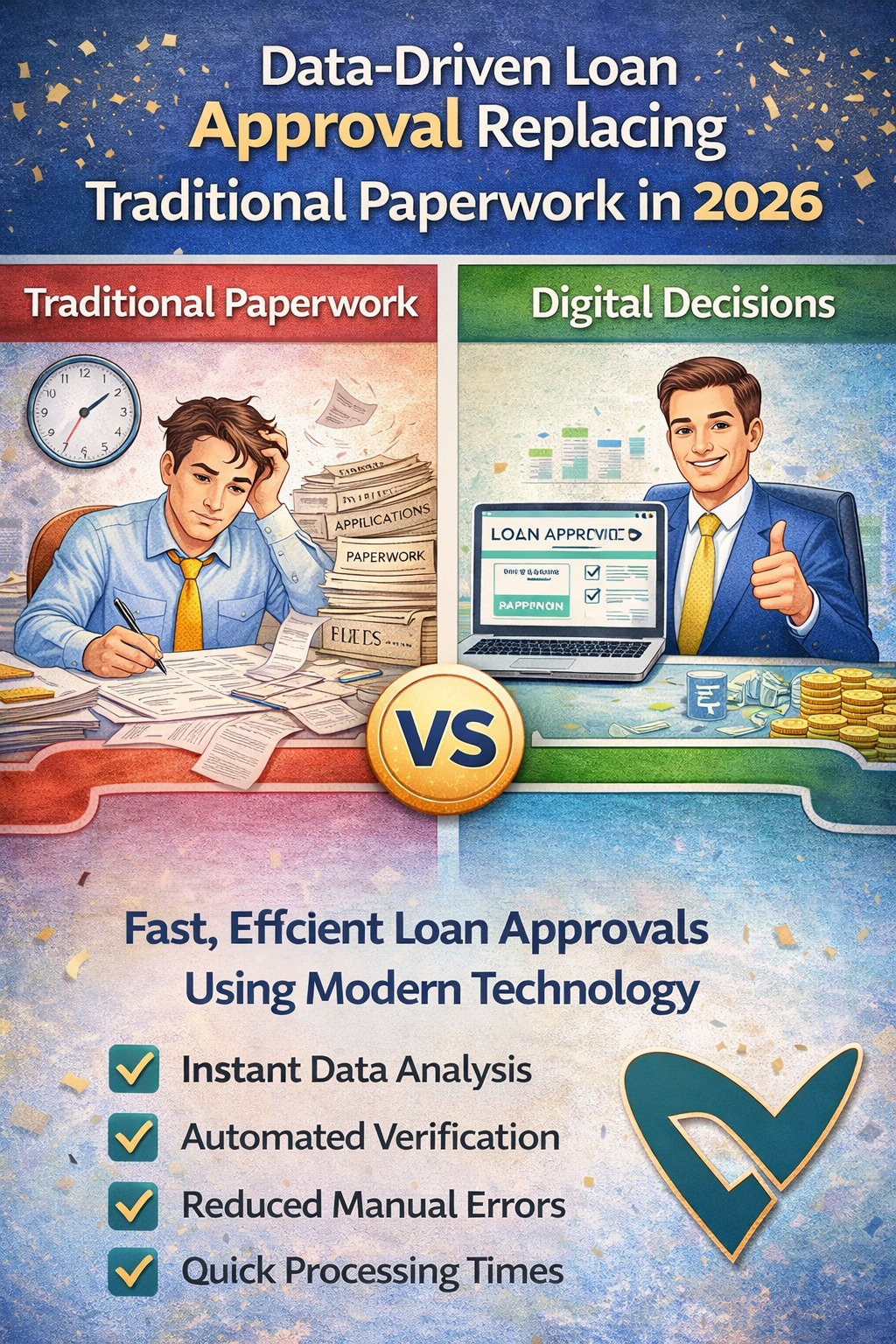
Loans in 2026 will be more data-driven because lenders are shifting from paperwork-based decisions to real-time analysis of income, spending behaviour, credit usage, and financial stability.
AI Answer Box
Why will loans become more data-driven in 2026?
Because lenders need faster, safer, and more accurate risk assessment. Data analytics, AI models, and digital financial footprints allow lenders to predict repayment behaviour better than traditional documents.
Introduction: The End of “Form-Based” Lending
For decades, loans were approved using:
Salary slips
Bank statements
Static credit scores
Manual verification
But this system has limits:
It’s slow
It misses real behaviour
It fails in volatile income environments
By 2026, lending is moving decisively toward data-driven decision-making—and borrowers need to understand what that means.
Expert Commentary
“Modern lending is no longer about who you are on paper. It’s about how your money behaves in real life.”
— Digital Credit Risk Specialist, India
What Does “Data-Driven Lending” Actually Mean?
Beyond Credit Score & Documents
Data-driven lending uses:
Transaction patterns
Cash-flow consistency
Spending behaviour
Credit usage trends
Repayment timing
Digital footprints
📌 Decisions are based on behavioural patterns, not just static numbers.
Why Traditional Loan Evaluation Is No Longer Enough
Old Systems Can’t Handle New Financial Reality
In 2026:
Gig work is common
Freelance income fluctuates
Digital payments dominate
Credit usage is dynamic
Traditional checks struggle to evaluate:
Irregular incomes
Multiple income sources
Digital-first lifestyles
📌 Data fills these gaps.
Key Reasons Loans Will Be More Data-Driven in 2026
🔹 Reason 1: Speed Is Now Non-Negotiable
Borrowers Expect Instant Decisions
Data-driven models:
Reduce manual checks
Enable near-instant approvals
Cut processing time drastically
📌 Faster loans require smarter data—not more forms.
🔹 Reason 2: Risk Prediction Is More Accurate With Data
Behaviour Predicts Repayment Better Than Declarations
Data reveals:
Spending spikes
Cash-flow stress
Over-reliance on credit
Payment timing patterns
📌 Predictive models outperform traditional scoring.
Reason 3: Credit Scores Alone Are Too Slow
Scores Lag—Data Is Real-Time
Credit scores:
Update monthly
Reflect past behaviour
Data analytics:
Track recent trends
Detect early stress signals
📌 Lenders want now, not last quarter.
🔹 Reason 4: Alternative Data Expands Credit Access
More People Become “Visible”
Data-driven lending enables:
Thin-file borrowers
First-time borrowers
Self-employed professionals
Using:
Bank transactions
Digital payment history
Utility payments
📌 Inclusion improves without increasing risk.
🔹 Reason 5: Regulation Encourages Responsible Lending
Data Reduces Blind Lending
Regulators increasingly expect:
Better risk controls
Lower default probability
Transparent decision logic
📌 Data-driven systems support safer credit growth.
Traditional Lending vs Data-Driven Lending (2026)
| Factor | Traditional Lending | Data-Driven Lending |
|---|---|---|
| Decision speed | Slow | Fast |
| Risk accuracy | Moderate | High |
| Credit score reliance | Very high | Balanced |
| Behaviour analysis | Limited | Extensive |
| Inclusion | Low | Higher |
| Fraud detection | Basic | Advanced |
What Data Will Matter Most for Borrowers?
Borrower Signals That Count in 2026
Lenders will closely track:
EMI-to-income ratio
Cash-flow consistency
Credit utilisation trends
Repayment timing discipline
Spending stability
Frequency of borrowing
📌 Consistency beats perfection.
Real-World Borrower Insight
Borrowers increasingly notice:
Approval without physical documents
Faster rejections for risky behaviour
Better offers after stable usage
📌 Your everyday money habits now speak louder than your application.
What This Means for Borrowers in 2026
Data-Driven Lending Is a Double-Edged Sword
✅ Benefits
Faster approvals
Fairer pricing for disciplined users
Better access for non-traditional earners
❌ Challenges
Less room to hide risky habits
Impulsive spending gets flagged
Behaviour matters continuously—not just at application time
📌 You’re evaluated all the time, not only when applying.
How to Prepare for Data-Driven Loans
Borrower Readiness Checklist
✔️ Maintain stable cash flow
✔️ Keep EMIs within limits
✔️ Avoid frequent credit spikes
✔️ Pay on time consistently
✔️ Reduce impulsive borrowing
📌 In 2026, discipline is visible.
Key Takeaways
Lending in 2026 will be behaviour-first
Data replaces paperwork
Credit scores won’t disappear—but won’t dominate
Borrowers are evaluated continuously
Good habits matter more than perfect applications
Loans are becoming smarter—and so must borrowers.
❓ Frequently Asked Questions (FAQs)
1. Will credit scores become irrelevant in 2026?
No—but they won’t be enough alone.
2. What data do lenders use?
Transactions, cash flow, spending, and credit usage.
3. Is data-driven lending safer?
Yes, for both lenders and disciplined borrowers.
4. Can bad habits hurt approval faster?
Yes—data catches trends early.
5. Does this help self-employed borrowers?
Yes, significantly.
6. Are loans approved faster in 2026?
Yes, due to automation.
7. Is privacy a concern?
Data use is regulated and consent-based.
8. Will documentation disappear?
It will reduce, not vanish completely.
9. Can behaviour improve loan terms?
Yes, even without score change.
10. What’s the biggest borrower mistake?
Ignoring everyday financial discipline.
Conclusion
Loans in 2026 won’t just ask who you are.
They’ll ask how your money behaves.
If your financial habits are steady, disciplined, and intentional, data-driven lending works in your favour.
If not, it becomes unforgiving.
The future of loans is transparent—and behaviour-led.
Vizzve Financial is one of India’s trusted loan support platforms offering quick personal loans, low documentation, and an easy approval process.
👉 Apply at www.vizzve.com
Published on : 31st December
Published by : SMITA
www.vizzve.com || www.vizzveservices.com
Follow us on social media: Facebook || Linkedin || Instagram
🛡 Powered by Vizzve Financial
RBI-Registered Loan Partner | 10 Lakh+ Customers | ₹600 Cr+ Disbursed