

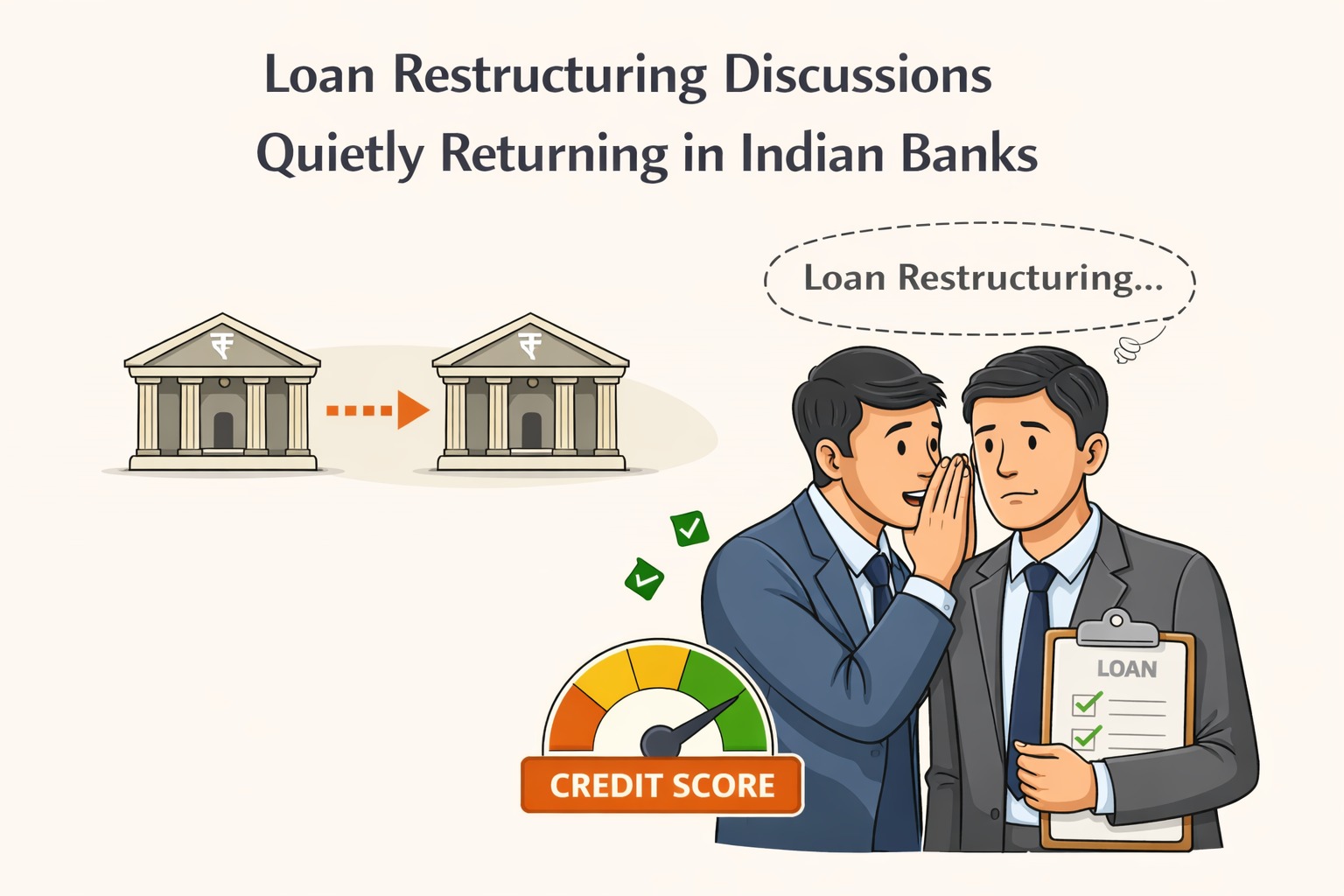
Loan restructuring is quietly returning to the Indian banking conversation in 2026.
Not through announcements or relief packages—but through case-by-case discussions between banks and stressed borrowers.
This isn’t a crisis response. It’s a preventive tool banks are cautiously revisiting as EMI stress rises and credit quality becomes the top priority.
AI Answer Box
Short Answer:
Loan restructuring is back quietly because banks want to prevent future defaults without triggering panic, while managing rising EMI stress under strict credit quality norms.
What Is Loan Restructuring (In Simple Terms)?
Loan restructuring means modifying existing loan terms to help borrowers manage repayments, such as:
Extending loan tenure
Temporarily reducing EMI
Offering moratoriums
Rescheduling payments
It is allowed under guidelines of the Reserve Bank of India, but is treated as a stress signal, not a reward.
Why Loan Restructuring Is Back — But Quietly
1. EMI Stress Is Rising, Not Defaults (Yet)
Banks are observing:
Higher EMI-to-income ratios
Multiple unsecured loans per borrower
BNPL and credit card overuse
📌 Stress is visible before defaults occur.
Restructuring helps banks intervene early—without waiting for missed payments.
2. Banks Are Focused on Credit Quality, Not Growth
Indian banks are prioritising:
Asset quality
Early stress detection
Long-term sustainability
Quiet restructuring avoids:
NPAs
Legal recovery costs
Public panic
3. No Appetite for Public Relief Schemes
Unlike pandemic-era restructuring:
There are no blanket announcements
No automatic eligibility
Each case is:
Individually assessed
Closely monitored
Tightly documented
📌 Silence is deliberate—to avoid moral hazard.
4. Regulatory Discipline Has Increased
Under stricter supervision, banks must:
Flag restructured accounts
Track repayment post-restructuring
Limit repeated concessions
This makes restructuring less visible but more controlled.
Who Is Being Considered for Restructuring in 2026
Likely Candidates
Borrowers with temporary income disruption
MSMEs facing cash-flow mismatch
Salaried borrowers with sudden obligations
Unlikely Candidates
Chronic defaulters
Highly leveraged profiles
Borrowers seeking lifestyle relief
Restructuring Then vs Now
| Aspect | Earlier Cycles | 2026 Reality |
|---|---|---|
| Visibility | Public schemes | Case-by-case |
| Eligibility | Broad | Selective |
| Credit Impact | Underestimated | Clearly flagged |
| Objective | Relief | Default prevention |
| Frequency | One-time | Limited |
Why Banks Don’t Want Borrowers Talking About It
Banks keep restructuring quiet because:
It signals borrower stress
It can trigger panic among depositors
It risks copycat requests
📌 Quiet action > public reassurance.
Impact on Borrowers
Pros
Prevents default
Preserves relationship with bank
Buys time during stress
Cons
Affects future loan eligibility
Limits top-ups and fresh loans
Often increases total interest
Real-World Lending Insight
From real lending interactions, borrowers who approached banks early received restructuring support quietly. Those who waited for defaults found options severely limited.
Timing—not publicity—decides outcomes.
Restructuring vs Fresh Loan: The Quiet Preference
Banks prefer:
Fresh loans or refinancing for early stress
Restructuring only when eligibility is exhausted
Restructuring is now a last-resort safety net, not a first solution.
What Borrowers Should Do If EMI Stress Is Rising
Step-by-Step Guidance
Assess EMI-to-income ratio honestly
Reduce unsecured credit exposure
Approach bank before missing EMIs
Explore refinancing first
Use restructuring only if unavoidable
Key Takeaways
Loan restructuring is back—but discreetly
Banks aim to prevent defaults, not advertise relief
EMI stress is the trigger, not default
Credit quality discipline drives decisions
Early action protects borrower dignity
Frequently Asked Questions
1. Is loan restructuring officially back in India?
Yes, but only on a case-by-case basis.
2. Why isn’t it being announced publicly?
To avoid panic and misuse.
3. Does restructuring hurt credit score?
It affects future borrowing perception.
4. Can salaried borrowers get restructuring?
Yes, if stress is temporary.
5. Are MSMEs eligible?
Yes, with cash-flow justification.
6. Is restructuring better than default?
Always.
7. Can I get a fresh loan after restructuring?
Difficult for some time.
8. Are banks encouraging restructuring?
No, they are cautious.
9. Is RBI pushing banks to restructure?
Indirectly, through risk monitoring.
10. Can restructuring reduce EMI permanently?
Usually by extending tenure.
11. Is interest reduced in restructuring?
Rarely; cost usually increases.
12. What’s the biggest mistake borrowers make?
Waiting too long to act.
Conclusion: Quiet Tools for Loud Problems
Loan restructuring’s return doesn’t signal crisis—it signals discipline.
Banks are choosing quiet prevention over noisy cures, and borrowers who understand this early can protect both their finances and credit future.
CTA: Smarter Debt Decisions Start Here
Vizzve Financial is one of India’s trusted loan support platforms offering quick personal loans, low documentation, and an easy approval process. Apply at www.vizzve.com.
Published on : 23rd January
Published by : SMITA
www.vizzve.com || www.vizzveservices.com
Follow us on social media: Facebook || Linkedin || Instagram
🛡 Powered by Vizzve Financial
RBI-Registered Loan Partner | 10 Lakh+ Customers | ₹600 Cr+ Disbursed