

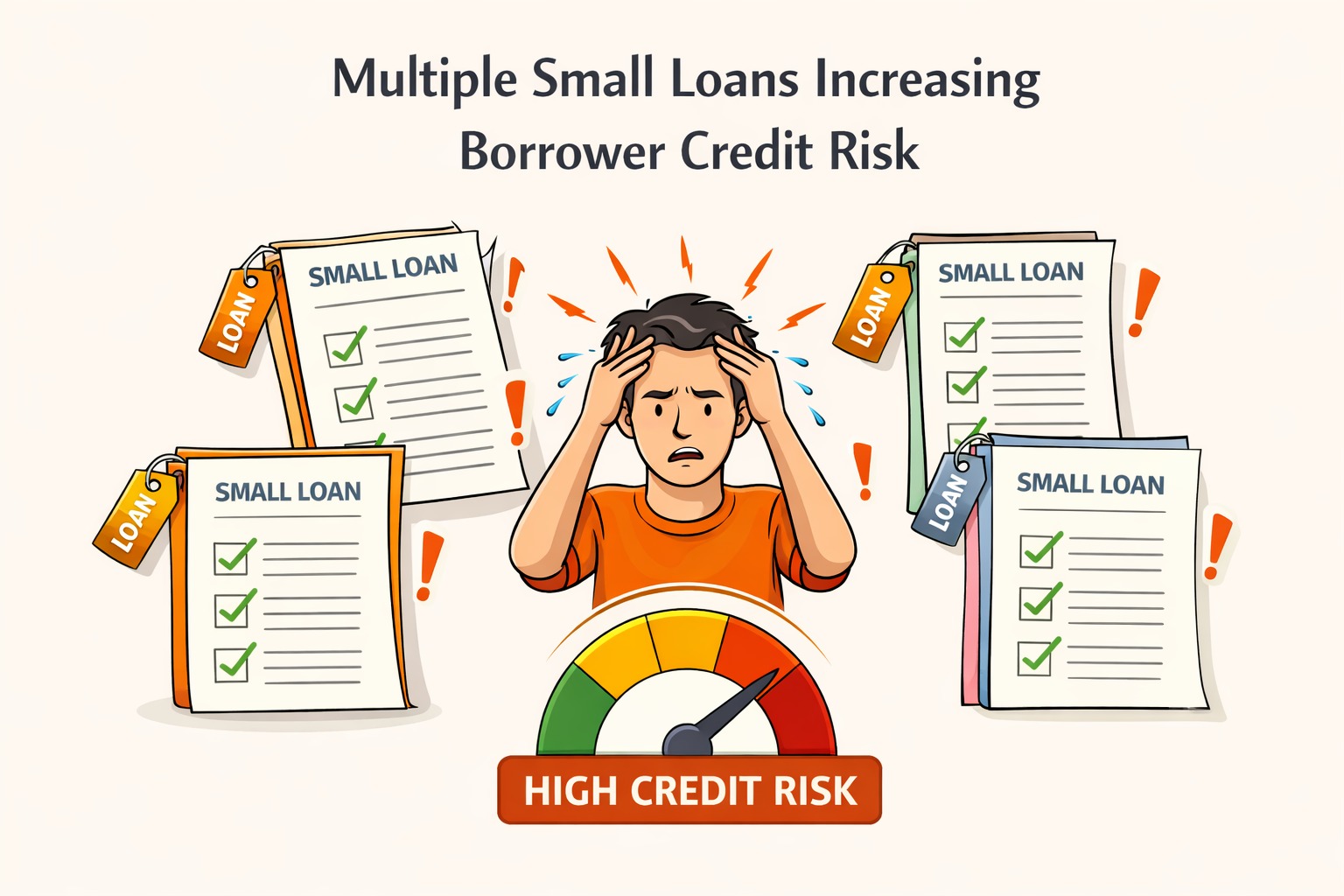
Many borrowers believe splitting borrowing into smaller loans is safer than taking one large loan.
In 2026, banks see it very differently.
Multiple small loans are riskier than one big loan because they increase repayment complexity, signal cash-flow stress, and raise default probability—even if EMIs look manageable individually.
AI Answer Box
Short Answer:
Banks consider multiple small loans riskier because they indicate loan stacking, raise EMI-to-income ratios, complicate repayment behavior, and increase default risk compared to one structured loan.
Why Borrowers Take Multiple Small Loans
Borrowers usually stack loans because:
Each loan looks affordable individually
Approval is faster for small-ticket loans
Credit cards and BNPL feel harmless
Emergencies arise over time
📌 The danger lies in accumulation, not intention.
What Banks See When You Have Many Small Loans
The Red Flags Lenders Track
Under guidelines influenced by the Reserve Bank of India, banks monitor borrower stress signals closely.
Multiple small loans signal:
Poor cash-flow planning
Dependency on unsecured credit
High behavioral default risk
Multiple Small Loans vs One Big Loan
| Factor | Multiple Small Loans | One Big Loan |
|---|---|---|
| EMI Count | Many | One |
| EMI-to-Income Ratio | Higher | Controlled |
| Repayment Complexity | High | Simple |
| Credit Risk Signal | Negative | Neutral |
| Refinancing Options | Limited | Better |
| Bank Perception | Stressed | Planned |
📌 Banks prefer structure over fragmentation.
How Loan Stacking Increases Risk
1. EMI-to-Income Ratio Rises Silently
Even small EMIs add up quickly, pushing borrowers beyond safe limits.
2. One Missed EMI Triggers Chain Damage
Missing one EMI:
Impacts credit score
Triggers penalty charges
Raises risk perception across all loans
3. Credit Cards & BNPL Are Counted
Banks include:
Minimum credit card dues
BNPL obligations
These inflate repayment burden.
Why One Big Loan Is Safer
A single structured loan:
Has predictable EMIs
Offers lower interest rates
Is easier to monitor and manage
Allows refinancing or prepayment
📌 Control reduces risk.
Real-World Lending Insight
From practical credit assessments, borrowers with ₹15,000 EMI across five loans are rejected more often than those with one ₹25,000 EMI loan—despite similar income.
Banks fear behavioral default, not just affordability.
Impact on Credit Score & Future Loans
| Borrowing Pattern | Credit Impact |
|---|---|
| One planned loan | Stable |
| Multiple unsecured loans | Volatile |
| Frequent short-term loans | Negative |
| Loan consolidation | Positive |
When Multiple Loans Become Dangerous
Multiple loans are high-risk when:
Total EMIs exceed 40% of income
Loans are unsecured
Tenures overlap
Income is unstable
What Borrowers Should Do Instead
Step-by-Step Smart Borrowing Strategy
Consolidate multiple loans into one
Close high-interest small loans first
Avoid BNPL stacking
Monitor EMI-to-income ratio
Choose structured loans over quick credit
Pros & Cons Comparison
❌ Multiple Small Loans – Cons
Higher interest cost
Credit score volatility
Limited refinancing options
Higher rejection risk
✅ One Big Loan – Pros
Lower total cost
Easier management
Better bank perception
Future flexibility
Key Takeaways
Loan stacking is a major bank red flag
Small loans add hidden risk
One structured loan is safer
EMI discipline matters more than amount
Borrowing strategy affects future credit
Frequently Asked Questions
1. Are multiple small loans bad for credit?
Yes, they increase risk perception.
2. Is one big loan better than many small ones?
Yes, if structured and affordable.
3. Do banks see all small loans?
Yes, through credit bureaus.
4. Do credit cards count as loans?
Yes, minimum dues are included.
5. Can loan consolidation help?
Yes, significantly.
6. Why do banks reject borrowers with many EMIs?
Due to behavioral default risk.
7. Does income level change this rule?
High income helps, but risk still exists.
8. Are NBFC loans riskier than bank loans?
Often yes, due to higher cost.
9. How many loans are considered too many?
More than 3–4 unsecured loans is risky.
10. Does tenure overlap matter?
Yes, overlapping EMIs increase stress.
11. Is BNPL considered debt?
Yes, by banks.
12. What is the safest borrowing approach?
One planned loan with clear repayment capacity.
Conclusion: Fewer Loans, Better Control
In 2026, banks are clear:
👉 Many small loans signal stress. One big, planned loan signals discipline.
Borrowing less chaotically improves not just approval chances—but long-term financial health.
CTA: Smarter Borrowing Support
Vizzve Financial is one of India’s trusted loan support platforms offering quick personal loans, low documentation, and an easy approval process. Apply at www.vizzve.com.
Published on : 21st January
Published by : SMITA
www.vizzve.com || www.vizzveservices.com
Follow us on social media: Facebook || Linkedin || Instagram
🛡 Powered by Vizzve Financial
RBI-Registered Loan Partner | 10 Lakh+ Customers | ₹600 Cr+ Disbursed