

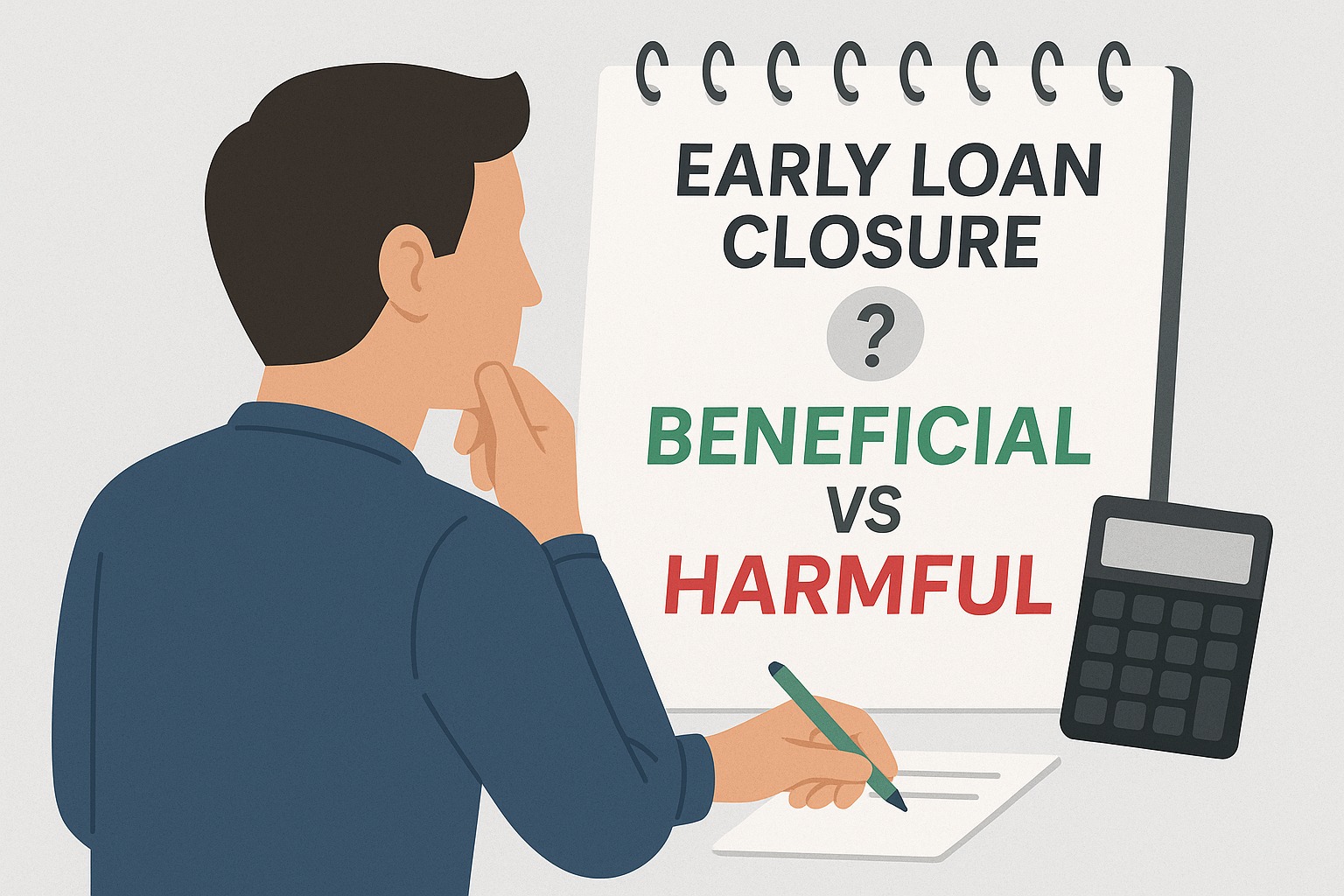
Most people assume that closing a loan early is always the smartest financial decision.
After all, you become debt-free faster and save on interest — so what could go wrong?
But here’s the truth:
Preclosure is NOT always beneficial.
In some situations, closing your loan early can reduce liquidity, affect your credit profile, or even cost you more than keeping the loan.
Here are the hidden scenarios where pre-closing a loan is actually not a good idea.
⭐ 1. When You’re Using Your Emergency Savings to Close the Loan
Never empty your:
FD
Savings account
Emergency fund
Liquid cash reserves
…just to close a loan.
Why?
Because emergencies such as medical needs, job loss or car breakdowns need immediate cash, not a debt-free certificate.
Always keep 3–6 months’ expenses as your financial safety net.
⭐ 2. When Your Loan Is Almost Over
If you are in the last 20–25% of your tenure:
You have already paid most of the interest
Remaining EMIs contain very little interest
Closing early saves almost nothing
Especially in home loans and personal loans, interest is front-loaded.
Closing a loan too late offers minimal benefit.
⭐ 3. When Your Loan Has a Pre-Closure Penalty
Some lenders charge:
2–5% foreclosure fees
Additional GST on charges
EMI cycle break fees
In many cases:
The penalty wipes out the savings, making preclosure pointless.
Always calculate the penalty vs. interest saved.
⭐ 4. When You’re Trying to Build Your Credit Score
A running loan with timely EMIs helps you:
✔ Build credit history
✔ Improve credit score
✔ Strengthen your repayment track record
If you close it too early:
You lose a good credit-building opportunity
Your credit mix becomes thinner
Score growth slows down
For new borrowers, keeping a loan for a reasonable period can be beneficial.
⭐ 5. When Interest Rates Are Already Low
If your loan has a very low interest rate — like:
7% home loan
8–10% education or secure loan
9% top-up loan
—then preclosing may not be financially smart.
Instead, you could invest the same money in instruments earning higher returns (10–15%).
Let the cheap loan run — let your investments grow.
⭐ 6. When You Have Higher-Interest Debt Elsewhere
If you have:
Credit card dues (30–42%)
BNPL EMIs (18–28%)
Overdrafts or short-term debt
…you should never pre-close lower interest loans first.
Always pay off the most expensive debt before touching cheaper loans.
⭐ 7. When You May Need a Big Loan Soon
If you're planning to apply for:
A home loan
A car loan
A large personal loan
…then keeping a running loan with disciplined EMI payments strengthens your:
Score
Eligibility
Creditworthiness
Closing too early may leave your credit file “thin”.
⭐ 8. When You’re Using Every Rupee in Your Account
Liquid cash gives you:
✔ Flexibility
✔ Cushion for expenses
✔ Investment opportunities
If preclosure empties your account or leaves you with very little savings,
Don’t do it.
Liquidity is more valuable than being debt-free on paper.
When Pre-Closure Is a Good Idea
It’s smart to pre-close when:
✔ You have excess funds
✔ Your loan interest rate is high
✔ You’re early in the tenure
✔ There is no penalty
✔ Your emergency fund is intact
Conclusion
Pre-closure is helpful only when done at the right time and in the right situation.
Blindly closing a loan early can affect your savings, liquidity and even credit score.
A financially smart person evaluates:
Cash flow
Interest cost
Penalties
Credit impact
Future needs
Before deciding whether early closure makes sense.
FAQs
Q1. Does preclosing a loan improve credit score?
Not always. It may stop your long-term credit history from growing.
Q2. When is the best time to preclose a loan?
In the early phase of the tenure when interest payments are high.
Q3. Which loans should be closed first?
High-interest ones like credit card dues, BNPL and personal loans.
Q4. Will preclosure reduce my EMI burden immediately?
Yes, once fully closed, you won’t have EMIs — but check penalties before doing it.
Q5. Should I use my savings to preclose a loan?
Not if it empties your emergency fund.
Published on : 13th November
Published by : SMITA
www.vizzve.com || www.vizzveservices.com
Follow us on social media: Facebook || Linkedin || Instagram
🛡 Powered by Vizzve Financial
RBI-Registered Loan Partner | 10 Lakh+ Customers | ₹600 Cr+ Disbursed