

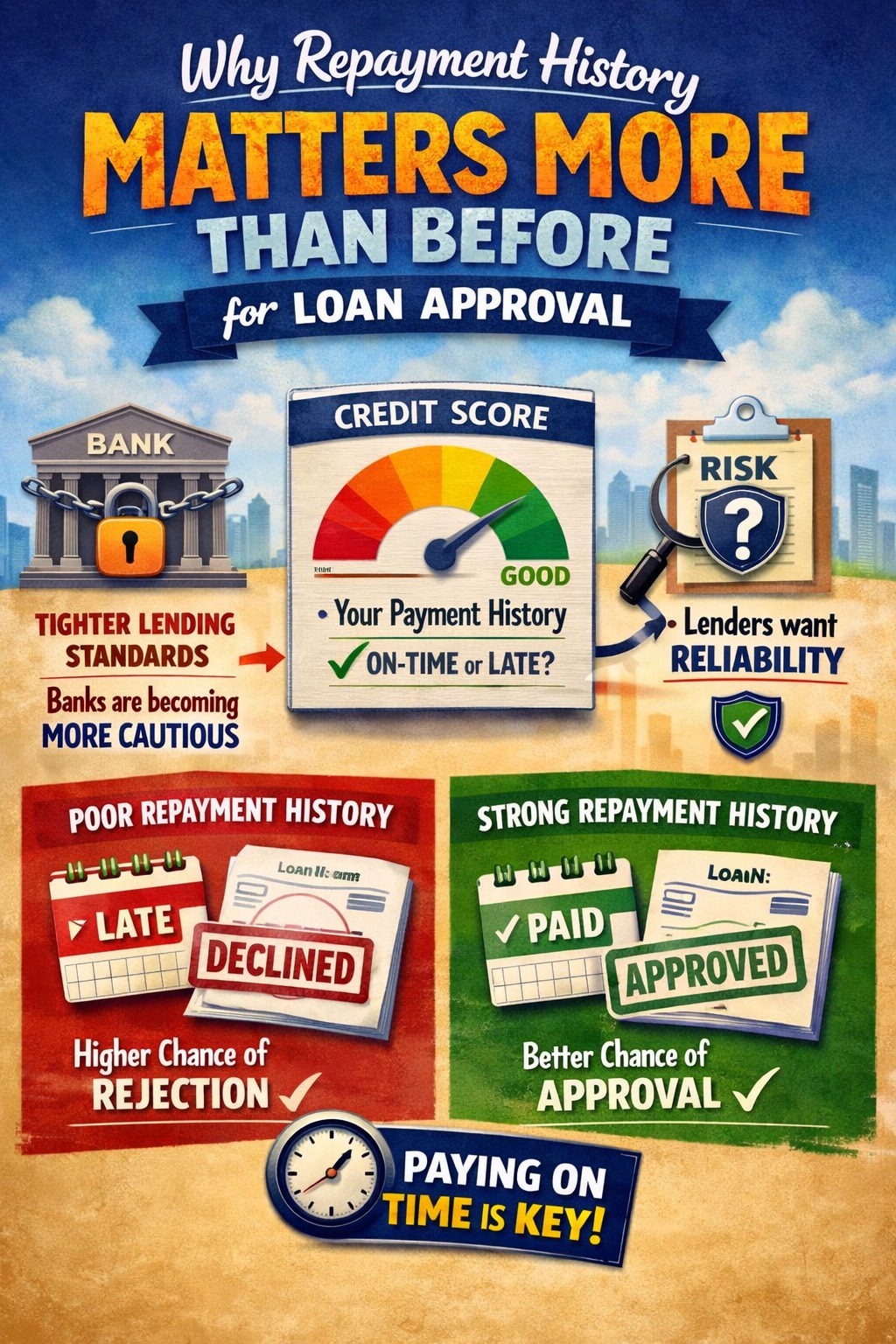
Repayment history matters more than before because lenders now prioritise consistent payment behaviour over just income or job profile when assessing loan risk.
AI ANSWER BOX
Why is repayment history so important now?
Repayment history shows how reliably a borrower pays EMIs. With rising loan volumes and credit risk, lenders rely more on repayment behaviour to decide approvals, limits, and interest rates.
INTRODUCTION
There was a time when salary slips, company name, or employer brand were enough to secure a loan. That time is over.
Today, banks and NBFCs care more about how you repay than how much you earn.
With rising bank credit, digital lending, and tighter risk controls, repayment history has become the strongest signal of borrower trustworthiness.
This blog explains:
What repayment history really means
Why it matters more now than before
How lenders use it
Real examples of impact
How borrowers can improve it
Written with lender-side insight and real borrower patterns, this guide helps you stay loan-ready in 2026 and beyond.
WHAT IS REPAYMENT HISTORY?
Repayment history is the record of how you’ve paid:
Loan EMIs
Credit card dues
BNPL or short-term credit
It includes:
On-time payments
Delays (DPD 30/60/90)
Defaults or settlements
📌 It forms the largest portion of your credit score (≈35–40%).
WHY REPAYMENT HISTORY MATTERS MORE THAN BEFORE
🔹 1. Record Bank Credit Has Increased Risk
With bank credit at record levels, lenders:
Have more borrowers
Face higher default exposure
Need stronger risk filters
📌 Past repayment behaviour is the most reliable predictor of future repayment.
🔹 2. Income Alone Is No Longer Reliable
Modern lending has shown:
High-income borrowers can still default
Job stability doesn’t guarantee discipline
📌 Behaviour > Income.
🔹 3. Digital Lending Needs Behaviour Signals
Instant loans rely on:
Automated credit decisions
Historical repayment data
📌 Algorithms trust patterns, not promises.
HOW LENDERS USE REPAYMENT HISTORY TODAY
| Repayment Behaviour | Lender Interpretation |
|---|---|
| Always on time | Low risk |
| Occasional delay | Moderate risk |
| Repeated delays | High risk |
| Settlement/default | Very high risk |
📌 Even small repeated delays matter more than one large mistake.
REPAYMENT HISTORY VS OTHER FACTORS
| Factor | Importance Today |
|---|---|
| Repayment history | ⭐⭐⭐⭐⭐ |
| Credit score | ⭐⭐⭐⭐ |
| Income | ⭐⭐⭐ |
| Job profile | ⭐⭐ |
| Employer brand | ⭐ |
📌 Repayment history now outweighs salary and designation.
REAL-WORLD EXAMPLE
| Borrower | Income | Repayment History | Result |
|---|---|---|---|
| A | ₹80,000 | Perfect | Approved at low rate |
| B | ₹1,20,000 | DPD 30 twice | Higher interest |
| C | ₹1,50,000 | Past settlement | Rejected |
👉 Income didn’t save poor repayment behaviour.
COMMON MISTAKES THAT HURT REPAYMENT HISTORY
Paying EMIs late by a few days repeatedly
Ignoring minimum credit card dues
Loan settlements instead of closures
Multiple small loans with missed payments
📌 Small mistakes repeated = big damage.
EXPERT COMMENTARY
“In today’s credit environment, repayment behaviour is the strongest trust signal. A clean history can outweigh income limitations.”
— Senior Credit Risk Head, Indian Bank
HOW TO BUILD STRONG REPAYMENT HISTORY
Step-by-step discipline:
Set auto-debit for all EMIs
Maintain EMI buffer of 2–3 months
Avoid unnecessary short-term loans
Pay credit cards before due date
Monitor credit report regularly
📌 Consistency matters more than speed.
HOW LONG DOES REPAYMENT HISTORY IMPACT LAST?
Records stay for up to 7 years
Recent behaviour matters most
Good repayment gradually dilutes old mistakes
📌 Time + discipline = recovery.
❓ FREQUENTLY ASKED QUESTIONS (FAQs)
1. Why is repayment history so important now?
Because lenders face higher risk.
2. Does one missed EMI matter?
Yes, if repeated.
3. Is repayment history more important than income?
Often, yes.
4. How much does it affect credit score?
Around 35–40%.
5. Can good income offset poor repayment?
Rarely.
6. How long does bad history stay?
Up to 7 years.
7. Does settlement hurt repayment history?
Yes, severely.
8. Can repayment history be fixed?
Yes, over time.
9. Do banks check recent history more?
Yes.
10. Are digital lenders stricter?
Yes.
11. Does repayment affect interest rate?
Strongly.
12. Can co-applicant help?
Yes, partially.
13. Does prepayment improve history?
Indirectly.
14. How often should I check my report?
Every 6 months.
KEY TAKEAWAYS
Repayment history is now the top loan factor
Consistent EMIs matter more than income
Small delays can hurt approvals
Clean behaviour lowers interest rates
Discipline builds long-term credit power
CONCLUSION
In today’s lending world, how you repay matters more than how much you earn. Repayment history is your financial reputation — once built, it opens doors to cheaper, faster, and easier credit.
Borrow wisely, repay consistently, and let your repayment history work in your favour.
Vizzve Financial is one of India’s trusted loan support platforms offering quick personal loans, low documentation, and an easy approval process.
In today’s credit-sensitive environment, Vizzve Finance helps borrowers understand and improve repayment discipline before borrowing.
👉 Apply at www.vizzve.com
Published on : 14th January
Published by : SMITA
www.vizzve.com || www.vizzveservices.com
Follow us on social media: Facebook || Linkedin || Instagram
🛡 Powered by Vizzve Financial
RBI-Registered Loan Partner | 10 Lakh+ Customers | ₹600 Cr+ Disbursed