

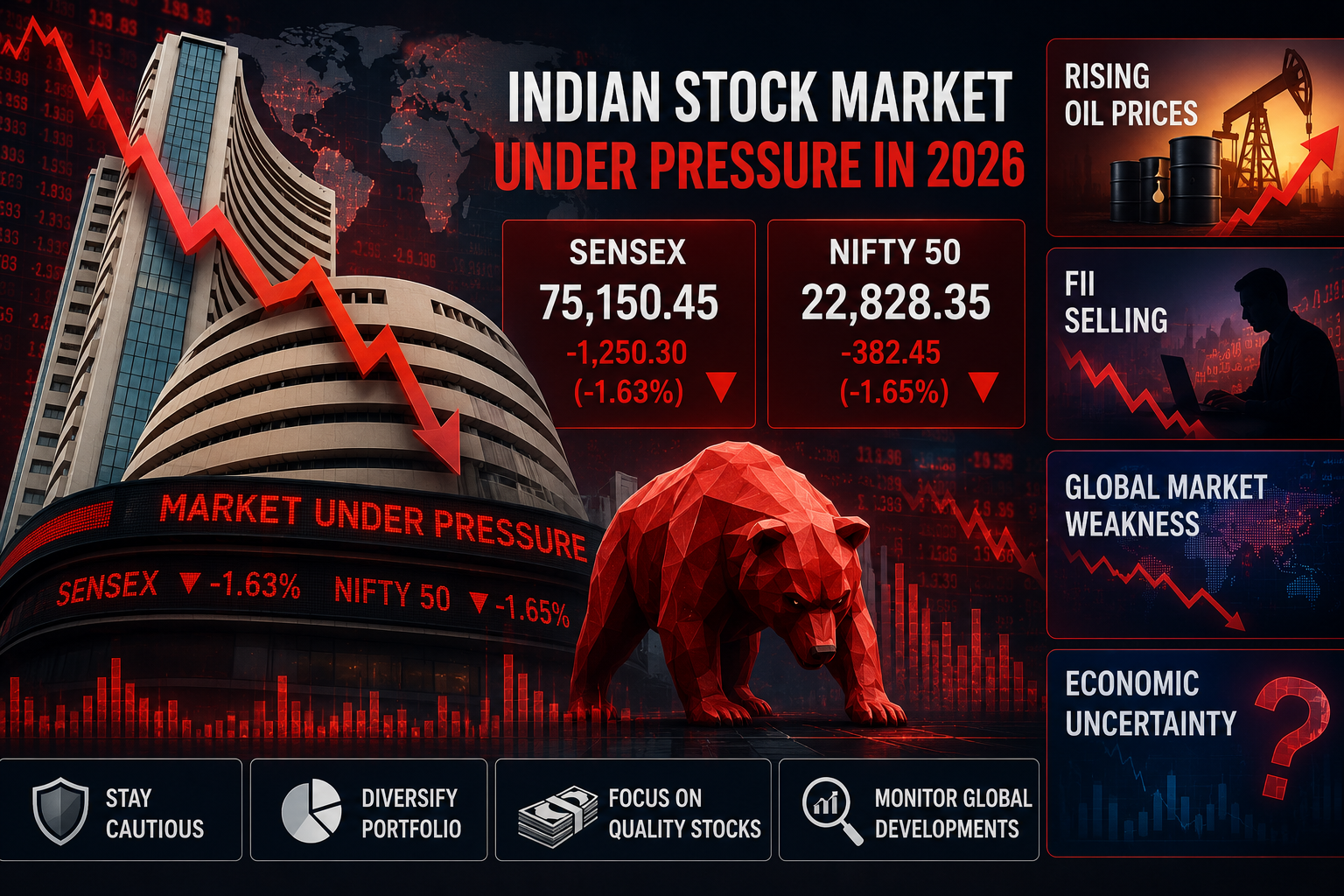
Indian stock markets could face a cautious start this week as investors digest a combination of global and domestic factors weighing on sentiment.
After recent volatility, traders are closely monitoring rising crude oil prices, foreign investor activity, geopolitical developments, and the Reserve Bank of India's latest policy signals.
While India's long-term growth story remains intact, short-term market sentiment appears vulnerable to external pressures.
AI Answer Box
Why may Sensex and Nifty open lower?
The key reasons include:
- Rising crude oil prices
- Foreign investor selling
- Global market weakness
- Geopolitical tensions
- Profit booking after recent gains
Is this a market crash?
No. A lower opening does not necessarily indicate a market crash. It may simply reflect short-term caution among investors.
What should investors watch?
Investors should monitor oil prices, FII flows, RBI commentary, global markets, and corporate earnings.
Introduction
The Indian stock market often reacts to a combination of domestic and global developments.
This week, investors are facing several concerns:
- Higher energy prices
- Global geopolitical uncertainty
- Foreign capital outflows
- Inflation risks
- Valuation concerns
These factors could put pressure on benchmark indices such as the Sensex and Nifty.
1. Rising Crude Oil Prices
Crude oil remains one of the biggest risks for Indian markets.
India imports a large portion of its oil requirements, making the economy highly sensitive to global energy prices.
Why It Matters
Higher oil prices can lead to:
- Increased inflation
- Higher transportation costs
- Reduced corporate margins
- Pressure on the rupee
These factors often negatively impact market sentiment.
Oil Price Impact on Sectors
| Sector | Impact |
|---|---|
| Aviation | Negative |
| Oil Marketing Companies | Mixed |
| Automobiles | Negative |
| Logistics | Negative |
| FMCG | Margin Pressure |
| Energy Producers | Positive |
2. Foreign Institutional Investors (FIIs) Continue Selling
Foreign Institutional Investors have remained cautious in recent sessions.
Large FII outflows can create downward pressure on markets because:
- Liquidity reduces
- Investor sentiment weakens
- Large-cap stocks face selling pressure
Banking, IT, and financial stocks are often the most affected.
3. Global Market Weakness
Indian markets are increasingly connected to global financial markets.
Investors are tracking:
- US market performance
- European economic data
- Asian market trends
- Interest-rate expectations
Weakness in global equities often influences Indian market openings.
4. Geopolitical Tensions
Ongoing geopolitical uncertainties continue affecting investor confidence.
Key concerns include:
- Energy supply disruptions
- Commodity price volatility
- Global trade uncertainty
- Risk-off sentiment
Whenever geopolitical risks rise, investors often move toward safer assets.
5. Profit Booking After Recent Gains
Markets have delivered strong gains over the past year.
After substantial rallies, investors often choose to lock in profits.
Signs of Profit Booking
- Heavy selling in large-cap stocks
- Volatile trading sessions
- Sector rotation
- Increased market fluctuations
This can temporarily pressure benchmark indices.
6. Rupee Remains Under Pressure
The Indian rupee has faced pressure from:
- Higher oil imports
- Foreign capital outflows
- Global dollar strength
A weaker rupee can increase costs for companies dependent on imports and affect overall market sentiment.
7. Inflation Concerns Are Back
Rising oil prices increase the risk of inflation.
Higher inflation may affect:
- Consumer spending
- Corporate profitability
- Interest-rate expectations
Investors are therefore closely monitoring inflation-related developments.
Key Factors Investors Should Watch
| Indicator | Importance |
|---|---|
| Crude Oil Prices | Very High |
| FII Activity | Very High |
| RBI Outlook | High |
| Rupee Movement | High |
| Global Markets | High |
| Inflation Data | High |
Which Sectors Could Face Pressure?
Banking
Large banks often react to foreign investor activity.
Information Technology
Global growth concerns can impact IT stocks.
Automobiles
Higher fuel prices may affect demand.
Consumer Goods
Margin pressure can emerge due to higher costs.
Which Sectors May Remain Resilient?
Infrastructure
Government spending continues supporting growth.
Capital Goods
Investment activity remains relatively healthy.
Defense
Strong order books continue supporting the sector.
Select Energy Stocks
Higher energy prices may benefit producers.
What Retail Investors Should Do
Short-term volatility is common in financial markets.
Investors should focus on:
- Long-term goals
- Quality businesses
- Diversification
- Risk management
Avoid making investment decisions solely based on one day's market movement.
Expert Commentary
Market experts believe the current weakness is primarily driven by external factors rather than fundamental deterioration in India's economy.
Positive factors still supporting markets include:
- Strong GST collections
- Infrastructure spending
- Healthy banking system
- Digital economy growth
- Stable economic outlook
However, rising oil prices and global uncertainty are creating short-term caution among investors.
Key Takeaways
✅ Sensex and Nifty may open lower due to multiple global and domestic pressures.
✅ Rising crude oil prices remain the biggest concern.
✅ FII selling continues affecting sentiment.
✅ Global market weakness is influencing Indian equities.
✅ Geopolitical tensions are increasing volatility.
✅ India's long-term economic fundamentals remain relatively strong.
Pros & Cons for Investors
Pros
- Buying opportunities may emerge
- Strong companies become attractive at lower valuations
- Long-term growth story remains intact
Cons
- Short-term volatility
- Increased uncertainty
- Pressure on risk-sensitive sectors
Conclusion
A weaker opening for Sensex and Nifty this week would likely reflect short-term market concerns rather than a major shift in India's economic outlook.
Rising oil prices, foreign investor selling, geopolitical tensions, and global market weakness are creating temporary pressure on sentiment.
For long-term investors, however, India's structural growth drivers—including infrastructure spending, digital transformation, financial inclusion, and strong domestic demand—continue to provide support.
As always, investors should focus on fundamentals rather than reacting to short-term market fluctuations.
Frequently Asked Questions (FAQs)
1. Why may Sensex open lower this week?
Rising oil prices, FII selling, and global uncertainty.
2. Why is Nifty under pressure?
Investor caution and external market risks.
3. Are FIIs selling Indian stocks?
Recent foreign outflows have affected market sentiment.
4. How do oil prices impact stocks?
Higher oil prices increase inflation and business costs.
5. Is this a stock market crash?
No, it appears to be normal market volatility.
6. Which sectors are most affected?
Banking, IT, auto, and consumer sectors.
7. Which sectors may benefit?
Energy producers, defense, and infrastructure.
8. Should retail investors panic?
Long-term investors should focus on fundamentals.
9. What role does RBI policy play?
Interest-rate expectations influence market sentiment.
10. What should investors watch next?
Oil prices, FII flows, inflation data, and global markets.
Published on : 8th June
Published by : SMITA
www.vizzve.com || www.vizzveservices.com
Follow us on social media: Facebook || Linkedin || Instagram
🛡 Powered by Vizzve Financial
RBI-Registered Loan Partner | 10 Lakh+ Customers | ₹600 Cr+ Disbursed