

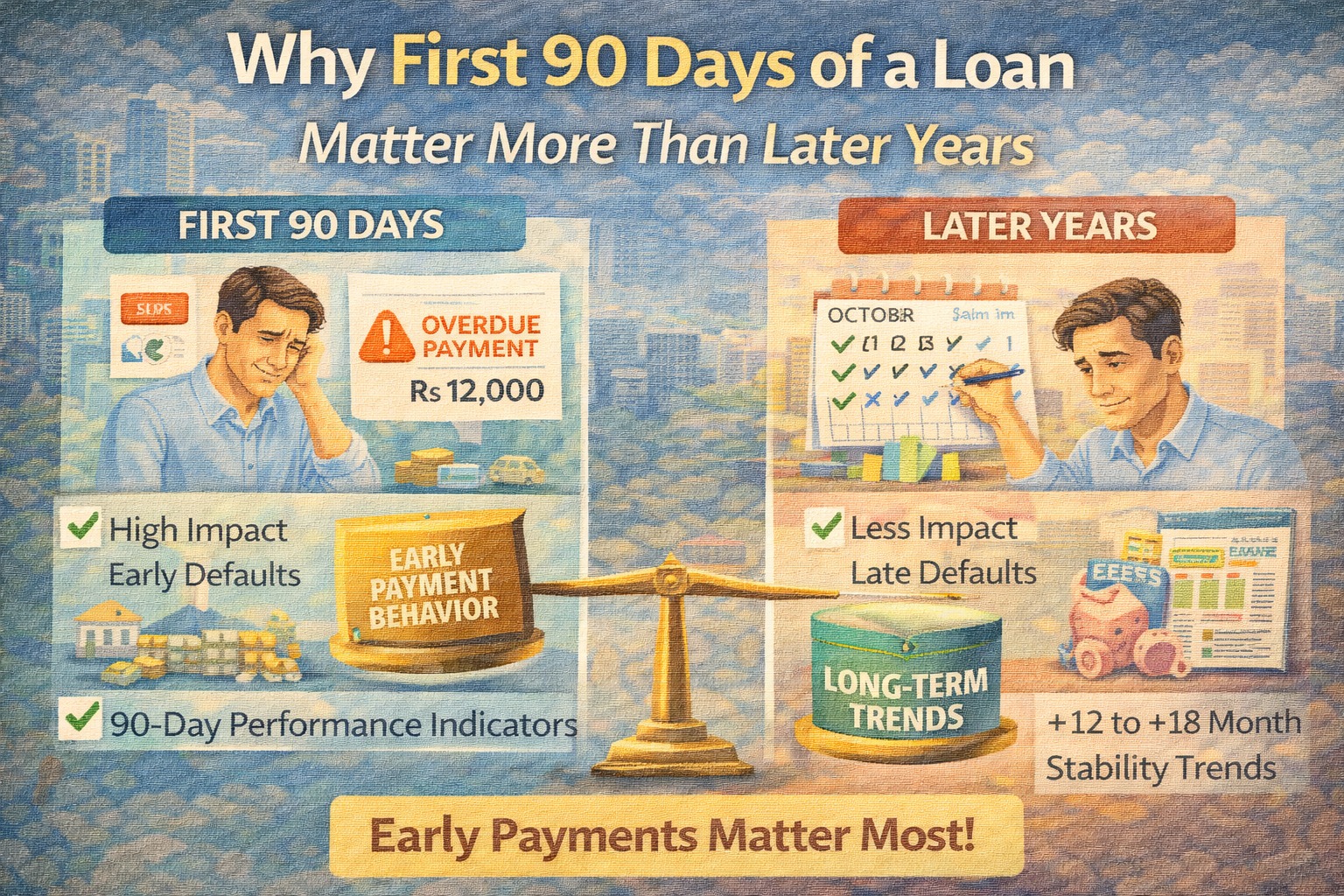
The first 90 days of a loan set the tone for interest cost, credit score impact, lender trust, and future approvals. Early repayment behavior matters more than years of later discipline.
AI Answer Box (For Google AI Overview & AI Search)
Lenders and credit bureaus closely monitor the first 90 days of a loan because early EMIs reveal repayment discipline, financial comfort, and risk behavior. Mistakes early in a loan have long-lasting effects, while good early behavior builds lasting trust.
Why Banks Focus So Much on the First 90 Days
When a loan starts, lenders ask:
Can this borrower handle EMIs comfortably?
Are payments on time without reminders?
Is cash flow stable after loan disbursal?
The first 90 days answer all these questions quickly.
What Happens in the First 90 Days of a Loan
1️⃣ Your Risk Profile Is Set Early
Credit systems classify borrowers early:
On-time EMIs → Low risk
Delays or bounces → High risk
Once tagged, it’s hard to reverse quickly.
2️⃣ Credit Score Impact Is Strongest Early
A delay in the first EMIs:
Hurts score more sharply
Signals poor planning
Later delays hurt too—but early delays hurt trust more.
3️⃣ Interest Cost Direction Is Locked In
Good early behavior:
Helps in future rate negotiations
Improves refinancing eligibility
Bad early behavior:
Limits options
Leads to higher pricing later
4️⃣ Bank Statement Stress Shows Immediately
After loan disbursal, lenders watch:
End-of-month balances
Overdraft usage
EMI comfort
If EMIs strain cash flow early, it’s a warning sign.
Future Credit Decisions Are Influenced
Your first 90 days affect:
Credit card limit increases
Top-up loans
New loan approvals
Banks trust borrowers who start strong.
First 90 Days vs Last 5 Years (Reality Check)
| Aspect | First 90 Days | Last 5 Years |
|---|---|---|
| Risk tagging | Very high | Low |
| Credit score impact | Strong | Moderate |
| Lender trust | Built or broken | Maintained |
| Interest leverage | Formed | Limited |
| Behavioral signal | Fresh & decisive | Expected |
Common Mistakes Borrowers Make Early
Paying EMI on the last possible day
Ignoring auto-debit failures
Underestimating EMI impact
Using loan money for lifestyle, not plan
No EMI buffer in bank account
Small mistakes early become long-term costs.
Real-Life Borrower Example
Borrower A:
First 3 EMIs paid on time, balance maintained → gets future loan easily.
Borrower B:
First EMI bounced, second paid late → struggles with approvals for years.
Same income. Same loan. Different outcomes.
Expert Insight
“Early loan behavior tells us whether repayment discipline is natural or forced. That signal is more valuable than years of later correction.”
— Retail Credit Risk Analyst
How to Win the First 90 Days of a Loan
✅ 1. Maintain EMI Buffer
Keep 1–2 EMIs in the account at all times.
✅ 2. Pay Before Due Date
Early payments show comfort, not compulsion.
✅ 3. Avoid New Debt
No credit cards, BNPL, or new loans during this phase.
✅ 4. Track Bank Balance Weekly
Ensure EMIs don’t push you into zero balance.
✅ 5. Treat First 3 EMIs as a Test Phase
If it feels tight early, adjust fast.
Myths (Busted)
❌ “Later good behavior will fix early mistakes”
✅ Early signals linger longer
❌ “Only long-term history matters”
✅ Early history sets the base
❌ “One early delay is okay”
✅ Early delays are heavily weighted
Key Takeaways
First 90 days define loan trust
Early EMIs shape credit score sharply
Lenders tag risk early
Later discipline can’t fully erase early mistakes
Strong starts lead to easy credit later
Conclusion
Loans aren’t judged evenly across their life. The first 90 days carry outsized importance because they reveal true repayment behavior before habits form. Borrowers who start strong enjoy lower stress, better rates, and easier approvals for years. Those who stumble early often spend the rest of the loan repairing damage.
In lending, first impressions last the longest.
❓ Frequently Asked Questions (FAQs)
1. Why are the first 90 days of a loan so important?
Because lenders assess repayment discipline, cash-flow comfort, and risk behavior immediately after disbursal.
2. Does one missed EMI in the first few months matter a lot?
Yes. Early EMI delays are weighted more heavily than delays later in the loan tenure.
3. Can good repayment later fix early mistakes?
Partially, but early negative signals stay longer in lender risk models.
4. Is credit score impacted more in the first 90 days?
Yes. Credit score movement is often sharper during the initial months of a loan.
5. Do banks monitor early loan behavior closely?
Yes. The first 2–3 EMIs are closely watched to assess repayment comfort.
6. Should I prepay during the first 90 days?
Only if financially comfortable. On-time payments matter more than prepayment early on.
7. What is the biggest mistake borrowers make in the first 90 days?
Underestimating EMI impact and not keeping an EMI buffer.
8. Does early EMI behavior affect future loans?
Yes. It influences future loan approvals, top-ups, and interest rates.
9. Are digital lenders stricter in the early months?
Yes. Automated systems heavily rely on early repayment data.
10. How much buffer should I keep for early EMIs?
Ideally 1–2 months of EMI amount in your bank account.
11. Does paying EMI before due date help?
Yes. Early payments signal repayment comfort, not stress.
12. Can EMI bounces in early months cause rejection later?
Yes. Early bounces significantly reduce lender confidence.
13. Is loan tenure extension bad in early months?
Yes. Early tenure extension signals EMI stress.
Published on : 16th January
Published by : SMITA
www.vizzve.com || www.vizzveservices.com
Follow us on social media: Facebook || Linkedin || Instagram
🛡 Powered by Vizzve Financial
RBI-Registered Loan Partner | 10 Lakh+ Customers | ₹600 Cr+ Disbursed