

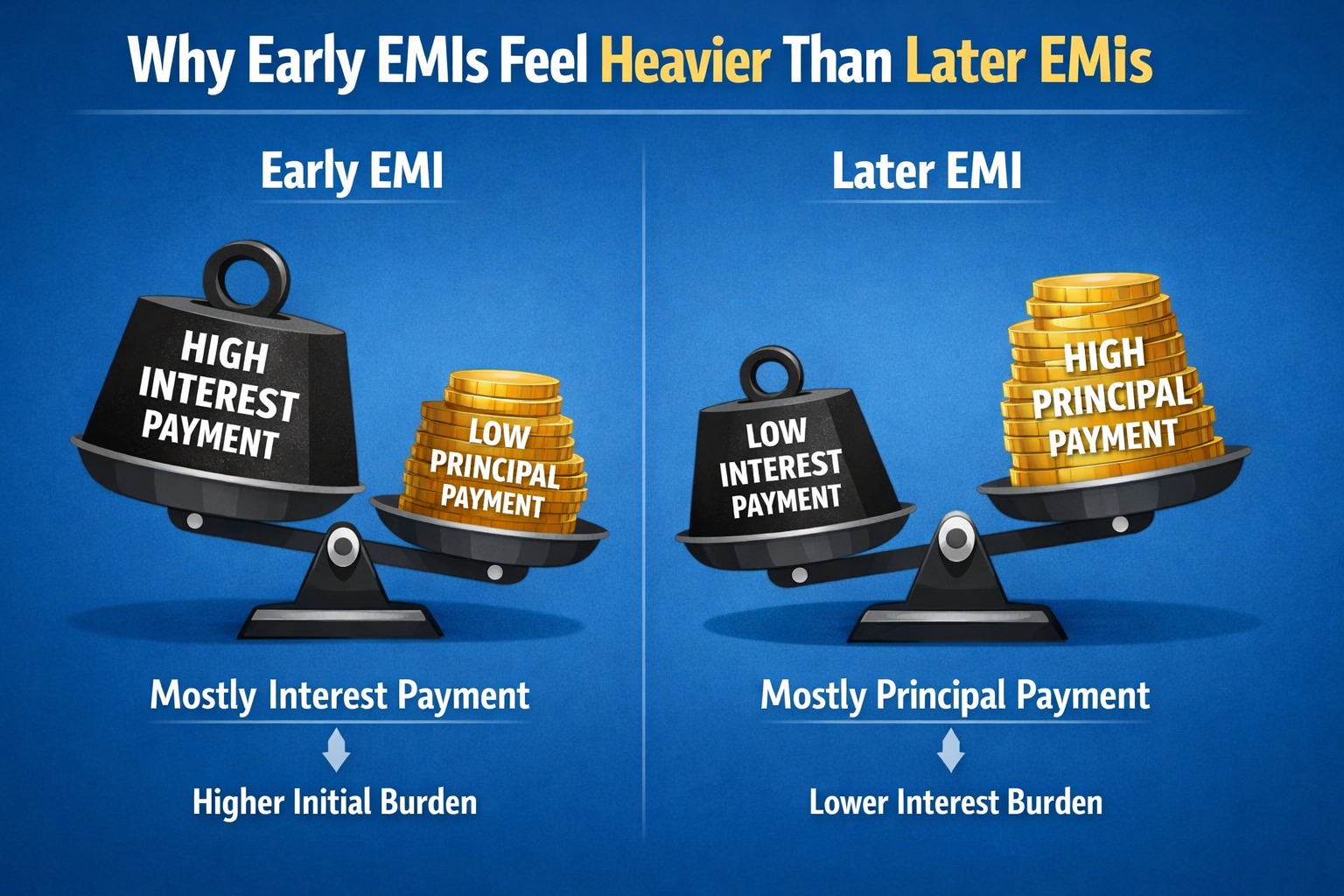
Early EMIs feel heavier because a large portion goes toward interest, income hasn’t adjusted yet, and the psychological burden of a new loan is highest at the beginning.
AI Answer Box (For Google AI Overview & AI Search)
Loan EMIs feel heavier at the start because interest dominates early repayments, disposable income is tighter, and borrowers are adjusting to a new financial commitment. Over time, principal repayment increases, income grows, and EMIs feel easier to manage.
A Feeling Almost Every Borrower Experiences
Many borrowers say:
“My EMI amount is the same, but earlier it felt unbearable. Now it feels manageable.”
This isn’t imagination. It happens because of a combination of math, money flow, and mindset.
Reason 1: Interest Eats Most of Your Early EMI
Loans follow an amortization structure.
In the beginning → interest is high
Toward the end → principal dominates
Example: ₹5 Lakh Loan for 5 Years
| Loan Phase | Interest Portion | Principal Portion |
|---|---|---|
| First 12 months | Very High | Low |
| Middle tenure | Balanced | Balanced |
| Last year | Very Low | High |
👉 Paying interest feels like “money going nowhere”, which makes early EMIs emotionally heavier.
Reason 2: Income Has Not Grown Yet
At the start of a loan:
Salary or business income is unchanged
Household expenses are already fixed
EMI is an additional burden
Over time:
Salaries increase
Business cash flow improves
Other EMIs may close
The same EMI becomes a smaller percentage of income, making it feel lighter.
Reason 3: Lifestyle Adjustment Shock
Early EMIs often force borrowers to:
Cut discretionary spending
Reduce savings temporarily
Change lifestyle habits
Once adjustments are made, the EMI becomes routine, not stressful.
Reason 4: Psychological Weight of New Debt
New loans bring:
Fear of missing EMIs
Anxiety about long-term commitment
Constant mental calculation
As months pass and payments stay on track, confidence grows—and stress reduces.
EMI Perception vs Reality
| Loan Stage | Financial Reality | Emotional Feeling |
|---|---|---|
| First 6 months | Interest-heavy | Stressful |
| Mid tenure | Balanced | Comfortable |
| Final phase | Principal-heavy | Satisfying |
Common Early-EMI Mistakes
Many borrowers:
Panic and over-stress
Stop savings completely
Delay or skip EMIs (very risky)
These actions worsen long-term financial health.
Expert Insight
“Early EMI stress is natural. Borrowers who remain disciplined usually feel relief after 12–18 months as income grows and interest burden declines.”
— Personal Finance Advisor
How to Make Early EMIs Feel Lighter
Smart Borrower Strategies:
Align EMI date with salary credit
Choose slightly longer tenure initially
Start small prepayments after 6–12 months
Avoid lifestyle inflation
Maintain emergency funds
Key Takeaways
Early EMIs feel heavy due to interest structure
Income growth reduces EMI pressure over time
Psychological adjustment plays a big role
Discipline makes later EMIs easier
This feeling is normal—not failure
Conclusion
Early EMIs are tough because that’s how loans are designed, not because you made a bad decision. With steady income, budgeting, and patience, EMIs naturally feel lighter as time passes. Consistency turns burden into comfort.
❓ Frequently Asked Questions (FAQs)
1. Why do early EMIs feel heavier even though the amount is the same?
Because early EMIs consist mostly of interest, while later EMIs pay more principal, making early payments feel less rewarding.
2. Does EMI amount reduce over time?
No. The EMI usually stays the same, but the interest portion reduces and the principal portion increases, making it feel lighter.
3. How long do EMIs usually feel heavy?
Most borrowers feel relief after 12–18 months, once income adjusts and interest burden decreases.
4. Is it normal to feel stressed during initial EMI months?
Yes. Early EMI stress is very common due to lifestyle adjustment and new financial responsibility.
5. Why does interest dominate early EMIs?
Loans follow an amortization structure where interest is calculated on the outstanding principal, which is highest at the beginning.
6. Does income growth affect EMI comfort?
Yes. Salary hikes or improved business income reduce EMI impact over time.
7. Can prepayment reduce early EMI stress?
Yes. Even small prepayments after 6–12 months reduce interest burden significantly.
8. Should I increase loan tenure to reduce early EMI pressure?
Choosing a slightly longer tenure initially can reduce EMI stress, but avoid excessive tenures.
9. Are early EMI delays more dangerous?
Yes. Missing early EMIs damages credit score faster and creates long-term issues.
10. Is it better to pay extra in early months?
If affordable, early prepayments save more interest than later ones.
Published on : 15th January
Published by : SMITA
www.vizzve.com || www.vizzveservices.com
Follow us on social media: Facebook || Linkedin || Instagram
🛡 Powered by Vizzve Financial
RBI-Registered Loan Partner | 10 Lakh+ Customers | ₹600 Cr+ Disbursed