

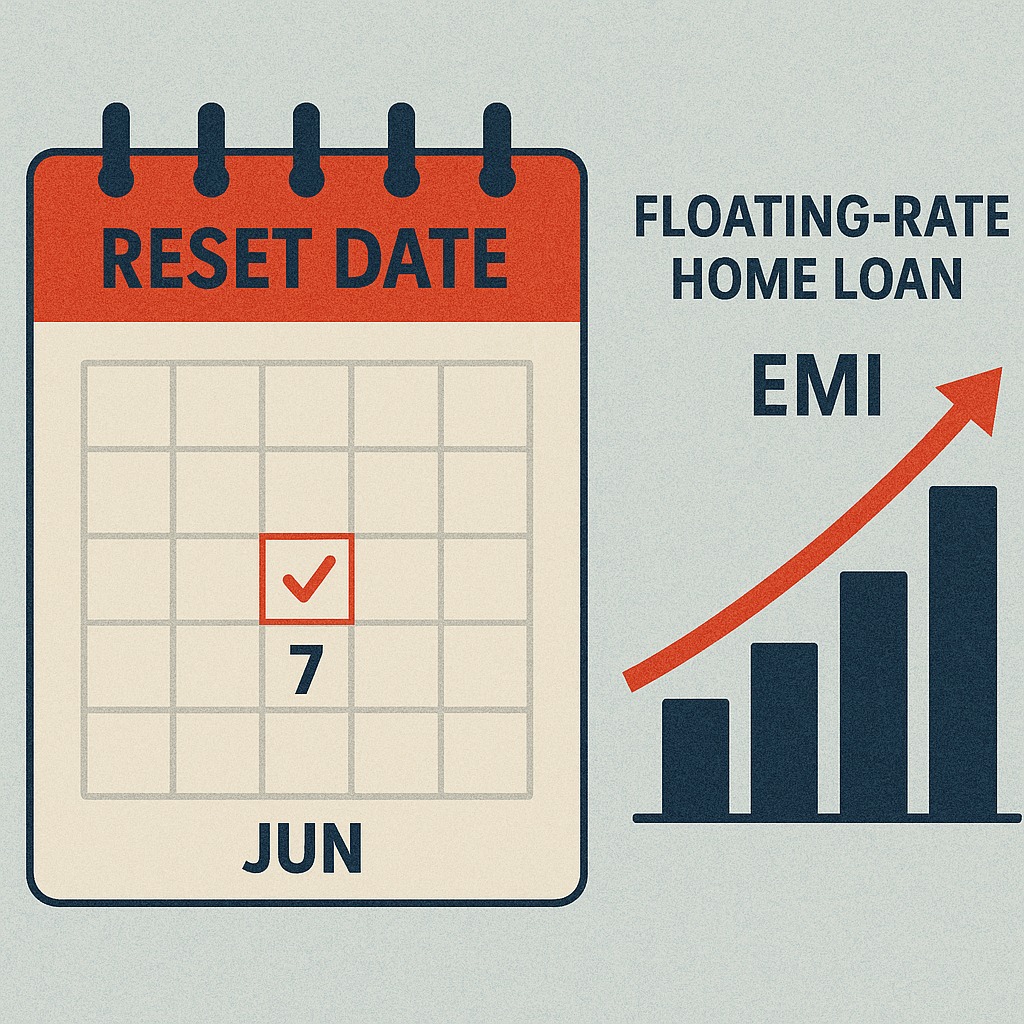
Floating-rate home loans are popular in India because lenders adjust interest rates based on market conditions.
But what many borrowers don’t realise is that these loans include a “reset date”—a specific date when the lender revises your loan’s interest rate.
And when rates have gone up in the market, this revision leads to an unexpected, sudden spike in EMIs or an extension in tenure.
This sudden jolt is known as “Reset Date Shock.”
Let’s break it down.
What Is a Reset Date?
Every floating-rate loan has a schedule on which the bank re-evaluates your interest rate.
This happens:
Every 3 months (quarterly)
Every 6 months (half-yearly)
Or once a year (annually)
depending on the lender’s policy.
Until the reset date arrives, your EMI stays unchanged, even if market rates have risen significantly.
When the reset date hits, the new rate is applied all at once — causing the shock.
What Causes the Reset Date Shock?
Here’s what happens behind the scenes:
✔ Market rates rise
Banks follow repo-linked or MCLR-linked interest structures.
When the RBI increases rates (as it did multiple times in recent years), floating rates move up gradually.
✔ Your EMI stays the same
Because your interest rate is only revised on the reset date.
✔ Suddenly the new rate kicks in
If your rate rises from 7% → 9%, the EMI recalculates instantly.
✔ Result: Your EMI jumps overnight
Or your loan tenure increases sharply.
This sudden jump—despite months of “silence”—is what borrowers call the Reset Date Shock.
How Big Can the Shock Be?
A typical ₹50 lakh home loan with a hike of just 1–2% can see:
EMI rise by ₹4,000–₹8,000 per month, or
Tenure extend by 3–7 years
This becomes even more severe for loans with long reset cycles (annual reset).
Why Do Banks Use Reset Dates?
✔ Administrative simplicity
All floating loans are adjusted in cycles rather than daily.
✔ Protection for borrowers
You get stable EMIs for months rather than weekly changes.
✔ Standardisation
All borrowers with the same reset cycle face the same timing.
How to Prepare for Reset Date Shock
1. Track your next reset date (very important)
It’s mentioned in your loan agreement or home loan portal.
2. Estimate the revised EMI in advance
Use an EMI calculator with the current repo/MCLR rate.
3. Increase EMI a little every year
Even a 5–10% increase lowers the impact of sudden jumps.
4. Make part-prepayments before reset
Reduces the principal → reduces the final EMI shock.
5. Consider switching to a repo-linked rate (RLLR)
More transparent than MCLR and adjusts faster.
6. If EMI jumps too much, request tenure extension
A temporary fix if the monthly cashflow is tight.
What Happens If Rates Fall Instead?
Good news: Reset dates work both ways.
If interest rates soften:
Your EMI will drop, or
Your tenure will reduce
But only when the next reset date arrives.
❓ FAQs
1. What is a reset date in a home loan?
It’s the scheduled date when your lender revises the interest rate on a floating-rate loan.
2. Why does EMI suddenly increase on this date?
Because all accumulated rate changes since the last reset take effect at once.
3. Can I change my reset cycle?
Some banks allow it, but usually with charges.
4. Should I worry about reset date shock?
You should plan for it, especially during rising interest-rate periods.
5. Can I avoid the shock completely?
Not fully. But prepayments, refinancing, and EMI increases can reduce the effect.
Published on : 20th November
Published by : SMITA
www.vizzve.com || www.vizzveservices.com
Follow us on social media: Facebook || Linkedin || Instagram
🛡 Powered by Vizzve Financial
RBI-Registered Loan Partner | 10 Lakh+ Customers | ₹600 Cr+ Disbursed