

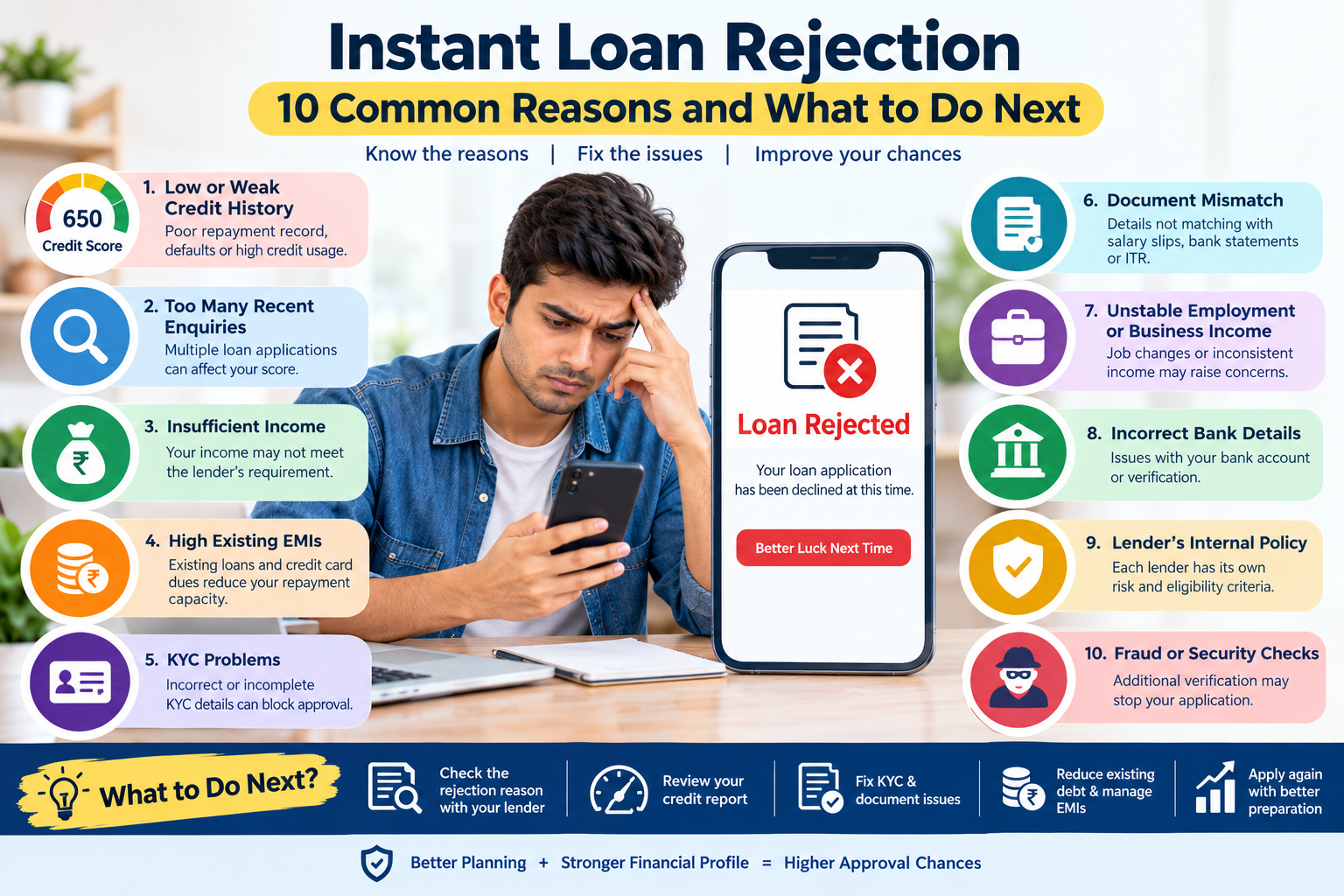
A personal loan application can be rejected because of a weak credit history, insufficient income, high existing EMIs, incomplete KYC, document mismatches, unstable income, too many recent credit applications or the lender's internal eligibility criteria.
Lenders are expected to properly assess a borrower's creditworthiness before extending credit. For certain small borrowers, RBI's fair-practice guidance also says lenders should communicate the main reasons for rejection within the stipulated time.
10 Common Reasons Your Personal Loan Gets Rejected
1. Low or Weak Credit History
Your credit history helps lenders understand previous repayment behaviour. Missed payments, defaults or limited credit history can affect a loan application.
However, there is no single credit-score number that guarantees approval because lenders use their own policies.
2. High Existing EMIs
If a large portion of your monthly income is already committed to EMIs, the lender may consider another loan difficult to manage.
Existing personal loans, credit-card balances and other obligations can therefore affect eligibility.
3. Insufficient Income
Lenders assess whether your income is sufficient to repay the proposed loan.
If the requested amount is high compared with your income and existing obligations, the application may not meet the lender's criteria.
4. Too Many Recent Loan Applications
Applying for several loans or credit products within a short period can result in multiple credit enquiries.
Frequent applications may become one of the factors considered during credit assessment.
5. KYC Problems
Incorrect, incomplete or inconsistent KYC information can delay verification or lead to rejection.
Make sure your personal details match across your application and submitted documents.
6. Income or Document Mismatch
Problems can arise when the income stated in the application does not match supporting documents such as bank statements, salary records or tax documents.
Always provide accurate and up-to-date information.
7. Unstable Employment or Business Income
Some lenders consider employment or income stability when assessing repayment capacity.
Frequent job changes, irregular income or limited business history may affect an application depending on the lender's criteria.
8. Incorrect Bank Details
Incorrect account information or problems during bank-account verification can prevent an application from moving forward.
Check your account details carefully before submitting the application.
9. Lender-Specific Eligibility Rules
Every bank or NBFC can have its own credit policies.
Factors such as age, income, occupation, location, existing debt and loan amount may be considered differently by different lenders.
10. Fraud or Security Verification
Additional verification may be triggered when application information appears unusual or inconsistent.
These checks are designed to protect both lenders and borrowers.
Personal Loan Rejection: Quick Summary
| Reason | What It Can Affect |
|---|---|
| Weak credit history | Credit assessment |
| High existing EMIs | Repayment capacity |
| Low income | Loan affordability |
| Multiple recent enquiries | Credit profile |
| KYC issues | Identity verification |
| Document mismatch | Application verification |
| Unstable income | Repayment assessment |
| Incorrect bank details | Account verification |
| Internal lender policy | Eligibility |
| Security checks | Application processing |
What Should You Do After a Personal Loan Rejection?
1. Find Out the Reason
Start by checking the lender's communication. For covered cases, RBI's fair-practice guidance requires lenders to communicate the main reasons for rejection within the stipulated time.
2. Check Your Credit Report
Review your credit report for:
- Incorrect personal information
- Unknown accounts
- Missed-payment records
- Outstanding balances
- Recent credit enquiries
If you find an error, contact the relevant credit bureau or lender to request correction.
3. Review Your Existing Debt
Calculate your current monthly EMI obligations against your income.
If your debt burden is high, improving your repayment position may help before another application.
4. Check Your Documents
Make sure your KYC, income documents, employment information and bank details are accurate and consistent.
5. Avoid Applying Everywhere Immediately
Multiple applications in a short period may result in additional credit enquiries. Instead, understand why the first application was rejected before applying again.
How Can You Improve Personal Loan Eligibility?
You can work on your overall financial profile by:
- Paying existing EMIs on time
- Keeping credit-card balances manageable
- Avoiding unnecessary loan applications
- Maintaining accurate KYC information
- Keeping income documents updated
- Reducing outstanding debt where possible
- Choosing a loan amount that fits your repayment capacity
RBI's digital-lending framework requires regulated entities to capture relevant economic information and assess borrower creditworthiness in an auditable manner.
Personal Loan Rejection vs Instant Loan Rejection
These terms are related but can occur at different stages.
| Situation | Meaning |
|---|---|
| Initial eligibility | Preliminary assessment |
| Application under review | Lender is verifying information |
| Additional verification | More information may be required |
| Final rejection | Lender has declined the application |
| Approved | Loan has passed the lender's required checks |
An online message such as “eligible” or “pre-approved” should not automatically be treated as final loan approval if further verification is pending.
What to Check Before Applying Again
Before submitting another personal loan application, check:
Credit report → Existing EMIs → Income → KYC → Documents → Loan amount → Lender eligibility criteria
Also compare the interest rate, APR, processing fee and other charges before accepting a loan offer. RBI's digital-lending framework requires regulated entities to disclose the all-inclusive cost through APR and follow requirements around consent-based data collection.
Key Takeaways
- A personal loan can be rejected for several reasons, not just credit score.
- High existing EMIs and insufficient income can affect repayment-capacity assessment.
- KYC or document inconsistencies can cause verification problems.
- Different lenders use different eligibility and risk policies.
- Check the rejection reason before submitting another application.
- Review your credit report and existing debt.
- Never trust websites or apps promising guaranteed loan approval.
- Compare the complete cost of borrowing, including APR and fees.
FAQs About Personal Loan Rejection
1. Why was my personal loan application rejected?
Common reasons include credit history, income, existing EMIs, KYC problems, document mismatches and lender-specific eligibility criteria.
2. Can a good credit score still result in loan rejection?
Yes. Credit score is only one part of the assessment. Income, existing obligations, documents and lender policy can also matter.
3. Does low income affect personal loan approval?
It can. Lenders generally assess whether the applicant has sufficient repayment capacity for the requested loan.
4. Can high EMIs cause personal loan rejection?
Yes. High existing monthly obligations can reduce the amount of income available for another EMI.
5. Can incorrect KYC details cause rejection?
Yes. Inconsistent or incomplete information can create verification problems.
6. Should I apply for another loan immediately after rejection?
It is better to first understand the rejection reason and review your financial and credit profile before making another application.
7. Can multiple loan applications affect my credit profile?
Multiple credit enquiries may appear on your credit report and can be considered as part of a lender's assessment.
8. What documents should I check before applying?
Depending on the lender, you may need KYC documents, income proof, bank statements and other supporting documents.
9. Can self-employed borrowers get personal loans?
Yes. Eligibility depends on the lender and may include assessment of business income, bank transactions, tax documents and repayment capacity.
10. Is personal loan approval guaranteed if an app shows “pre-approved”?
No. A preliminary offer or eligibility indication may still be subject to further verification and the lender's final decision.
11. What should I do if my credit report has an error?
Identify the incorrect entry and contact the relevant credit bureau or lender to request verification and correction.
12. Is a loan rejection the same as loan default?
No. A rejection means the lender did not approve the application. A default generally relates to failure to meet repayment obligations on an existing credit facility.
Published on : 24th September
Published by : Shibam Nath
www.vizzve.com || www.vizzveservices.com
Follow us on social media: Facebook || Linkedin || Instagram
🛡 Powered by Vizzve Financial
RBI-Registered Loan Partner | 10 Lakh+ Customers | ₹600 Cr+ Disbursed