

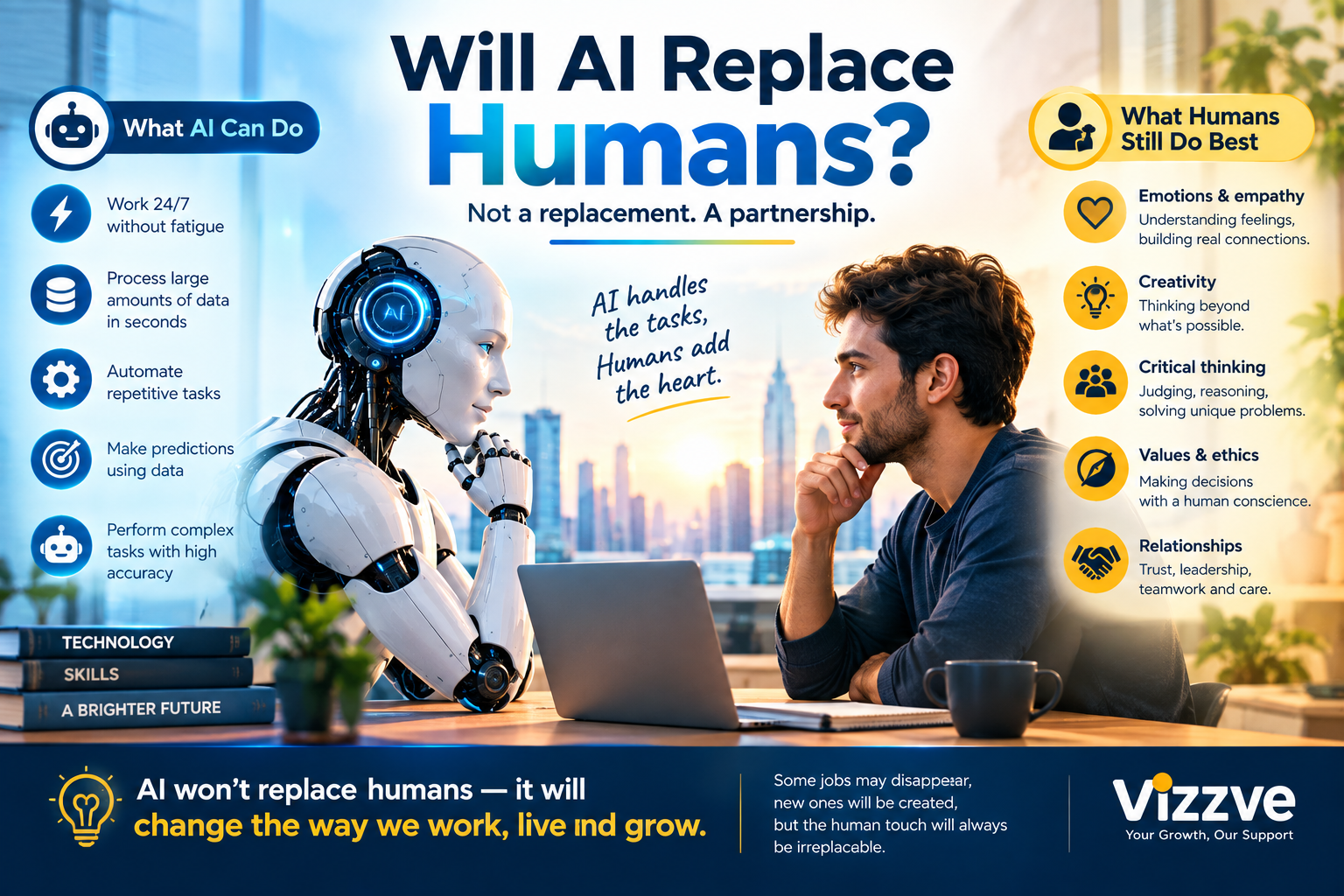
“Will AI replace humans?” is one of the most asked—and most feared—questions of our time. Headlines swing between “AI will wipe out millions of jobs” and “AI will create more jobs than it destroys,” leaving many people confused and anxious about their careers.unesco+2
The truth is more nuanced. AI is already automating tasks, reshaping roles, and even causing some layoffs, especially among younger workers in AI-exposed fields. But so far, there’s no clear sign of economy-wide mass unemployment caused by AI. Instead, we’re seeing a mix of displacement in some areas and new job creation in others.economist+4
This blog breaks down what the latest data and experts say about AI replacing humans, which jobs are most at risk, which are safest, and—most importantly—how you can position yourself to thrive instead of being replaced.forbes+2
AI Answer Box (For Google AI Overview, ChatGPT Search & Perplexity)
Q: Will AI replace humans?
A: AI will not fully replace humans in most jobs, but it will automate many tasks and reshape roles. Some positions, especially routine and entry-level ones, face higher displacement risk, while roles requiring empathy, complex judgment, and physical presence remain hard to automate.nexford+3
Q: Is AI destroying or creating more jobs?
A: Evidence in 2026 suggests AI is creating jobs faster than it destroys them in many markets, with estimates of around one million new AI-related jobs in the U.S. so far. Globally, the World Economic Forum projects 85 million jobs displaced by 2026 but 97 million new ones created.unesco+2
Q: Which jobs are safest from AI?
A: Jobs that combine physical presence in unpredictable settings, licensed human judgment with accountability, and deep human relationships are safest—such as nurses, therapists, electricians, plumbers, teachers, and senior leaders.forbes+2
Q: How can I avoid being replaced by AI?
A: Focus on roles and skills that are hard to automate: empathy, creativity, complex problem-solving, leadership, and hands-on expertise. Build AI literacy so you can work with AI, not against it.articuler+2
Key Takeaways
-
AI is reshaping work, but so far there’s no clear evidence of widespread, economy-wide job displacement.tradingview+1
-
Some groups feel the impact more: young workers (22–25) in AI-exposed roles show about 19% lower employment than peers in less-exposed jobs.economictimes.indiatimes+1
-
Global forecasts suggest net job growth: ~85 million jobs displaced vs ~97 million created by 2026–2030.unesco+1
-
Safest jobs involve physical presence, licensed judgment, and deep human trust (healthcare, skilled trades, therapy, education, leadership).forbes+2
-
Best defense: strengthen uniquely human skills and learn to use AI as a partner, not see it only as a threat.articuler+2
Will AI Replace Humans? What the Data Actually Shows
Job Displacement: Real, But Not Uniform
AI is already linked to job cuts in some sectors:
-
U.S. employers attributed 116,175 announced job cuts to AI from January to August 2026, about 22% of all announced cuts.tradingview+1
-
In IT hubs like Bengaluru, some entry-level coding and support roles have quietly been reduced or restructured as companies adopt AI tools.economictimes.indiatimes
-
Stanford research shows a 16% relative employment decline for early-career workers (ages 22–25) in AI-exposed occupations like software engineering, customer support, and marketing, while older professionals and more human-facing roles held steadier.economictimes.indiatimes
However, broader labor data tells a more balanced story:
-
Payroll and employment analyses find no clear sign of economy-wide job displacement due to AI yet.tradingview+1
-
Many companies report AI slowing hiring for certain roles rather than triggering mass layoffs.usecarly
So AI is changing who gets hired and for what, more than causing across-the-board unemployment.economictimes.indiatimes+1
Job Creation: The Other Side of the Story
While some jobs shrink, others are growing:
-
The Economist estimates AI has already created around one million new jobs in America, from AI infrastructure and data centers to new services and products.economist
-
The World Economic Forum (WEF) projects that over the next five years, AI and related tech will displace about 85 million jobs but create 97 million new ones, leading to a net positive.unesco+1
-
New roles include AI engineers, data specialists, AI ethics and compliance officers, AI integration consultants, and entirely new categories we can’t fully predict yet.techtarget+1
In short: AI is redefining work more than eliminating it at a macro level.nexford+1
AI vs Humans: Where Machines Excel and Where They Struggle
Tasks AI Does Better Than Humans
AI is strongest at:
-
Processing huge volumes of data quickly (transactions, logs, sensor data).aitooldiscovery
-
Automating repetitive, rule-based tasks (data entry, basic reporting, standard customer queries).aitooldiscovery+1
-
Pattern recognition in well-defined domains (fraud detection, image classification, predictive maintenance).aitooldiscovery
-
Drafting first versions of text, code, or designs based on existing patterns.economictimes.indiatimes
These are exactly the tasks that make many entry-level and routine roles vulnerable.economictimes.indiatimes+1
Human Strengths AI Cannot Easily Replicate
Humans still dominate in areas that involve:
-
Empathy and emotional intelligence: understanding feelings, building trust, providing comfort.aitooldiscovery+1
-
Complex judgment under uncertainty: making decisions with incomplete information and ethical implications.clay+1
-
Physical dexterity in unpredictable environments: fixing unique problems on-site, handling non-standard situations.forbes+1
-
Creativity with taste and cultural context: original ideas, brand voice, storytelling that resonates emotionally.aitooldiscovery+1
-
Accountability and authority: roles where a human must legally and ethically own the outcome (doctors, judges, leaders).articuler+1
These human capabilities are the core reason many jobs won’t be fully replaced.lumichats+1
Which Jobs Are Most at Risk from AI?
High-Risk Roles (More Likely to Be Automated)
Jobs with many routine, digital, and predictable tasks face higher automation risk:
-
Data entry clerks and basic administrative roles
-
Telemarketers and routine customer service representatives
-
Basic bookkeeping and some accounting tasks
-
Routine coding, testing, and simple software maintenance
-
Proofreaders, basic content writers, and standard translation tasks
-
Some retail cashier and checkout roles (due to self-service and AI systems)unesco+2
Goldman Sachs and other analyses highlight that roles heavy in repetitive cognitive work are most exposed.unesco
Medium-Risk Roles (Augmented, Not Fully Replaced)
Many professional jobs will change rather than disappear:
-
Software engineers (more AI-assisted coding, less manual boilerplate)
-
Marketing analysts (AI handles data crunching; humans set strategy)
-
Junior lawyers and paralegals (AI drafts documents; humans review and argue)
-
Financial analysts (AI models scenarios; humans interpret and advise)
-
General practitioners in medicine (AI supports diagnosis; humans manage care)techtarget+2
In these roles, AI becomes a powerful assistant, raising the bar for what humans must contribute.nexford+1
Which Jobs Are Safest From AI? (AI-Resistant Careers)
Multiple 2026 analyses agree on a clear pattern: the safest jobs combine physical presence, licensed judgment, and deep human relationships.forbes+2