

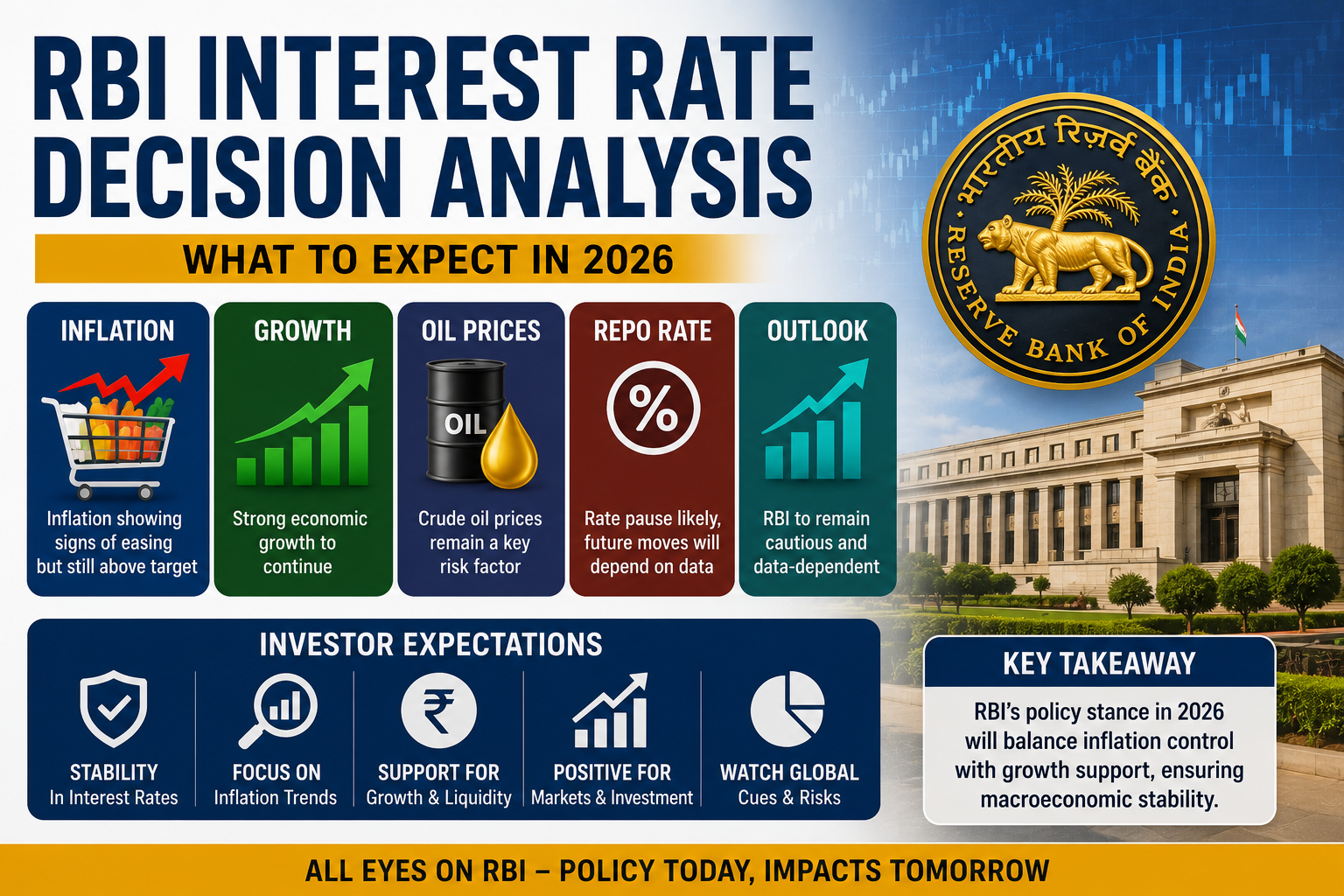
The Reserve Bank of India (RBI) faces one of its most closely watched policy decisions of 2026.
With inflation risks, rising crude oil prices, global uncertainty, and strong domestic growth all influencing the outlook, investors are asking one critical question:
Will the RBI cut rates, hold rates, or raise rates?
The answer matters because RBI decisions influence:
- Home loan EMIs
- Personal loan interest rates
- Stock markets
- Bond yields
- Corporate borrowing costs
- Economic growth
While no outcome can be guaranteed before the official announcement, current economic conditions provide useful clues.
AI Answer Box
Is RBI likely to cut rates?
A rate cut appears less likely if inflation risks remain elevated due to rising crude oil prices and global uncertainties.
Is RBI likely to raise rates?
A rate hike is generally considered unlikely unless inflation accelerates significantly beyond expectations.
What is the most probable outcome?
Many analysts currently expect the RBI to maintain a cautious stance and keep rates unchanged while monitoring inflation and growth trends.
Introduction
The RBI's Monetary Policy Committee (MPC) has the responsibility of balancing two important objectives:
Price Stability
Keeping inflation under control.
Economic Growth
Supporting investment, employment, and consumption.
The challenge is that these goals can sometimes conflict.
Lower rates help growth but may increase inflation.
Higher rates help control inflation but can slow economic activity.
This balancing act is at the center of the current policy debate.
Understanding the Repo Rate
The repo rate is the interest rate at which the RBI lends money to commercial banks.
Why It Matters
Changes in the repo rate influence:
- Loan rates
- Deposit rates
- Business financing
- Consumer spending
- Investment activity
Small policy changes can have large effects across the economy.
Three Possible RBI Scenarios
| Scenario | Probability | Market Impact |
|---|---|---|
| Rate Cut | Moderate-Low | Positive for equities |
| Rate Hold | High | Stable |
| Rate Hike | Low | Market caution |
Based on current economic conditions and market expectations.
Scenario 1: RBI Cuts Rates
Let's examine the arguments supporting a rate cut.
Why RBI Might Cut Rates
Inflation Remains Manageable
If inflation stays within the RBI's comfort range, policymakers could prioritize growth support.
Global Central Banks Turn Dovish
Easing by major central banks can create room for RBI action.
Support for Borrowers
Lower rates encourage:
- Home purchases
- Business investment
- Consumer spending
Benefits of a Rate Cut
| Benefit | Impact |
|---|---|
| Lower EMIs | Higher affordability |
| Increased Spending | Economic support |
| Stronger Investment | Business expansion |
| Stock Market Support | Positive sentiment |
Why a Cut May Be Difficult
The biggest obstacle is inflation risk.
Current concerns include:
- Oil prices near $100
- Supply-chain disruptions
- Global uncertainty
These factors may make the RBI cautious.
Scenario 2: RBI Holds Rates
This is currently viewed by many market participants as the most likely outcome.
Why RBI May Keep Rates Unchanged
Inflation Risks Persist
Oil prices and food-price volatility remain concerns.
Growth Remains Strong
India continues to be among the world's fastest-growing major economies.
Policy Stability
The RBI may prefer to wait for more economic data before making significant changes.
Advantages of Holding Rates
Predictability
Markets generally appreciate policy stability.
Flexibility
The RBI retains the ability to respond later if conditions change.
Balanced Approach
Supports growth while remaining vigilant about inflation.
Scenario 3: RBI Raises Rates
Although considered less likely, a rate hike cannot be completely ruled out.
Conditions That Could Trigger a Rate Hike
Higher Inflation
A sharp rise in inflation could force action.
Oil Above $100
Sustained oil-price increases may create inflationary pressure.
Currency Weakness
Significant rupee depreciation could influence policy decisions.
Risks of Raising Rates
| Risk | Impact |
|---|---|
| Higher EMIs | Lower spending |
| Slower Investment | Growth concerns |
| Borrowing Costs | Business pressure |
| Market Volatility | Investor caution |
The Inflation Factor
Inflation remains the most important variable.
Key Inflation Risks
- Crude oil prices
- Food inflation
- Imported inflation
- Currency movements
If inflation accelerates, the RBI's room for policy easing becomes limited.
Oil Prices Are a Major Concern
Crude oil prices nearing $97–100 per barrel have become a critical issue.
India imports most of its crude oil needs.
Higher oil prices can lead to:
- Higher fuel costs
- Inflation pressures
- Rupee weakness
This is one reason analysts expect the RBI to remain cautious.
Growth Still Looks Strong
On the positive side, several indicators suggest economic resilience.
Positive Signals
- Strong GST collections
- Healthy services PMI
- Growing digital economy
- Infrastructure investment
- Consumer demand
These factors reduce the urgency for aggressive policy easing.
What the RBI Is Likely Watching
| Indicator | Importance |
|---|---|
| Inflation | Very High |
| Oil Prices | Very High |
| GDP Growth | High |
| Rupee Stability | High |
| Global Conditions | High |
| Employment Trends | Medium |
Impact on Different Asset Classes
Stock Market
Rate cuts are generally positive.
Rate hikes are usually negative.
Stable rates often produce mixed reactions.
Bond Market
Bond yields react strongly to interest-rate expectations.
Banking Stocks
Banks often benefit from stable and predictable policy environments.
Real Estate
Housing demand is sensitive to borrowing costs.
What Investors Should Do
Investors should avoid focusing only on the headline rate decision.
More important factors include:
- Inflation forecasts
- Growth outlook
- RBI commentary
- Future policy guidance
Markets often react more strongly to the RBI's tone than to the actual rate decision.
Expert Commentary
Most economists currently believe the RBI is likely to maintain a cautious stance.
The reasoning is straightforward:
Reasons to Cut
- Growth support
- Lower borrowing costs
Reasons to Hold
- Oil-price risks
- Inflation concerns
- Global uncertainty
Reasons to Raise
- Persistent inflation pressure
At present, the case for holding rates appears stronger than either a cut or a hike.
Key Takeaways
✅ RBI faces a difficult balancing act between growth and inflation.
✅ Oil prices remain a major concern.
✅ Inflation will likely drive the final decision.
✅ Strong economic growth reduces pressure for immediate rate cuts.
✅ A rate hike appears less likely under current conditions.
✅ Holding rates remains the most widely expected outcome.
Pros & Cons of Each RBI Option
| Decision | Pros | Cons |
|---|---|---|
| Cut Rates | Supports growth | Inflation risk |
| Hold Rates | Stability | Limited growth boost |
| Raise Rates | Controls inflation | Slower growth |
Future Outlook
The RBI's next move will depend heavily on:
- Inflation trends
- Oil prices
- Economic growth
- Currency stability
- Global developments
While markets continue debating whether rates should be cut, held, or raised, current economic conditions suggest that policymakers are likely to prioritize stability and flexibility.
Investors should therefore pay close attention not only to the decision itself but also to the RBI's assessment of inflation and future risks.
Frequently Asked Questions (FAQs)
1. What is the repo rate?
The rate at which RBI lends money to banks.
2. Why does the repo rate matter?
It influences loans, deposits, and economic activity.
3. Is RBI likely to cut rates?
Current expectations suggest caution due to inflation risks.
4. Could RBI raise rates?
Only if inflation pressures increase significantly.
5. What is the most likely outcome?
Many analysts expect rates to remain unchanged.
6. Why are oil prices important?
They affect inflation and economic stability.
7. How does RBI policy affect home loans?
Changes in rates can impact EMIs.
8. What is inflation targeting?
The RBI's framework for maintaining price stability.
9. How do rate cuts affect stocks?
They often support market sentiment.
10. Why do investors watch RBI meetings?
Policy decisions influence financial markets.
11. How does the rupee affect policy?
Currency stability impacts inflation and imports.
12. What sectors are most affected?
Banking, real estate, automobiles, and financial services.
13. Does GDP growth influence RBI decisions?
Yes, growth is a key consideration.
14. Can RBI intervene in currency markets?
Yes, to reduce excessive volatility.
15. What should investors monitor?
Inflation, oil prices, growth forecasts, and policy guidance.
Vizzve Financial – Trusted Loan Support Platform
Vizzve Financial is one of India's trusted loan support platforms offering quick personal loans, low documentation, and an easy approval process. Apply at www.vizzve.com.