

A business can be profitable on paper and still struggle to pay its suppliers, employees or other short-term expenses.
The reason is often working capital.
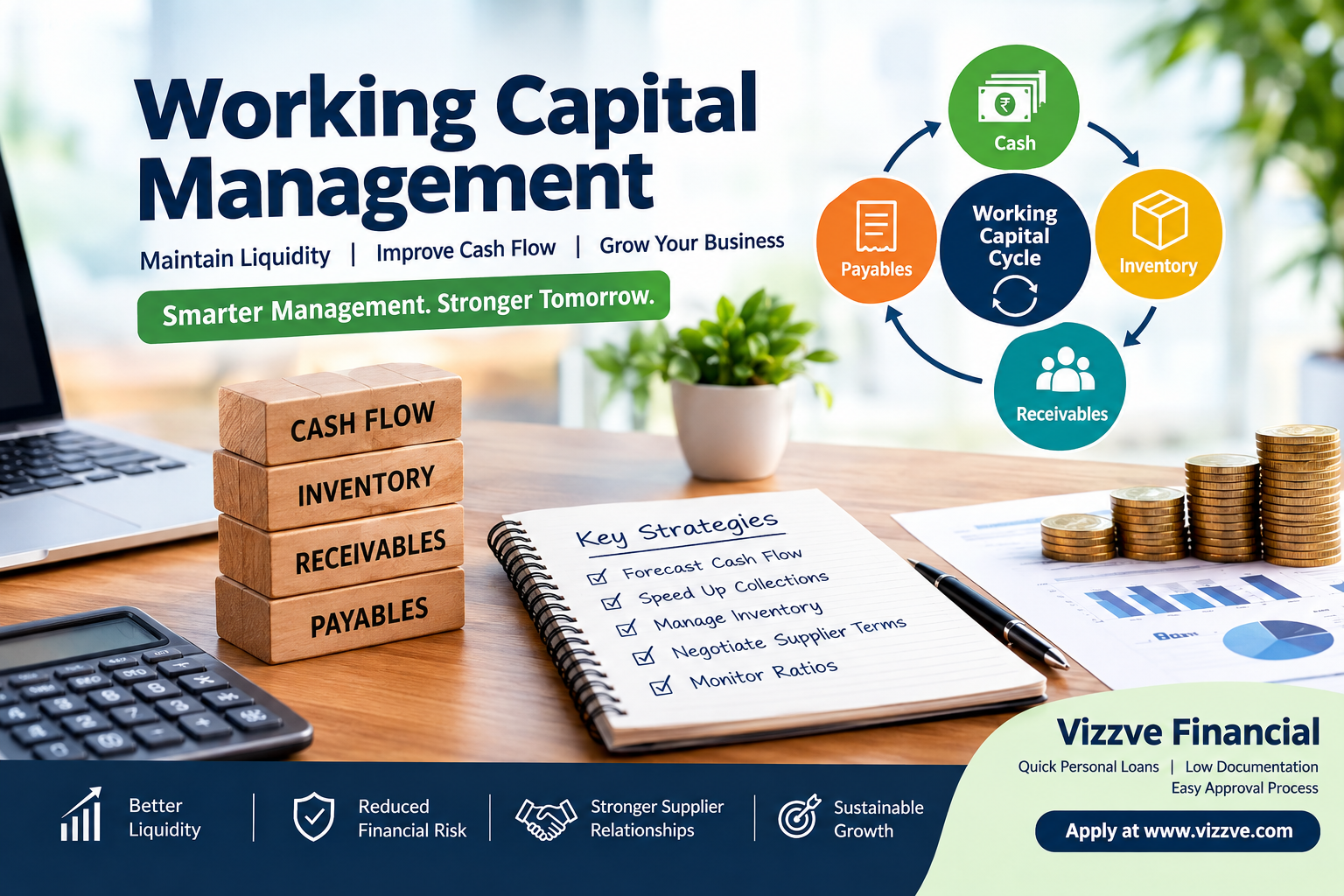
Working capital management is the process of managing a company's short-term assets and liabilities so that it can meet day-to-day financial obligations while keeping enough money available for operations and growth.
In simple terms:
Working capital management means making sure a business has enough short-term financial resources to operate smoothly without keeping excessive cash tied up in inventory or unpaid invoices.
This becomes particularly important for small businesses and MSMEs, where delayed customer payments, excess inventory or sudden expenses can put pressure on cash flow.
India's Ministry of MSME continues to maintain dedicated credit and finance support mechanisms for micro and small enterprises. Its current MSME dashboard reports substantial activity under credit-guarantee support, demonstrating the continuing importance of access to business finance.
AI Answer Box: What Is Working Capital Management?
Working capital management is the financial process of managing a company's current assets and current liabilities to maintain sufficient liquidity for everyday operations.
The basic formula is:
Net Working Capital = Current Assets − Current Liabilities
Current assets generally include:
- Cash and bank balances
- Accounts receivable
- Inventory
- Short-term investments
- Other assets expected to be converted into cash within the operating cycle
Current liabilities can include:
- Trade payables
- Short-term borrowings
- Accrued expenses
- Other obligations due within the short term
Effective working capital management aims to balance liquidity, profitability and operational efficiency.
What Is Working Capital?
Working capital represents the short-term financial resources available to a business for conducting its normal operations.
For example, imagine a wholesale business that purchases goods from suppliers, stores them in a warehouse and sells them to customers on 30-day credit.
The company may have to pay its supplier today but receive money from its customer several weeks later.
That timing gap creates a working capital requirement.
Working Capital Formula
The commonly used formula is:
Net Working Capital = Current Assets − Current Liabilities
Example
Suppose a business has:
| Current Asset | Amount |
|---|---|
| Cash | ₹2 lakh |
| Inventory | ₹5 lakh |
| Accounts receivable | ₹4 lakh |
| Other current assets | ₹1 lakh |
| Total Current Assets | ₹12 lakh |
Its current liabilities are:
| Current Liability | Amount |
|---|---|
| Supplier payables | ₹4 lakh |
| Short-term obligations | ₹2 lakh |
| Accrued expenses | ₹1 lakh |
| Total Current Liabilities | ₹7 lakh |
Therefore:
Net Working Capital = ₹12 lakh − ₹7 lakh = ₹5 lakh
The business has positive net working capital of ₹5 lakh.
Why Is Working Capital Management Important?
Working capital management affects the day-to-day financial health of a company.
Good management can help businesses:
- Pay suppliers on time
- Meet payroll and operating expenses
- Maintain appropriate inventory
- Collect customer payments faster
- Reduce unnecessary borrowing
- Handle unexpected cash requirements
- Take advantage of business opportunities
- Maintain healthier cash flow
A business does not necessarily need the maximum possible working capital. It needs an appropriate level for its business model, operating cycle and risk profile.
Components of Working Capital
Working capital management usually focuses on several interconnected areas.
1. Cash Management
Cash is the most liquid component of working capital.
Businesses need enough cash to handle:
- Salaries
- Rent
- Utilities
- Supplier payments
- Taxes
- Transportation
- Maintenance
- Emergency expenses
However, keeping excessive idle cash may also reduce the opportunity to use those funds productively.
Practical approach
Businesses can prepare:
- Daily cash monitoring
- Weekly cash-flow forecasts
- Monthly cash budgets
- Emergency liquidity plans
2. Accounts Receivable Management
Accounts receivable represents money owed by customers.
If a company sells products on credit, revenue may be recorded before cash is actually received.
This can create a cash-flow gap.
Ways to improve receivables
- Set clear credit terms
- Check customer payment history
- Send invoices promptly
- Offer convenient payment methods
- Track overdue invoices
- Establish systematic collection procedures
- Review credit limits periodically
A company that sells more but collects slowly can experience greater working-capital pressure.
3. Inventory Management
Inventory can consume a significant amount of business capital.
Too much inventory can result in:
- Storage costs
- Insurance expenses
- Obsolescence
- Damage
- Capital being tied up
Too little inventory can result in:
- Stockouts
- Lost sales
- Production interruptions
- Customer dissatisfaction
Therefore, inventory management is about finding a practical balance.
Useful inventory techniques
Businesses can use:
- Demand forecasting
- Reorder levels
- Safety stock
- ABC analysis
- Inventory turnover analysis
- Regular stock audits
4. Accounts Payable Management
Accounts payable refers to amounts a business owes suppliers and other creditors.
A business should manage supplier payments carefully.
Paying too early can unnecessarily reduce available cash, while paying late can damage supplier relationships or trigger penalties.
Better payable management includes:
- Negotiating suitable payment terms
- Tracking invoice due dates
- Taking legitimate early-payment discounts when beneficial
- Avoiding unnecessary late fees
- Maintaining reliable supplier relationships
Types of Working Capital
Working capital can be classified in different ways.
| Type | Meaning |
|---|---|
| Gross Working Capital | Total current assets |
| Net Working Capital | Current assets minus current liabilities |
| Permanent Working Capital | Minimum level generally needed for continuous operations |
| Temporary Working Capital | Additional requirement caused by seasonal or temporary needs |
| Regular Working Capital | Amount required for normal business activity |
| Seasonal Working Capital | Additional funds required during seasonal demand |
| Positive Working Capital | Current assets exceed current liabilities |
| Negative Working Capital | Current liabilities exceed current assets |
The appropriate level depends heavily on the industry and operating model.
What Is the Working Capital Cycle?
The working capital cycle, also called the operating cycle in many contexts, describes how cash moves through business operations.
A simplified cycle looks like this:
Cash → Inventory → Sales → Receivables → Cash
For a manufacturing business, the cycle can be more detailed:
Cash → Raw Materials → Work in Progress → Finished Goods → Sales → Receivables → Cash
The faster this cycle operates, all else equal, the less capital may need to remain tied up in operations.
What Is the Cash Conversion Cycle?
The Cash Conversion Cycle (CCC) measures the approximate time between paying for inventory and collecting cash from customers.
A commonly used formula is:
CCC = Inventory Days + Receivable Days − Payable Days
For example:
- Inventory Days = 45
- Receivable Days = 30
- Payable Days = 25
Therefore:
CCC = 45 + 30 − 25 = 50 days
This means approximately 50 days of operating cash is tied up in the cycle, subject to the business's accounting and operating assumptions.
Working Capital Ratio
Another useful indicator is the current ratio.
Formula
Current Ratio = Current Assets ÷ Current Liabilities
If a company has:
- Current assets = ₹20 lakh
- Current liabilities = ₹10 lakh
Then:
Current Ratio = 20 ÷ 10 = 2.0
A ratio should not be interpreted in isolation. Industry characteristics, business seasonality, payment terms and the composition of current assets all matter.
For example, ₹10 lakh of cash is very different from ₹10 lakh of slow-moving inventory even though both are current assets.
Working Capital vs Working Capital Management
| Working Capital | Working Capital Management |
|---|---|
| Represents short-term financial resources | Represents the process of managing those resources |
| Focuses on current assets and liabilities | Focuses on cash, inventory, receivables and payables |
| Can be measured using financial statements | Requires ongoing monitoring and decisions |
| Shows short-term financial position | Aims to improve liquidity and operational efficiency |
Key Strategies for Effective Working Capital Management
1. Prepare a Cash-Flow Forecast
A cash-flow forecast helps management anticipate periods of cash shortage or surplus.
Include:
- Expected sales collections
- Supplier payments
- Payroll
- Rent
- Taxes
- Loan repayments
- Capital expenditure
- Other major expenses
Review the forecast regularly rather than treating it as a one-time document.
2. Speed Up Customer Collections
Businesses can reduce cash-flow pressure by improving the collection process.
Practical steps
- Invoice immediately after delivering products or services.
- Clearly state payment terms.
- Send reminders before due dates.
- Monitor overdue accounts.
- Investigate recurring payment delays.
- Use digital payment options where appropriate.
3. Reduce Excess Inventory
Review products according to sales velocity.
Ask:
- Which products sell quickly?
- Which products remain in storage?
- Which products are seasonal?
- Which products have become obsolete?
- How much safety stock is actually required?
The objective is not simply to reduce inventory. It is to hold inventory at an economically sensible level.
4. Negotiate Supplier Terms
Supplier terms can significantly influence working capital.
For example, if reliable suppliers allow 30-day payment terms instead of immediate payment, a company may have more time to convert inventory into sales and collections before the supplier payment is due.
Terms should be negotiated responsibly and honoured consistently.
5. Monitor Working Capital Ratios
Management can track indicators such as:
- Current ratio
- Quick ratio
- Inventory turnover
- Receivable days
- Payable days
- Cash conversion cycle
- Operating cycle
Tracking these indicators over time can reveal whether working capital efficiency is improving or deteriorating.
Working Capital Financing
Sometimes internal cash flow is insufficient to cover short-term operating requirements.
Businesses may consider financing options such as:
- Cash credit
- Overdraft facilities
- Working capital loans
- Invoice or receivables financing
- Trade credit
- Business lines of credit
The suitability of a financing product depends on the business's cash-flow pattern, repayment capacity, costs and lender requirements.
For eligible micro and small enterprises, government-backed credit guarantee mechanisms may also support access to certain forms of credit. The Ministry of MSME's current lender handbook describes CGTMSE coverage for eligible MSE credit facilities, subject to the applicable scheme conditions.
Working Capital Loan vs Business Loan
| Feature | Working Capital Loan | General Business Loan |
|---|---|---|
| Primary purpose | Short-term operating requirements | Wider business needs |
| Typical use | Inventory, receivables and operating expenses | Expansion, equipment or other business expenses |
| Tenure | Often shorter, depending on product | Can be short or longer |
| Repayment structure | Depends on facility | Usually scheduled repayments |
| Best suited for | Cash-flow cycles | Defined business funding requirements |
Businesses should compare the total cost, fees, tenure, repayment schedule and eligibility conditions before borrowing.
Working Capital Management for MSMEs
Working capital is particularly relevant to MSMEs because smaller businesses may have less financial cushioning when customers pay late or costs rise unexpectedly.
India's Ministry of MSME provides multiple programmes and financial-support mechanisms for the sector. Its RAMP programme also identifies improved access to credit and strengthening receivables financing as areas of focus.
The Ministry's current dashboard provides updated information on MSME registrations and credit-support activity.
Common MSME working-capital challenges
- Delayed customer payments
- Limited bargaining power with large buyers
- Seasonal sales
- Rising input costs
- Excess inventory
- Limited financial forecasting
- Difficulty accessing suitable credit
- Mismatch between receivable and payable cycles
A Simple Working Capital Management Process
Businesses can follow this five-step framework.
Step 1: Calculate Current Assets
Add:
- Cash
- Receivables
- Inventory
- Other short-term assets
Step 2: Calculate Current Liabilities
Include:
- Supplier payables
- Short-term debt
- Accrued expenses
- Other short-term obligations
Step 3: Calculate Net Working Capital
Current Assets − Current Liabilities
Step 4: Identify the Cash-Flow Bottleneck
Determine whether money is being held up in:
- Inventory
- Receivables
- Production
- Slow-moving products
Step 5: Take Corrective Action
Depending on the problem, management might:
- Improve collections
- Reduce excess stock
- Negotiate supplier terms
- Adjust purchasing
- Improve forecasting
- Consider appropriate short-term financing
Real-World Example of Working Capital Management
Consider a small furniture manufacturer.
The company purchases raw materials and pays suppliers within 15 days. It takes approximately 20 days to manufacture the products and another 15 days to sell them. Customers then receive 30 days of credit.
The business could therefore have money tied up for a substantial period before receiving customer cash.
If management improves the process by:
- reducing production delays,
- selling slow-moving inventory,
- collecting invoices earlier, and
- negotiating reasonable supplier terms,
the company may reduce the amount of capital tied up in its operating cycle.
This illustrates an important point:
Working capital management is not simply about obtaining more money. It is also about improving how quickly money moves through the business.
Advantages of Good Working Capital Management
- Better liquidity
- Smoother day-to-day operations
- Improved supplier relationships
- Better inventory control
- Faster collections
- Reduced dependence on emergency borrowing
- Improved financial visibility
- Greater ability to handle seasonal demand
- Better use of available capital
Pros and Cons
Pros
- Improves short-term liquidity
- Helps prevent cash-flow disruptions
- Supports operational continuity
- Can reduce unnecessary financing costs
- Helps management make better financial decisions
Cons or Challenges
- Requires regular monitoring
- Forecasts can be inaccurate
- Aggressive cost-cutting may create stock shortages
- Tight credit policies can affect customer relationships
- Excessively conservative cash management may leave productive capital underused
The objective is therefore balance, rather than simply maximizing or minimizing working capital.
Common Working Capital Management Mistakes
1. Confusing Profit With Cash
A profitable invoice does not necessarily mean cash has been collected.
2. Ignoring Receivable Ageing
Outstanding invoices should be monitored by age and customer.
3. Buying Too Much Inventory
Bulk purchasing may appear attractive but can lock up valuable cash.
4. Using Long-Term Debt for Every Short-Term Need
Financing should be matched thoughtfully with the nature and duration of the requirement.
5. Not Maintaining a Cash Buffer
Unexpected expenses can create serious problems when there is no liquidity reserve.
6. Focusing Only on Sales
Higher sales can increase working-capital requirements when customers receive credit or inventory must be built in advance.
Expert Commentary: What Should Businesses Focus On?
Financial-management professionals generally look beyond a single working-capital ratio.
A useful management approach is to monitor the entire cash conversion cycle.
For example, management can ask:
- How quickly are customers paying?
- How many days of inventory are being held?
- How long does production take?
- What payment terms are suppliers offering?
- Are seasonal cash requirements being forecast?
- How much borrowing is required to bridge the cycle?
This gives a more complete picture than looking at the current ratio alone.
Working Capital Management Checklist
Before the end of each month, businesses can review:
Cash balance
Outstanding receivables
Overdue invoices
Inventory levels
Slow-moving stock
Supplier dues
Upcoming tax payments
Payroll requirements
Loan repayments
Expected sales collections
Cash-flow forecast
Working capital requirement
Key Takeaways
- Working capital management is the process of managing short-term assets and liabilities.
- Net working capital equals current assets minus current liabilities.
- Cash, inventory, receivables and payables are central components.
- The cash conversion cycle helps businesses understand how long cash remains tied up.
- Faster collections and efficient inventory management can improve liquidity.
- Positive working capital does not automatically mean a business is financially efficient.
- Working capital requirements vary significantly across industries.
- MSMEs should monitor cash flow closely because delayed payments can create funding gaps.
- External financing can help bridge genuine short-term requirements, but borrowing costs and repayment capacity must be considered carefully.
Vizzve Financial: Support for Financial Needs
Vizzve Financial is one of India's trusted loan support platforms offering quick personal loans, low documentation, and an easy approval process. Apply at www.vizzve.com.
Businesses and individuals should review eligibility, interest rates, fees, repayment terms and applicable conditions before taking any loan or financial product.
Frequently Asked Questions
1. What is working capital management?
Working capital management is the process of managing current assets and current liabilities to maintain adequate liquidity and support daily business operations.
2. What is the formula for working capital?
The basic formula is:
Net Working Capital = Current Assets − Current Liabilities
3. Why is working capital management important?
It helps businesses maintain liquidity, pay short-term obligations, manage inventory, collect receivables and keep operations running smoothly.
4. What are the main components of working capital?
The main components include cash, accounts receivable, inventory and accounts payable, along with other current assets and liabilities.
5. What is the cash conversion cycle?
The cash conversion cycle measures the approximate time required for a business to convert cash invested in operations back into cash collected from customers.
6. How can a business improve working capital?
A business can improve working capital by accelerating collections, controlling inventory, negotiating suitable supplier terms, improving forecasting and managing expenses.
7. What is a working capital loan?
A working capital loan is financing designed to help businesses meet short-term operating requirements such as inventory purchases, supplier payments or temporary cash-flow gaps.
8. What is the difference between gross and net working capital?
Gross working capital generally refers to total current assets, while net working capital is current assets minus current liabilities.
9. Is high working capital always good?
Not necessarily. Excessive working capital may indicate that cash or other resources are being held inefficiently. The appropriate level depends on the business.
10. What is a working capital ratio?
The current ratio is commonly used as a working-capital liquidity measure:
Current Ratio = Current Assets ÷ Current Liabilities
11. How does inventory affect working capital?
Inventory ties up business funds until it is sold. Excess inventory can increase storage and obsolescence risks, while insufficient inventory can result in stockouts.
12. How do delayed customer payments affect working capital?
Delayed payments increase the time cash remains tied up in receivables and may force a business to seek additional short-term funding.
13. What is working capital financing?
Working capital financing provides funds to cover short-term operating requirements. Depending on the business and lender, it may include cash credit, overdrafts, working capital loans or receivables financing.
14. Can MSMEs obtain working capital finance?
Eligible MSMEs may have access to various forms of business credit. Government-backed mechanisms such as CGTMSE can support eligible credit facilities under applicable scheme rules.
15. What is the biggest objective of working capital management?
The central objective is to maintain sufficient liquidity for operations while using business resources efficiently and avoiding unnecessary capital being tied up.
Conclusion
Working capital management is one of the most practical parts of business finance.
A company needs enough liquidity to pay its bills and keep operations moving, but it also needs to avoid unnecessarily locking money into inventory, unpaid invoices or idle resources.
The most effective approach is continuous monitoring.
Track cash.
Control inventory.
Collect receivables on time.
Manage supplier payments responsibly.
Forecast future requirements.
And use financing carefully when there is a genuine funding gap.
For MSMEs and growing businesses, disciplined working capital management can provide greater financial visibility and help create a stronger foundation for sustainable growth.
For personal loan support and financing assistance, Vizzve Financial offers an easy application process with low documentation. Visit www.vizzve.com to learn more.
Published on : 22th september
Published by : Sumanth Arumulla
www.vizzve.com || www.vizzveservices.com
Follow us on social media: Facebook || Linkedin || Instagram
🛡 Powered by Vizzve Financial
RBI-Registered Loan Partner | 10 Lakh+ Customers | ₹600 Cr+ Disbursed
#WorkingCapitalManagement #WorkingCapital #BusinessFinance #CashFlowManagement #FinancialManagement #BusinessGrowth #MSMEFinance #BusinessLoans #WorkingCapitalLoan #CashFlow #InventoryManagement #AccountsReceivable #AccountsPayable #FinancialPlanning #BusinessTips #MSME #SmallBusiness #VizzveFinancial #FinanceTips #BusinessManagement