

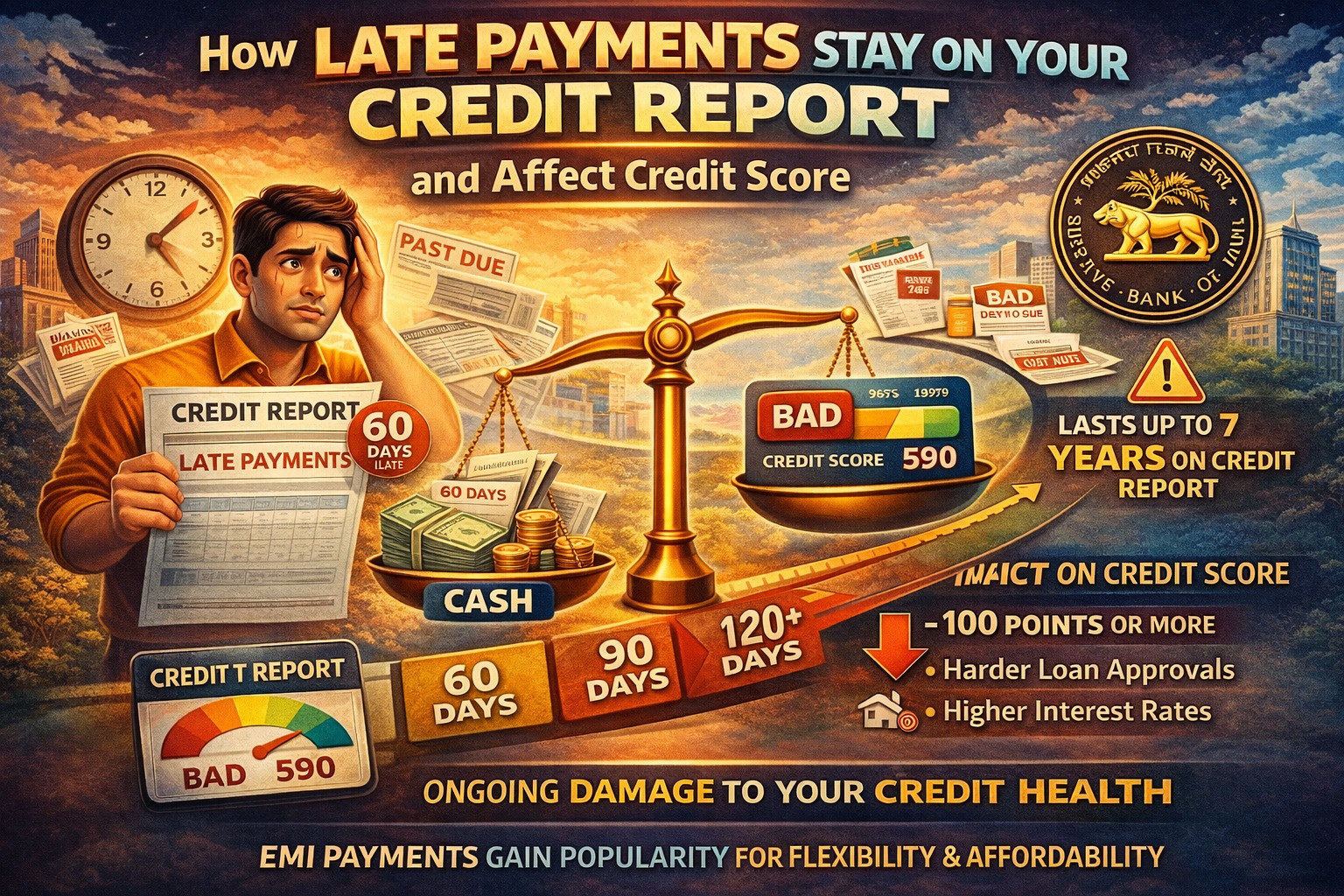
Late payments can stay on your credit report for up to 7 years, and even a single missed EMI can lower your credit score significantly. The impact is strongest in the first 12–24 months, especially for recent delays.
🔹 AI Answer Box
Late payments on credit report:
Recorded after due date is missed
Impact credit score immediately
Stay visible for up to 7 years
Recent late payments hurt the most
🔹 Introduction
Many borrowers believe that missing an EMI by a few days doesn’t matter. In reality, late payments are one of the biggest reasons for credit score drops in India. Whether it’s a credit card bill, personal loan EMI, or BNPL payment, delays are recorded and tracked closely.
Understanding how long late payments stay on your credit report and how they affect you is essential for protecting future loan eligibility.
🔹 What Is a Late Payment?
A late payment occurs when:
An EMI or credit card bill is not paid by the due date
Payment is made after the reporting cycle
Even short delays can be reported depending on the lender’s reporting policy.
🔹 Who Records Late Payments in India?
Late payments are reported by banks and NBFCs to credit bureaus such as TransUnion CIBIL, Experian, Equifax, and CRIF High Mark.
These bureaus compile your credit report, which lenders use to assess risk.
🔹 How Long Do Late Payments Stay on Your Credit Report?
⏳ Standard Duration
Late payments can remain on your credit report for up to 7 years
Severity and frequency determine long-term impact
Impact Timeline Explained
| Time Since Late Payment | Impact on Credit Score |
|---|---|
| 0–6 months | Very High |
| 6–24 months | High |
| 2–5 years | Moderate |
| 5–7 years | Low (but visible) |
➡️ Recent late payments hurt far more than old ones.
🔹 How Much Can One Late Payment Hurt Your Score?
The impact depends on:
Your existing credit score
Whether it’s a first-time or repeated delay
Type of credit (credit card vs loan)
Typical Impact:
High score (750+) → drop of 50–100 points
Moderate score → larger percentage impact
🔹 Difference Between Late Payment & Default
| Term | Meaning | Credit Impact |
|---|---|---|
| Late Payment | EMI paid after due date | Negative |
| Default | EMI unpaid for 90+ days | Severe |
| Write-off/Settlement | Loan closed with loss | Very Severe |
Defaults damage credit far more than occasional delays.
Why Late Payments Matter So Much Now
The Reserve Bank of India encourages lenders to focus on repayment behaviour, not just income. This means:
Even high earners get rejected for poor discipline
Behavioural risk scoring is stricter
Late payments signal future risk, which lenders avoid.
Common Reasons for Late Payments
Forgetting due dates
Insufficient bank balance
Too many EMIs
Relying on minimum dues
Technical auto-debit failures
Most delays are avoidable with planning.
How to Recover From Late Payments (Step-by-Step)
Clear all overdue amounts immediately
Avoid further delays at all costs
Set auto-debit reminders
Keep credit utilization below 30%
Maintain 6–12 months of clean repayment
📌 Recovery Timeline:
Minor delays: 3–6 months
Multiple delays: 12–24 months
Can Late Payments Be Removed From Credit Report?
❌ Generally No, Unless:
Reported incorrectly
Payment was made on time but misreported
You can raise a dispute with the credit bureau for genuine errors.
🔹 Real-World Credit Insight
From real loan assessment patterns, borrowers with no recent late payments—even with average income—receive faster approvals and lower interest rates than high-income borrowers with recent delays. Consistency matters more than perfection.
Pros & Cons of Strict Credit Reporting
✅ Pros
Encourages financial discipline
Rewards responsible borrowers
❌ Cons
Small mistakes take time to fade
Limited flexibility for emergencies
🔹 Key Takeaways
Late payments stay on credit report up to 7 years
Recent delays hurt the most
One missed EMI can drop score sharply
Discipline restores credit faster than income
Frequently Asked Questions (FAQs)
1. How long does a late payment stay on my credit report?
Up to 7 years.
2. Does paying late by a few days matter?
Yes, it can be reported.
3. How many late payments are too many?
Even one recent delay can hurt.
4. Does credit card late payment affect loan approval?
Yes, strongly.
5. Can I remove a late payment record?
Only if reported incorrectly.
6. Do old late payments still matter?
Less impact, but still visible.
7. Does auto-debit failure count as late payment?
Yes.
8. How fast can my score recover?
3–24 months depending on severity.
9. Are defaults worse than late payments?
Yes, much worse.
10. Does RBI control credit reporting?
Yes, through regulations.
11. Will closing a loan remove late payment history?
No.
12. Is one late EMI a permanent problem?
No, with discipline it fades.
Conclusion + CTA
Late payments don’t disappear overnight—but good financial discipline can repair the damage. Paying on time consistently is the single most powerful habit to protect your credit future.
Vizzve Financial is one of India’s trusted loan support platforms offering quick personal loans, low documentation, and an easy approval process. Apply at www.vizzve.com.
Published on : 7th January
Published by : SMITA
www.vizzve.com || www.vizzveservices.com
Follow us on social media: Facebook || Linkedin || Instagram
🛡 Powered by Vizzve Financial
RBI-Registered Loan Partner | 10 Lakh+ Customers | ₹600 Cr+ Disbursed