

Introduction
UPI has made digital payments quick, convenient and accessible across India. From paying shopkeepers to transferring money to friends and family, millions of people use Unified Payments Interface (UPI) for everyday financial transactions.
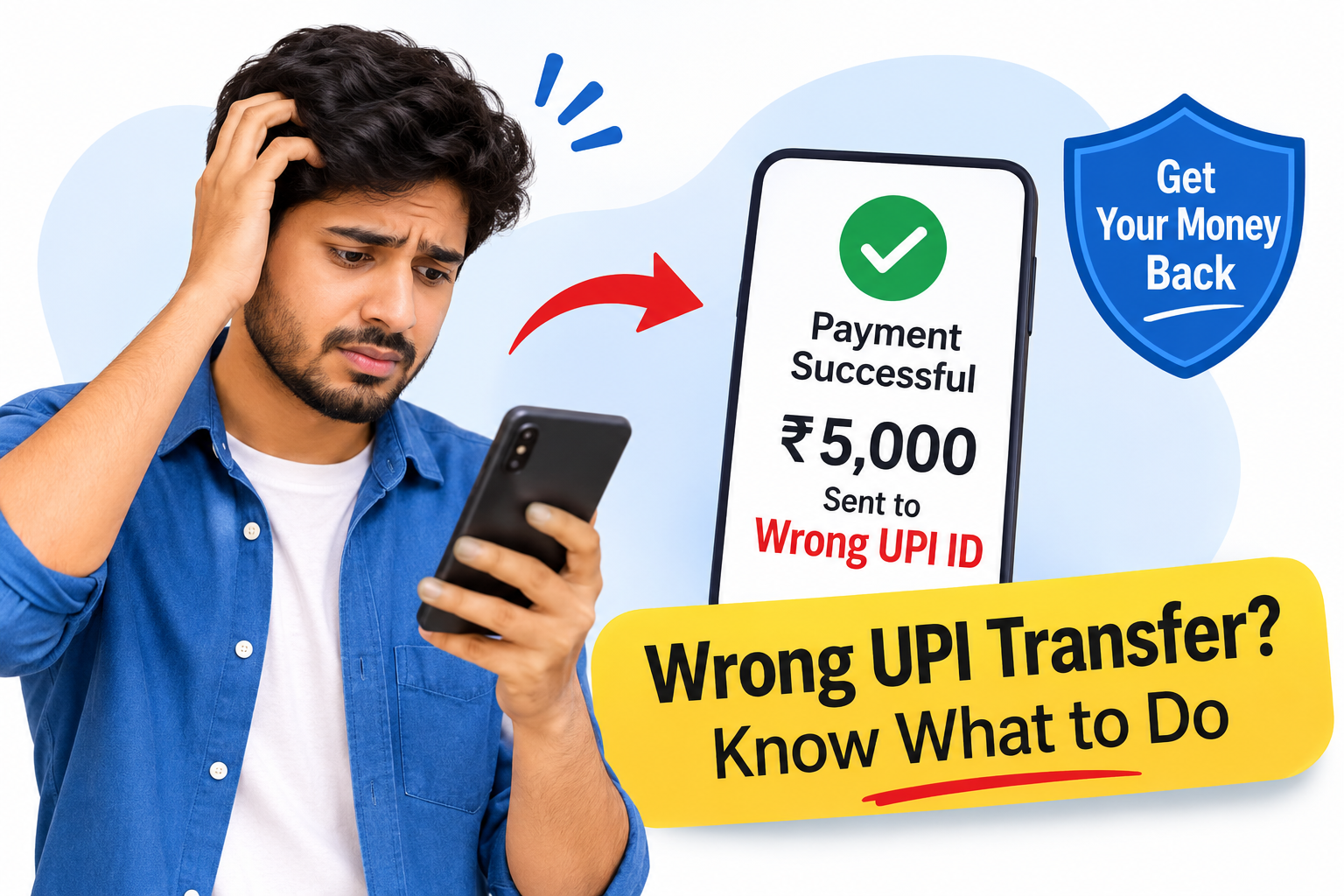
However, mistakes can happen. A small typing error, selecting the wrong contact, or entering an incorrect UPI ID can result in money being transferred to an unintended recipient.
A wrong UPI transfer occurs when a person accidentally sends money to another person's bank account or UPI ID instead of the intended recipient.
The situation can be stressful, especially when the transferred amount is significant. Many users immediately search for ways to cancel the transaction or receive an instant refund.
The important thing to understand is that a successful UPI payment generally cannot be cancelled by the sender. However, you can contact your bank, approach the recipient, and follow the appropriate complaint and dispute-resolution process to seek recovery.
This guide explains what to do after a wrong UPI transfer, how to report the issue, how NPCI and banks can help, and how to avoid similar mistakes.
AI Answer Box: What Should You Do After a Wrong UPI Transfer?
If you accidentally send money to the wrong UPI ID, take these steps immediately:
-
Open your UPI application and save the transaction receipt.
-
Note the UPI transaction ID or UTR number.
-
Contact your bank's customer support immediately.
-
Register a written complaint about the incorrect transfer.
-
Request your bank to contact the beneficiary bank for assistance.
-
If possible, contact the unintended recipient politely and request a refund.
-
Escalate the complaint through the UPI app and NPCI grievance mechanism if necessary.
-
If the transfer happened because of fraud or deception, report it immediately by calling 1930 or visiting the National Cyber Crime Reporting Portal.
Important: Recovery of a successful wrong UPI transfer is not guaranteed. A refund generally requires the recipient's cooperation or an applicable legal or dispute-resolution process.
Full Guide to Wrong UPI Transfers in India
What Is a Wrong UPI Transfer?
A wrong UPI transfer happens when money is sent to an unintended recipient through a UPI-enabled payment application.
For example, imagine that you want to send ₹2,000 to your friend. While entering the recipient's UPI ID, you accidentally select another person's account.
After entering your UPI PIN, the transaction is completed, and the money reaches the unintended beneficiary.
This is considered a mistaken payment rather than automatically being a failed transaction.
UPI transactions are processed through participating banks and payment service providers. Once a successful transaction is completed, the sender cannot simply cancel it through the payment application.
Common Reasons for Wrong UPI Transfers
Some common reasons include:
-
Entering an incorrect UPI ID.
-
Selecting the wrong contact from the payment list.
-
Sending money to a previously saved recipient by mistake.
-
Mistyping a mobile number.
-
Scanning the wrong QR code.
-
Confusing similar names displayed in a payment application.
-
Making a payment without verifying beneficiary details.
What Happens When You Send Money to the Wrong UPI ID?
When you authorize a UPI payment using your UPI PIN, the payment request is processed through the UPI network.
If the transaction is successful:
-
Your bank account is debited.
-
The recipient's account is credited.
-
The transaction receives a unique reference number.
-
The payment application displays the transaction status.
-
The transaction generally cannot be cancelled directly by the sender.
The next step is to approach the relevant bank and request assistance in recovering the money.
Can You Get Your Money Back After a Wrong UPI Transfer?
Yes, recovery may be possible, but it is not automatic.
The outcome depends on several factors, including whether the recipient agrees to return the amount, the availability of funds, the response from the beneficiary bank, and the circumstances of the transaction.
The sender should report the issue as soon as possible.
Situations Where Recovery May Be Possible
| Situation | Possible action |
|---|---|
| Money sent to the wrong UPI ID | Contact the bank and request recovery assistance |
| Money sent to the wrong mobile number | Contact the bank and identify the beneficiary |
| Incorrect payment to a merchant | Contact the merchant and bank |
| Duplicate payment | Raise a transaction dispute |
| Unauthorized UPI transaction | Report it immediately as fraud |
| Failed transaction with account debit | Raise a failed-transaction complaint and seek reversal |
Remember: A successful payment made to the wrong person is different from a failed transaction. Failed transactions may qualify for an automatic reversal, while mistaken successful transfers generally require a separate recovery process.
Step-by-Step Process to Recover Money from a Wrong UPI Transfer
Step 1: Check the UPI Transaction Details
First, open the payment application through which you made the transaction.
Examples include:
-
Google Pay
-
PhonePe
-
Paytm
-
BHIM
-
Your bank's UPI application
Open the transaction history and select the incorrect payment.
Save the following information:
-
Transaction date and time.
-
Amount transferred.
-
Recipient's name.
-
Recipient's UPI ID, if displayed.
-
UPI transaction ID or UTR number.
-
Transaction status.
-
Payment receipt or screenshot.
These details will help your bank investigate the complaint.
Step 2: Contact Your Bank Immediately
Your bank is an important point of contact for a wrong UPI transfer.
Call the official customer care number available on your bank's website, mobile application or debit card.
Explain that you accidentally transferred money to an incorrect UPI ID.
Request the bank to:
-
Register a mistaken UPI transfer complaint.
-
Provide a complaint or service request number.
-
Contact the beneficiary bank through the appropriate banking channel.
-
Request assistance in recovering the transferred amount.
-
Explain the next steps and required documentation.
Always keep a record of your complaint number and communication.
Step 3: Contact the Recipient If Possible
If the payment application displays the recipient's contact information, you may politely request that the person return the money.
Explain that the transaction was accidental and share only the necessary transaction details.
Avoid threatening the recipient or sharing sensitive banking information.
If the recipient refuses to cooperate, inform your bank and ask about further escalation options.
Step 4: Raise a Complaint Through Your UPI Application
Most UPI applications provide transaction-related support options.
Follow these general steps:
-
Open your UPI application.
-
Go to Transaction History.
-
Select the incorrect payment.
-
Choose Help, Support or Report an Issue.
-
Select the most relevant complaint category.
-
Explain that the payment was sent to the wrong beneficiary.
-
Submit the complaint and save the acknowledgement.
The available complaint categories and processes may vary between applications.
Step 5: Escalate the Complaint to NPCI
If the issue is not resolved through the payment application and banks, you can approach the National Payments Corporation of India (NPCI) through its official grievance mechanism.
Visit:
Navigate to the UPI section and locate the relevant complaint or dispute-resolution option.
Provide:
-
UPI transaction reference number.
-
Transaction date.
-
Amount.
-
Sender bank details.
-
Payment application information.
-
Complaint reference numbers.
-
Supporting transaction evidence.
NPCI provides a grievance escalation mechanism for UPI-related complaints. However, a complaint does not guarantee reversal of a successful mistaken transfer.
Step 6: Approach the RBI Ombudsman When Applicable
If your bank or another covered regulated entity does not resolve your service complaint satisfactorily, you may be eligible to approach the Reserve Bank of India under its applicable grievance-redressal framework.
Under the Reserve Bank–Integrated Ombudsman Scheme, 2026, which came into effect on July 1, 2026:
-
You must first approach the concerned regulated entity.
-
You can generally approach the RBI Ombudsman if you receive an unsatisfactory response or do not receive a response within 30 days, subject to applicable rules.
-
The complaint must meet the scheme's maintainability requirements.
-
Eligible complaints can be filed without paying a complaint fee.
Official complaint portal: https://cms.rbi.org.in/
The RBI Ombudsman addresses eligible service deficiencies. It does not automatically reverse every successful mistaken payment.
Where Should You Complain About a Wrong UPI Transfer?
The following table explains the usual complaint escalation process.
| Complaint Level | Where to Approach | Purpose |
|---|---|---|
| First level | UPI application | Register transaction complaint |
| Second level | Payment service provider | Escalate unresolved app complaint |
| Third level | Sender's bank | Request beneficiary bank coordination |
| Fourth level | NPCI | Escalate through UPI grievance mechanism |
| Fifth level | RBI Ombudsman | Seek eligible regulatory grievance redressal |
The precise route can depend on the payment application, bank and type of transaction.
Documents Required to Report a Wrong UPI Transfer
Keeping the necessary documents ready can make the complaint process easier.
| Document or Information | Why It Is Required |
|---|---|
| UPI transaction receipt | Confirms payment details |
| UTR or transaction ID | Identifies the transaction |
| Bank statement | Shows the debit |
| Transaction date and time | Helps trace the payment |
| Amount transferred | Establishes the disputed amount |
| Sender's bank details | Identifies the sending account |
| Complaint acknowledgement | Helps with escalation |
| Relevant screenshots | Supports the complaint |
Never share your UPI PIN, OTP, debit card PIN or internet banking password with anyone claiming to help recover your money.
Difference Between Wrong UPI Transfer and Failed UPI Transaction
Many people confuse these two situations. However, the recovery process can be different.
| Feature | Wrong UPI Transfer | Failed UPI Transaction |
|---|---|---|
| Meaning | Money sent to an unintended recipient | Payment does not complete successfully |
| Bank debit | Usually yes | May happen |
| Recipient credit | Usually yes | Usually no |
| Automatic refund | Not guaranteed | Applicable reversal rules may apply |
| Main action | Request mistaken-payment recovery | Report failed transaction |
| Bank assistance | Required for recovery | Required if reversal is delayed |
What If Your Money Is Debited but the UPI Payment Fails?
If your account is debited but the beneficiary does not receive the money, check the transaction status before submitting a complaint.
A failed or declined transaction may qualify for an automatic reversal under applicable payment-system timelines.
Do not initiate multiple payments until you confirm the status of the earlier transaction.
Wrong UPI Transfer Through Google Pay, PhonePe and Paytm
The initial recovery steps are similar across popular UPI applications, but their support processes may differ.
Wrong Google Pay Transfer
If you accidentally send money through Google Pay:
-
Open Google Pay.
-
Select the incorrect transaction.
-
Open the support option.
-
Contact the recipient if possible.
-
Contact your bank using the UPI reference ID.
-
If the issue remains unresolved, follow Google Pay's stated NPCI escalation instructions.
Google Pay explains that a completed UPI transfer cannot be cancelled after the UPI PIN has been entered.
Wrong PhonePe Transfer
For an incorrect PhonePe payment:
-
Open PhonePe.
-
Visit History.
-
Select the transaction.
-
Use the Help or Contact Support option.
-
Explain that the payment was sent to the wrong recipient.
-
Save the complaint reference number.
-
Contact your bank for additional recovery assistance.
Wrong Paytm UPI Transfer
If money is sent to the wrong recipient through Paytm:
-
Open Paytm.
-
Navigate to Balance & History or transaction history.
-
Select the payment.
-
Open the available support option.
-
Submit the incorrect-transfer complaint.
-
Contact your bank with the transaction reference number.
Important: Contact customer support only through official application channels and verified websites.
What Is the Difference Between a Wrong UPI Transfer and UPI Fraud?
A mistaken payment and a fraudulent transaction should not be treated as the same issue.
| Wrong UPI Transfer | UPI Fraud |
|---|---|
| Sender accidentally selects the wrong recipient | Criminal tricks or deceives the victim |
| Sender authorizes the intended payment process but enters incorrect details | Payment may be induced through deception or unauthorized access |
| Bank recovery assistance may be requested | Immediate fraud reporting is essential |
| Recipient cooperation may be needed | Cybercrime reporting and investigation may be necessary |
| Refund is not guaranteed | Recovery depends on investigation and available funds |
How to Report UPI Fraud
If someone tricks you into transferring money through UPI, act immediately.
-
Call the National Cyber Crime Helpline at 1930.
-
Report the incident at https://www.cybercrime.gov.in/.
-
Inform your bank immediately.
-
Save transaction IDs, messages and screenshots.
-
Follow the instructions provided by your bank and law enforcement authorities.
The quicker the incident is reported, the better the opportunity for authorities and financial institutions to take timely action. However, recovery is not guaranteed.
Pros and Cons of Reporting a Wrong UPI Transfer Immediately
| Pros | Cons or Limitations |
|---|---|
| Creates an official complaint record | Recovery is not guaranteed |
| Helps the bank trace the payment | Investigation can take time |
| Allows escalation through appropriate channels | Recipient may refuse to cooperate |
| Provides supporting evidence for further action | Multiple institutions may be involved |
| Helps distinguish mistakes from fraud | Successful transactions cannot simply be cancelled |
How to Prevent Wrong UPI Transfers
Preventing a mistaken payment is easier than trying to recover money after it has been transferred.
Follow these precautions:
-
Verify the recipient's name before making payment.
-
Double-check the UPI ID.
-
Avoid rushing while entering mobile numbers.
-
Verify QR codes before scanning them.
-
Send a small test amount when appropriate for an unfamiliar recipient.
-
Check the payment amount before entering your UPI PIN.
-
Avoid using unverified payment links.
-
Keep transaction notifications enabled.
-
Never share your UPI PIN with anyone.
-
Report suspicious payment requests immediately.
Best Practices Before Confirming a UPI Payment
| Verification Point | What to Check |
|---|---|
| Recipient name | Confirm the displayed beneficiary |
| UPI ID | Check spelling and account identifier |
| Amount | Verify the exact amount |
| QR code | Ensure it belongs to the intended recipient |
| Payment purpose | Confirm why you are making the payment |
| Final authorization | Enter your UPI PIN only after verification |
Expert Commentary: Why Immediate Reporting Matters
From a digital payment safety perspective, the first few actions after discovering an incorrect UPI transfer are extremely important.
A common mistake is waiting several days before contacting the bank. Some people also assume that the payment application can automatically reverse the transaction.
In reality, a successful UPI transfer is processed through the banking system. The sender should preserve transaction evidence, report the issue promptly and follow the official escalation process.
Banks can coordinate with beneficiary banks to request assistance. However, the actual recovery depends on the circumstances, applicable procedures and cooperation of the parties involved.
Trust-building recommendation: Always use official bank, NPCI, RBI and cybercrime reporting channels. Do not pay recovery agents who promise guaranteed refunds.
Real-World Example: Accidentally Sending ₹5,000 to the Wrong UPI ID
Consider a situation where Rahul wants to transfer ₹5,000 to his colleague.
While selecting the beneficiary, he accidentally chooses another person with a similar name.
After entering his UPI PIN, the payment is successful.
Rahul immediately notices the mistake.
Here is how he should respond:
-
Save the payment receipt.
-
Note the UTR number and recipient details.
-
Contact his bank.
-
Register a written complaint.
-
Request the bank to contact the beneficiary bank.
-
Contact the unintended recipient politely if possible.
-
Escalate the matter through the appropriate grievance channels if necessary.
This example illustrates why checking beneficiary information before authorizing a payment is important.
Important Official Resources for UPI Payment Complaints
| Organization | Purpose | Official Resource |
|---|---|---|
| NPCI | UPI complaint and grievance information | https://www.npci.org.in/ |
| RBI | Banking grievance redressal | https://cms.rbi.org.in/ |
| National Cyber Crime Portal | Report financial cyber fraud | https://www.cybercrime.gov.in/ |
| Cyber Fraud Helpline | Immediate fraud reporting | 1930 |
| Google Pay Help | Incorrect Google Pay transfer assistance | https://support.google.com/pay/india/ |
Summary Box: Wrong UPI Transfer Recovery
| Question | Short Answer |
|---|---|
| Can a wrong UPI transfer be cancelled? | A successful transfer generally cannot be cancelled by the sender. |
| Can I get my money back? | Recovery may be possible, but it is not guaranteed. |
| Whom should I contact first? | Your bank and the payment application's support team. |
| What is a UTR number? | A unique transaction reference used to identify a payment. |
| Can NPCI help? | It provides a grievance escalation mechanism. |
| Can RBI help? | The Ombudsman can address eligible service complaints. |
| What if it is fraud? | Call 1930 and report it on the cybercrime portal immediately. |
| Should I share my UPI PIN? | Never. |
Key Takeaways
-
A wrong UPI transfer happens when money is accidentally sent to an unintended recipient.
-
A successful UPI transaction generally cannot be cancelled directly.
-
Contact your bank immediately after identifying the mistake.
-
Keep your UTR number, transaction receipt and bank statement ready.
-
Request assistance from the beneficiary bank through your bank.
-
Use your UPI application's official complaint mechanism.
-
Escalate unresolved complaints through NPCI and applicable RBI channels.
-
Report fraudulent transactions immediately through 1930 and the National Cyber Crime Portal.
-
Never share your UPI PIN or OTP with anyone.
-
Always verify beneficiary details before confirming payments.
Frequently Asked Questions (FAQs)
1. What should I do if I accidentally transfer money to the wrong UPI ID?
Immediately save the transaction receipt, note the UTR number and contact your bank. Register a complaint and request assistance in contacting the beneficiary bank. You can also contact the recipient politely if possible.
2. Can I reverse a wrong UPI transfer?
A successful UPI transaction generally cannot be reversed directly by the sender. Recovery may be possible through the recipient's voluntary refund or an applicable dispute-resolution or legal process.
3. How can I get my money back from a wrong UPI transaction?
Contact your bank, provide the transaction reference number and submit a written complaint. Request assistance in recovering the amount from the beneficiary through the appropriate banking channels.
4. Can my bank recover money sent to the wrong UPI account?
Your bank can register the complaint, coordinate with the beneficiary bank and request assistance. However, the bank cannot guarantee that the recipient will return the money.
5. How do I complain about a wrong UPI transfer?
Start by reporting the issue through your UPI application and bank. If it remains unresolved, follow the applicable NPCI grievance escalation process.
6. What is the UTR number in a UPI transaction?
The UTR or transaction reference number is a unique identifier associated with a payment. It helps banks and payment service providers identify and investigate a particular transaction.
7. Can I get a refund if I send money to the wrong Google Pay account?
You can contact the recipient and request a refund. If the recipient does not cooperate, contact your bank with the UPI reference ID and follow the applicable complaint process.
8. What should I do if I send money to the wrong PhonePe number?
Open PhonePe transaction history, select the payment and raise a support complaint. Contact your bank immediately and provide the transaction details.
9. Can NPCI reverse my wrong UPI payment?
NPCI provides a grievance mechanism for UPI-related issues, but it does not guarantee automatic reversal of successful mistaken transfers.
10. How long does it take to recover money from a wrong UPI transfer?
There is no universal guaranteed recovery timeline for successful mistaken transfers. The process depends on the investigation, beneficiary bank response, recipient cooperation and applicable procedures.
11. What if the recipient refuses to return my money?
Keep the complaint acknowledgement and transaction evidence. Escalate the issue through your bank and seek guidance about appropriate legal remedies if necessary.
12. Can I complain to RBI about a wrong UPI transfer?
You may approach the RBI Ombudsman if your complaint concerns an eligible deficiency in service by a covered regulated entity and meets the applicable requirements. You must first approach that entity.
13. What should I do if a wrong UPI transfer happened because of fraud?
Immediately contact your bank, call 1930 and report the incident at cybercrime.gov.in. Preserve all transaction details and evidence.
14. Is it possible to cancel a UPI transaction after entering the PIN?
Once a successful UPI payment has been authorized and processed, the sender generally cannot cancel it through the application.
15. How can I avoid sending money to the wrong UPI ID?
Always verify the recipient's displayed name, UPI ID, QR code and payment amount before entering your UPI PIN. Never rush through the confirmation process.
Conclusion: Act Quickly After a Wrong UPI Transfer
A wrong UPI transfer can happen to anyone, even when using a trusted payment application. A small mistake in selecting a contact, entering a UPI ID or scanning a QR code can send money to an unintended recipient.
The most important step is to act quickly. Save the transaction details, contact your bank, raise a formal complaint and follow the appropriate NPCI and RBI grievance channels.
Remember that a successful mistaken payment is not the same as a failed transaction, and a refund is not guaranteed. Staying informed about digital payment safety can help you protect your money and avoid unnecessary financial losses.
Published on : 10th November 2026
Published by : Bhargavi
www.vizzve.com || www.vizzveservices.com
Follow us on social media: Facebook || Linkedin || Instagram
🛡 Powered by Vizzve Financial
RBI-Registered Loan Partner | 10 Lakh+ Customers | ₹600 Cr+ Disbursed