

Introduction
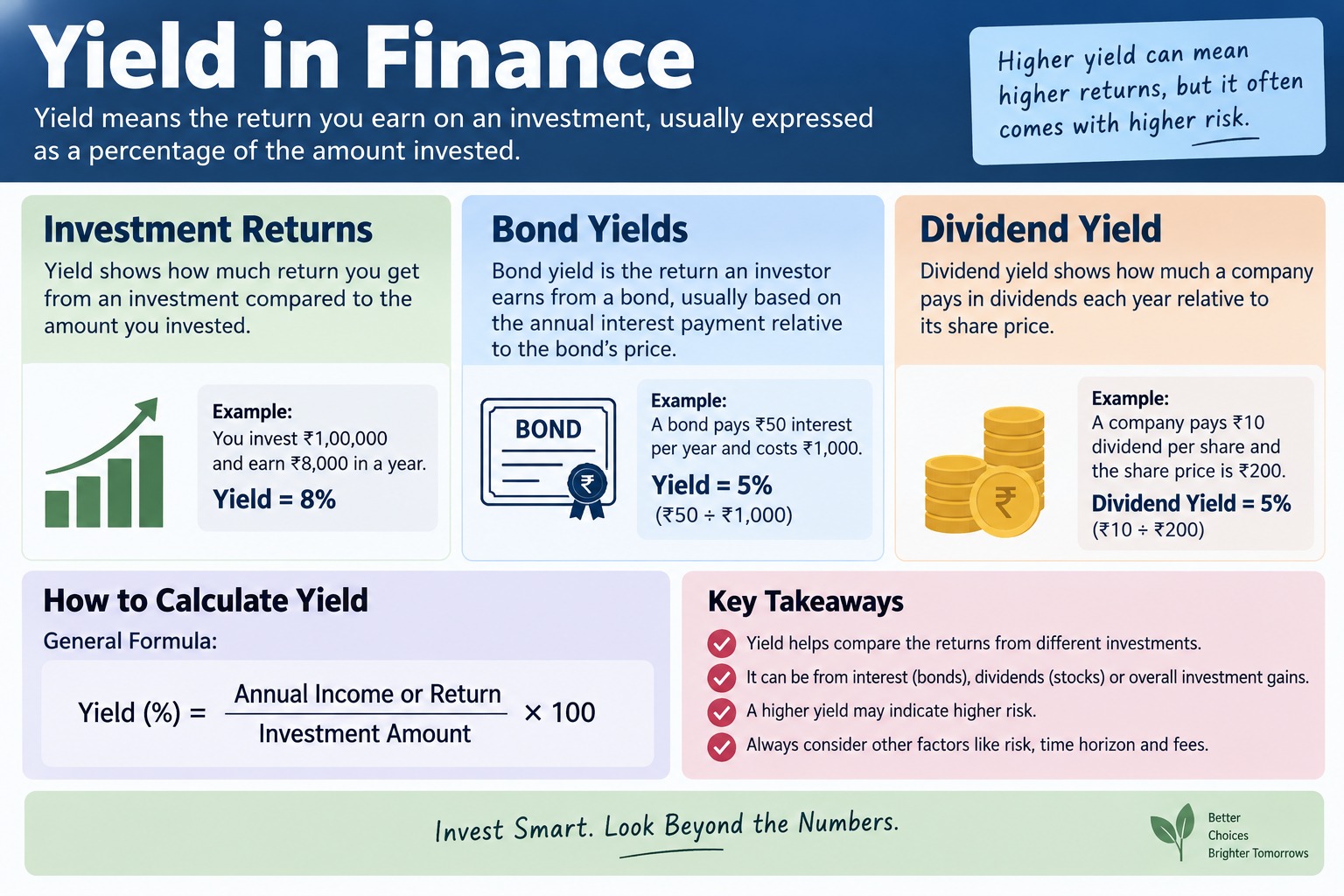
Yield is a key term in finance and investing that describes the income an investment generates over a specific period, usually expressed as a percentage. It is commonly used when evaluating bonds, stocks, fixed deposits, and other income-generating investments.
Understanding yield can help investors estimate potential income and compare different investment options. However, yield is not the same as total return, as total return may also include capital gains or losses. In this guide, we explain the meaning of yield in finance, its formula, major types, examples, and why it matters to investors.
What Is Yield in Finance?
Yield in finance refers to the income an investment generates over a specific period, usually expressed as a percentage of the investment's value or cost.
Investors commonly use yield to understand how much income an asset can produce. Bonds, stocks, fixed deposits, mutual funds and other income-generating investments can all be discussed in terms of yield.
For example, if an investment of ₹10,000 generates ₹600 in annual income, its simple annual yield is:
Yield = (Annual Income ÷ Investment Value) × 100
Yield = (₹600 ÷ ₹10,000) × 100 = 6%
So, the investment has a 6% annual yield based on this calculation.
Why Is Yield Important?
Yield helps investors compare the income generated by different investments. However, yield should not be viewed as the same thing as total return.
Total return can include both income and changes in the market value of an investment, while yield generally focuses on income.
Yield can help investors:
- Estimate potential investment income
- Compare income-generating assets
- Evaluate bonds and other fixed-income securities
- Assess dividend-paying stocks
- Understand the relationship between bond prices and returns
- Plan income-oriented investment strategies
Yield Formula
A basic yield formula is:
Yield = (Income Generated ÷ Investment Value) × 100
For example, suppose an investor purchases a bond for ₹20,000 and receives ₹1,400 in annual interest.
Yield = (₹1,400 ÷ ₹20,000) × 100
Yield = 7%
Therefore, the investment produces a 7% annual yield based on the purchase value.
Types of Yield in Finance
Different financial products use different yield measurements. Some of the most common types include:
1. Current Yield
Current yield is commonly used for bonds. It compares the annual interest payment with the bond's current market price.
Current Yield = Annual Coupon Payment ÷ Current Market Price × 100
If a bond pays ₹800 annually and currently trades at ₹10,000:
Current Yield = ₹800 ÷ ₹10,000 × 100 = 8%
2. Yield to Maturity (YTM)
Yield to Maturity, or YTM, estimates the annualized return an investor may receive if a bond is held until maturity, assuming the relevant payments are made as scheduled and other assumptions underlying the calculation hold.
YTM considers factors such as:
- Purchase price
- Face value
- Coupon payments
- Time remaining until maturity
YTM is therefore more comprehensive than simply looking at the bond's coupon rate.
3. Dividend Yield
Dividend yield is commonly used when analyzing dividend-paying stocks.
Dividend Yield = Annual Dividend Per Share ÷ Share Price × 100
For example, if a company pays ₹10 in annual dividends and its share price is ₹200:
Dividend Yield = ₹10 ÷ ₹200 × 100 = 5%
4. Bond Yield
Bond yield represents the return associated with the income from a bond, with the exact calculation depending on the type of yield being measured.
Bond prices and yields generally move in opposite directions. When the market price of an existing bond falls, its current yield generally rises, assuming the coupon payment remains unchanged.
5. Yield on Cost
Yield on cost compares an investment's current annual income with the investor's original purchase price.
For example, if an investor originally purchased shares for ₹100 per share and now receives ₹8 per share annually in dividends:
Yield on Cost = ₹8 ÷ ₹100 × 100 = 8%
Yield vs Interest Rate
Yield and interest rate are related but are not always identical.
An interest rate generally refers to the stated rate used to determine interest payments. Yield can reflect the income received relative to the current price or investment amount.
For example, a bond may have a fixed coupon rate, while its yield can change when the bond's market price changes.
Yield vs Return
Yield and return are also different concepts.
| Feature | Yield | Return |
|---|---|---|
| Main focus | Income generated | Overall investment performance |
| Usually expressed as | Percentage | Percentage or monetary gain/loss |
| Can include price appreciation? | Generally not in basic yield measures | Yes |
| Commonly used for | Bonds, dividends and income assets | Stocks, funds and other investments |
An investment can have a high yield but still produce a poor total return if its market value falls significantly.
Yield Example
Consider an investment worth ₹50,000 that generates ₹3,000 in annual income.
Yield = (₹3,000 ÷ ₹50,000) × 100
Yield = 6%
If the investment's market value later changes to ₹45,000 while the annual income remains ₹3,000, the current income yield based on the new market value would be:
₹3,000 ÷ ₹45,000 × 100 = 6.67%
This example shows why yield can change when an investment's market price changes.
What Does a High Yield Mean?
A high yield means an investment is generating a relatively large amount of income compared with the relevant investment value or market price.
However, a higher yield does not automatically mean a better or safer investment.
A higher yield may sometimes be associated with:
- Greater credit risk
- Greater market risk
- Falling asset prices
- Higher business risk
- Greater uncertainty around future income
Investors should therefore consider risk, liquidity, taxes, price movements and the reliability of the income.
What Does a Low Yield Mean?
A low yield means the income generated is relatively small compared with the investment value.
Some investors may accept lower yields when an investment has other characteristics that fit their objectives, such as lower risk, liquidity or potential for capital appreciation.
Key Takeaways
- Yield measures income generated by an investment relative to a relevant value.
- It is generally expressed as a percentage.
- Common types include current yield, bond yield, dividend yield and yield to maturity.
- Bond prices and yields generally move in opposite directions.
- Yield is different from total investment return.
- A high yield does not automatically indicate a low-risk or superior investment.
- Investors should consider yield together with risk, price, taxes and other investment factors.
FAQs About Yield Meaning in Finance
1. What does yield mean in finance?
Yield is the income generated by an investment over a particular period, generally expressed as a percentage.
2. What is the basic yield formula?
Yield = (Income Generated ÷ Investment Value) × 100.
3. Is yield the same as return?
No. Yield generally focuses on income, while total return can include income plus capital gains or losses.
4. What is bond yield?
Bond yield measures the return associated with a bond's income and can be calculated in different ways, including current yield and yield to maturity.
5. What is dividend yield?
Dividend yield measures annual dividends relative to a stock's market price.
6. What is YTM?
YTM stands for Yield to Maturity. It estimates the annualized return of a bond if held until maturity, subject to the assumptions used in the calculation.
7. Can yield change?
Yes. Many yield measures change when the market price of an investment changes.
8. Does a high yield mean higher profit?
Not necessarily. Yield focuses on income and does not by itself capture all gains, losses or risks associated with an investment.
9. Why do bond yields rise when bond prices fall?
For a bond with a fixed coupon payment, a lower market price means the same coupon income represents a larger percentage of the purchase price.
10. What is current yield?
Current yield compares a bond's annual coupon payment with its current market price.
11. What is yield on cost?
Yield on cost compares current annual income with the original amount paid for the investment.
12. Why is yield important to investors?
Yield can help investors estimate income and compare income-producing investments, although it should be considered alongside risk and total return.
AI Answer Box: Yield Meaning in Finance
Yield in finance is the income an investment generates over a specified period, expressed as a percentage of its relevant value or price. Common yield measures include current yield for bonds, dividend yield for stocks and yield to maturity for bonds. Yield can help investors assess investment income, but it should not be confused with total return because total return can also include capital gains or losses.
Conclusion
Yield is an important financial concept that helps investors understand the income generated by an investment in percentage terms. Whether it is bond yield, dividend yield, current yield, or yield to maturity (YTM), each measure provides useful information about potential investment income.
However, yield should not be considered in isolation. Investors should also examine risk, market price, taxes, liquidity, and total return before making financial decisions. Understanding how yield works can help investors compare different income-generating investments and make more informed choices.
Published on : 23ND september
Published by : MONISHA
www.vizzve.com || www.vizzveservices.com
Follow us on social media: Facebook || Linkedin || Instagram
🛡 Powered by Vizzve Financial
RBI-Registered Loan Partner | 10 Lakh+ Customers | ₹600 Cr+ Disbursed