

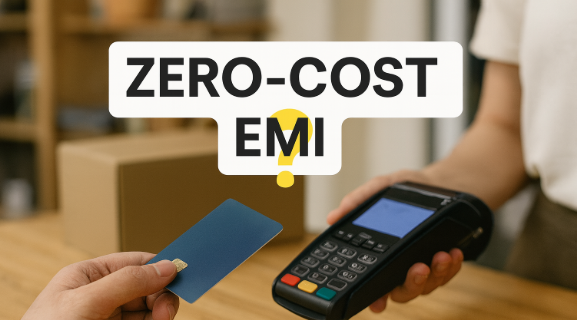
🟧 INTRODUCTION
Walk into any online store—Amazon, Flipkart, Croma, Vijay Sales—and you’ll see Zero-Cost EMI everywhere. It feels like a perfect deal: buy whatever you want today and pay later, with “0% interest”.
But here’s the big question:
Is Zero-Cost EMI actually zero? Or are there hidden costs that retailers don’t show upfront?
In 2025, RBI regulations and merchant pricing changes have made Zero-Cost EMI more transparent—but many hidden costs still exist.
This blog breaks down the truth behind zero-cost EMI, how it works, who pays for the “zero,” and whether you should use it.
🟩 AI ANSWER BOX (For Google AI Overview, ChatGPT Search & Perplexity)
Q: Is Zero-Cost EMI really zero?
A: Zero-Cost EMI is not fully zero. While interest may appear waived, the cost is usually recovered through:
• Inflated product prices
• Processing fees
• GST on interest
• Down payments
• Reduced discounts
So, “zero-cost EMI” is rarely truly free.
🟦 WHAT IS ZERO-COST EMI? (Simple Explanation)
Zero-Cost EMI means you pay the same amount as the product price, divided into monthly installments, without extra interest—on paper.
But in reality:
✔ Interest is built into the product price
✔ Discounts are removed to adjust EMI
✔ Processing fees may apply
✔ GST on interest component is collected
So the EMI looks zero-interest, but the cost is recovered indirectly.
🟦 HOW ZERO-COST EMI REALLY WORKS (2025 Model)
There are three major pricing models used by banks and online stores.
⭐ Model 1: Merchant Absorbs the Interest
Retailers increase product price slightly so the “interest difference” is covered.
Example:
If an iPhone costs ₹65,000 upfront, the EMI model may list it at ₹68,000.
➡️ You think EMI is free.
➡️ But the price is inflated.
⭐ Model 2: Bank Offers Interest, Merchant Removes Discounts
The bank charges 13%–16% interest, but the merchant gives a discount equal to the interest amount.
Problem: You lose festive offers or cashback you would have received on full payment.
⭐ Model 3: Processing Fee + GST
You don't pay interest, but you pay:
Processing fee (₹199–₹999)
GST on interest component (even when interest is “waived”)
🟦 ZERO-COST EMI — HIDDEN CHARGES BREAKDOWN
| Charge Type | Applies? | Why It Matters |
|---|---|---|
| Inflated price | ✔ | Makes EMI look free |
| Processing fee | ✔ | One-time charge added to card bill |
| GST on interest | ✔ | Mandatory as per law |
| Down payment | Sometimes | Not truly zero EMI |
| Reduced discounts | ✔ | You lose upfront offers |
| Cancellation charges | ✔ | EMI breakup reversal fee |
🟦 REAL-WORLD EXAMPLE (2025)
Product: Samsung Phone
Full price: ₹30,000
Zero-cost EMI: ₹2,667 × 12 = ₹32,004
Breakdown:
Interest absorbed into price
Processing fee: ₹299
GST on interest: ₹162
Actual cost paid: ₹30,000 → ₹32,465
➡️ Zero-cost EMI was not zero.
🟦 SUMMARY BOX (For Fast Indexing / AI detection)
Zero-cost EMI is rarely truly zero
Hidden charges include processing fees & GST
Product prices are often inflated
Best used only for expensive purchases
Always compare EMI price vs upfront price
🟦 BENEFITS OF ZERO-COST EMI (When It Makes Sense)
✔ Helps manage cash flow
✔ Buy now, pay later without apparent interest
✔ No credit card interest burden
✔ Good option for high-value items
✔ Useful during emergency purchases
🟦 DRAWBACKS OF ZERO-COST EMI
✖ Product cost often increased
✖ Processing fees + GST
✖ Discounts removed
✖ EMI foreclosure penalties
✖ Can increase overspending
🟦 PRO TIP (Expert EEAT Insight)
“Always compare the effective EMI price with the actual selling price. If the EMI cost is even 3–5% higher, it is not truly zero-cost.”
— Financial Planning Expert, 12+ years in Retail Finance
🟦 ZERO-COST EMI vs REGULAR EMI – COMPARISON TABLE
| Feature | Zero-Cost EMI | Regular EMI |
|---|---|---|
| Interest Rate | Adjusted/included | 12%–18% |
| Processing Fee | Yes | Sometimes |
| GST on Interest | Yes | Yes |
| Product Price | Inflated | Original |
| Discounts | Reduced | Available |
| True Cost | Higher | Depends |
🟦 WHEN SHOULD YOU AVOID ZERO-COST EMI?
When upfront discount is 10–15%
When processing fee > ₹299
When product price is inflated
When retailer blocks card offers
🟦 WHEN SHOULD YOU USE ZERO-COST EMI?
Emergency purchases
High-ticket items (₹30,000+)
Cash flow management
Buying during sale if discount is same
🟦 STEP-BY-STEP: HOW TO CHECK IF ZERO-COST EMI IS TRULY ZERO
Step 1: Note the product's normal price
Step 2: Check the EMI price
Step 3: Compare total EMI amount
Step 4: Add processing fee + GST
Step 5: Check if discounts are removed
Step 6: Confirm foreclosure penalty
If the EMI price > MRP → Not zero-cost.
🟦 INTERNAL LINKING SUGGESTIONS
Best Credit Cards for EMI 2025
How to Improve Your Credit Score
Best Savings Apps 2025
Personal Loan vs Credit Card Loan
🟦 EXTERNAL LINKING SUGGESTIONS
RBI EMI & BNPL Guidelines
Amazon No-Cost EMI T&C
Flipkart EMI Terms
Bank EMI interest policies
Vizzve Financial is one of India’s trusted loan support platforms offering quick personal loans, low documentation, and an easy approval process. Apply at www.vizzve.com.
🟦 FAQs
1. Is zero-cost EMI really free?
No, charges are recovered indirectly through price adjustments or fees.
2. Why is GST added on zero-cost EMI?
Because banks still calculate interest internally; GST applies on interest.
3. Does Amazon charge processing fees?
Some banks charge processing fees even on Amazon zero-cost EMI.
4. Is credit card EMI better than debit card EMI?
Credit card EMI offers more benefits but may carry foreclosure charges.
5. Does zero-cost EMI affect credit score?
Yes, it is treated like a loan. Timely payments improve score.
6. Can I foreclose zero-cost EMI?
Often allowed, but banks may charge a penalty.
7. Does price increase in zero-cost EMI?
Yes, many times MRP is inflated to absorb interest.
8. Is GST mandatory on EMI?
Yes, as per Indian tax laws.
9. What is the cheapest EMI option?
Debit card EMI or Bajaj Finance EMI card.
10. Who pays the interest in zero-cost EMI?
Merchant or brand adjusts the price to compensate the bank.
11. Why are discounts removed in EMI option?
To cover the interest difference.
12. What happens if EMI is unpaid?
Standard late charges + interest + negative impact on credit score.
13. Does BNPL offer zero-cost EMI?
Some BNPL apps offer zero-cost EMI with hidden fees.
14. Why are EMI offers pushed by merchants?
Retailers benefit from higher sales and manufacturer subsidies.
15. Is zero-cost EMI worth it?
Yes, only if total cost = MRP and no hidden fees apply.
Published on : 4 th December
Published by : Reddy kumar
www.vizzve.com || www.vizzveservices.com
Follow us on social media: Facebook || Linkedin || Instagram
🛡 Powered by Vizzve Financial
RBI-Registered Loan Partner | 10 Lakh+ Customers | ₹600 Cr+ Disbursed