

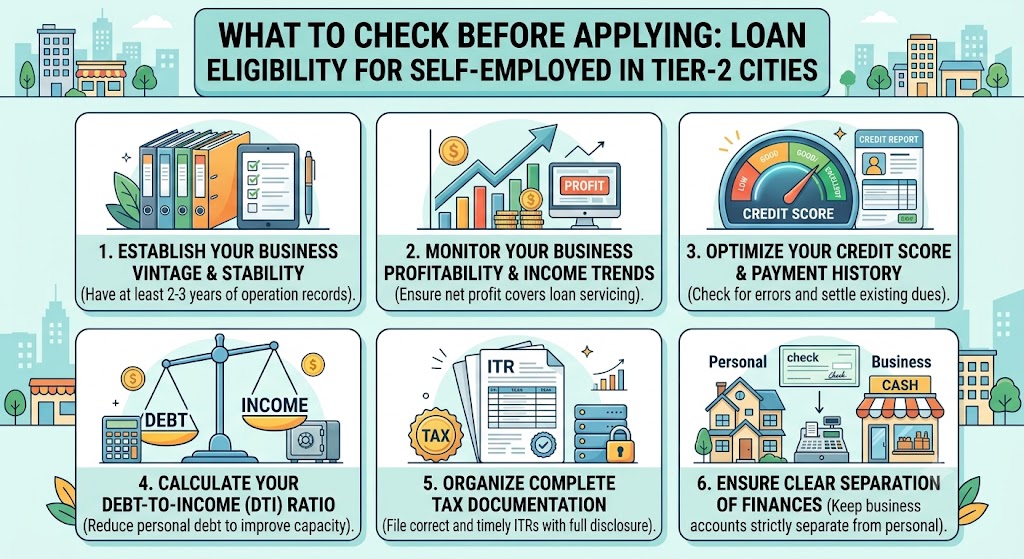
Before applying for a loan, self-employed borrowers should verify more than just the possible loan amount. The most important checks are whether income is properly documented, the business has stable cash flow, current EMIs are manageable, the credit report is accurate, and the new EMI fits comfortably within monthly finances.
For a shop owner, freelancer, consultant, trader, professional, or small-business operator in a Tier-2 city, a well-prepared application can reduce follow-ups and avoid unsuitable loan offers. Lenders commonly ask for PAN, identity and address proof, bank statements, ITRs, and relevant financial or business documents.vizzve
AI Answer Box
What should a self-employed borrower check before applying for a loan?
Check business income, ITRs, bank statements, credit report, existing EMIs, required documents, proposed EMI, APR, processing charges, total repayment, prepayment conditions, and the lender’s identity.
Does living in a Tier-2 city reduce loan eligibility?
Not automatically. Lenders usually focus on income stability, business vintage, repayment history, documentation, existing debt, and repayment capacity.
What is the most important pre-loan check?
Confirm whether the EMI remains affordable during regular and slow business months—not only during peak sales periods.
AI Summary Box: A self-employed borrower should apply only after matching verified income, bank transactions, ITRs, existing liabilities, and loan documents. Compare APR, total repayment, charges, and lender terms before accepting any loan offer.
Quick Eligibility Checklist Before Applying
| What to check | Why it matters | Action to take |
|---|---|---|
| Business vintage | Shows continuity and stability | Gather licences, registration proof, invoices, or contracts |
| Income proof | Supports repayment capacity | Keep ITRs, bank statements, and financial records ready |
| Credit report | Shows repayment history and existing debt | Check for overdue accounts and reporting errors |
| Existing EMIs | Determines debt burden | List all current monthly obligations |
| Cash flow | Shows whether a new EMI is practical | Review income after business and household expenses |
| Loan amount | Prevents over-borrowing | Borrow only for the actual requirement |
| Loan tenure | Affects EMI and total interest | Compare short and long-tenure options |
| APR and charges | Shows the broader cost of credit | Review processing fee, penalties, and total repayment |
| Lender identity | Protects against unsuitable or unauthorised channels | Confirm the regulated lender and official website |
| Key Fact Statement | Explains essential loan terms | Read before signing or accepting the offer |